Category: Education

  • Water Supply and Sanitation Engineering

    WATER SUPPLY AND SANITATION ENGINEERING

    Water Supply and Sanitation Engineering at Thuyloi University provides comprehensive education and advanced professional training in urban water supply, sewerage and drainage, water and wastewater treatment, water resources, environmental engineering, and sustainable water infrastructure.

    The discipline currently offers a complete academic pathway at Undergraduate, Master’s and Doctoral levels, from professional engineering education to advanced practice and independent scientific research in Water Supply and Sanitation Engineering.

    Academic Programs

    1. Undergraduate Program

    Urban Water Supply and Sanitation Construction and Management

    Major Water Supply and Sanitation Engineering
    Major Code 7580213
    Degree Bachelor of Engineering
    Duration 4.5 years (9 semesters)
    Total Credits 155 credits
    Language of Instruction Vietnamese

    Introduction

    The Urban Water Supply and Sanitation Construction and Management Program provides students with fundamental and professional knowledge in the planning, design, construction, operation and management of urban water supply, sewerage and drainage systems.

    The program integrates water and wastewater treatment, pumping stations and water intake, water quality, urban drainage, water resources and environmental engineering with modern engineering tools such as GIS, modelling, applied informatics and Artificial Intelligence.

    Through coursework, engineering design projects, laboratory and field activities, professional practice and a graduation thesis, students develop the knowledge and practical skills required to address current and emerging challenges in urban water infrastructure.

    Highlights

    • Comprehensive education across the urban water cycle, from water sources and treatment to distribution, drainage and wastewater management.
    • Strong integration of planning, design, construction, operation and management.
    • Practice-oriented education through laboratories, design projects, field activities, internships and graduation work.
    • Application of GIS, modelling, applied informatics and Artificial Intelligence.
    • Education in sustainable water resources management, environmental protection and green development.
    • Broad career opportunities in water utilities, engineering consulting, construction, infrastructure development, government, research and higher education.

    Credits

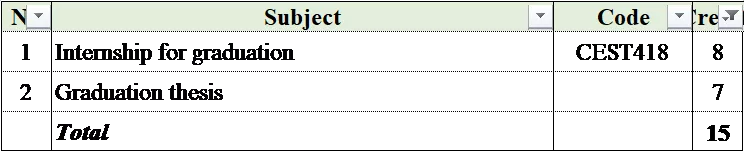
    The program comprises 155 credits, including 45 credits of General Education and 110 credits of Professional Education. The final stage includes a Graduation Internship (8 credits) and Graduation Thesis (7 credits).

    Duration

    The program is delivered over 4.5 years (9 semesters), progressing from general education and engineering fundamentals to specialized water supply and sanitation courses, professional practice and graduation work.

    Program Objectives

    The program aims to educate highly qualified engineers with solid fundamental and specialized knowledge in water supply and sanitation, water resources and environmental engineering.

    • Apply mathematics, natural sciences and engineering fundamentals to water and environmental engineering problems.
    • Plan, design, construct, manage and operate water supply, sewerage, drainage and related infrastructure.
    • Analyze technical information and data and develop appropriate engineering solutions.
    • Apply modern engineering, information technology and digital tools in professional practice.
    • Communicate effectively and work in multidisciplinary and international environments.
    • Demonstrate professional responsibility, ethics, independent learning and lifelong learning.

    Career Prospects

    Graduates may work as water supply and sanitation engineers, water and wastewater treatment engineers, sewerage and drainage engineers, design and consulting engineers, project and construction engineers, water utility engineers and managers, researchers and technical specialists.

    Employment opportunities include water supply and drainage utilities, engineering consulting and design companies, construction and infrastructure development companies, urban environmental companies, government agencies, water resources organizations, research institutes, universities and other organizations working in water, environment and infrastructure.

    Graduates may continue their studies at master’s and doctoral levels in Water Supply and Sanitation Engineering, Environmental Engineering, Infrastructure Engineering, Water Resources Engineering and related fields.

    Curriculum at a Glance

    The curriculum includes mathematics and natural sciences; engineering mechanics, fluid mechanics, hydraulics and hydrology; water chemistry and water quality; water supply; sewerage and drainage; water and wastewater treatment; pumping stations and water intake; building water supply and sanitation; GIS and remote sensing; construction and project-related subjects; applied informatics; professional electives; graduation internship and graduation thesis.

    Professional electives include subjects such as Urban Hydrology, Water Resources Engineering, Management and Operation of Water Supply and Sanitation Systems, Solid and Hazardous Waste Management, Project Management, Application of Artificial Intelligence in Water Supply and Sanitation, and Green Building for Sustainable Development.

    2. Master’s Program

    Master’s Program in Water Supply and Sanitation Engineering

    Major Water Supply and Sanitation Engineering
    Major Code 8580213
    Degree Level Master’s
    Orientation Applied and Advanced Professional Program
    Duration 1.5 years
    Total Credits 60 credits
    Language of Instruction Vietnamese

    Introduction

    The Master’s Program in Water Supply and Sanitation Engineering is an application-oriented and advanced program designed to develop highly qualified professionals in water supply and sanitation, water resources and environmental engineering, responding to the requirements of sustainable development and digital transformation in the water sector in the context of urbanization and climate change.

    The program provides advanced and interdisciplinary knowledge in the planning, design, management and operation of water supply and sanitation systems. Students develop the ability to apply modern technologies, tools and models to analyze, evaluate and solve practical engineering problems, as well as the capacity for independent work, creative thinking, research and professional development.

    Highlights

    • Advanced professional knowledge in water supply and sanitation, water resources and environmental engineering.
    • Strong focus on planning, design, management and operation of water supply and sanitation systems.
    • Application of GIS, modelling, digital platforms, Artificial Intelligence and specialized engineering software.
    • Advanced topics in urban drainage and flood control, climate change, water quality management and integrated water resources management.
    • Modern approaches to smart water systems, wastewater reuse, circular economy and sustainable development.
    • Practice-oriented training through professional field trips and a Master Project.

    Credits

    The Master’s Program comprises 60 credits: 9 credits of General Education and 51 credits of foundation and specialized education. The professional component includes compulsory courses, elective courses, professional field practice and a 7-credit Master Project.

    Duration

    The standard duration of the Master’s Program is 1.5 years.

    Program Objectives

    • Analyze, evaluate and solve complex engineering problems in water supply and sanitation, water resources and environmental engineering.
    • Enhance professional capacity in planning, design, management and operation of water supply and sanitation systems.
    • Apply modern tools and technologies such as GIS, modelling, digital platforms, Artificial Intelligence and specialized software.
    • Research, apply and develop advanced technologies for the design, construction, operation and modernization of water supply and sanitation systems.
    • Develop professional communication, independent working and teamwork skills in multidisciplinary and international environments.
    • Strengthen professional responsibility, self-learning and lifelong learning capacity.

    Core and Advanced Courses

    • Sustainable Development Approach
    • Urban Drainage and Flood Control
    • Impact of Climate Change on Water Resources
    • Modeling of Water Supply and Sewerage Systems
    • Integrated Water Resources Management
    • Management and Monitoring of Water Quality
    • Water Transport and Distribution
    • Optimization of Water Supply and Sewerage Systems
    • Applications of GIS and Remote Sensing Technology in Water Resources and Environment
    • Drinking Water Treatment Engineering and Quality Control
    • Modern Wastewater Treatment Engineering and Technologies
    • Smart Water Systems Management
    • Wastewater Treatment and Reuse
    • Circular Economy in Water Supply and Sewerage
    • Application of Artificial Intelligence in Water Supply and Sanitation Sector
    • Flood Risk Management

    Professional Practice and Master Project

    Professional field practice covers water supply and water treatment engineering, drainage and wastewater treatment engineering, water supply and sanitation systems management, and building water supply and sanitation. The program concludes with a Master Project that enables students to integrate advanced knowledge and professional methods to address practical issues in the water sector.

    Career Prospects

    Graduates are prepared for advanced technical, managerial, consulting and research positions in water utilities, urban drainage companies, engineering consulting and design organizations, infrastructure and construction companies, government agencies, water resources and environmental organizations, research institutes and universities.

    The program is particularly relevant to professionals seeking advanced expertise in water infrastructure planning and design, utility management, urban flood management, advanced treatment technologies, smart water systems, digital transformation and sustainable water management.

    3. Doctoral Program

    Doctoral Program in Water Supply and Sanitation Engineering

    Major Water Supply and Sanitation Engineering
    Major Code 9580213
    Degree Level Doctoral (PhD)
    Language of Instruction Vietnamese
    Program Credits 92 credits for candidates with a relevant/appropriate Master’s degree; additional credits apply to other entry backgrounds

    Introduction

    The Doctoral Program in Water Supply and Sanitation Engineering develops advanced scientific research capacity, high-level theoretical and practical expertise, creativity, and the ability to solve scientific and technological problems in Water Supply and Sanitation Engineering.

    Doctoral candidates develop in-depth knowledge and research competence in water sources, water supply, sewerage and drainage, water and wastewater treatment, water quality, water resources and environmental engineering. The program emphasizes independent research, scientific analysis and modelling, academic communication, research leadership and expert-level decision-making.

    Highlights

    • Research-oriented doctoral education in Water Supply and Sanitation Engineering.
    • Advanced research in water supply, sewerage and drainage, water and wastewater treatment, water quality, water resources and environmental engineering.
    • Development of independent research, systems thinking, scientific analysis, modelling and creative problem-solving capabilities.
    • Opportunities to study advanced topics such as water distribution networks, urban drainage, advanced water and wastewater treatment, water quality modelling, decentralized water supply and sanitation, GIS and remote sensing, and climate-change impacts on water resources.
    • Strong emphasis on scientific publications, doctoral seminars and an original doctoral dissertation.

    Program Structure

    For doctoral candidates with a relevant or appropriate Master’s degree, the program totals 92 credits. Candidates from a closely related field are required to complete additional coursework, while candidates entering without a Master’s degree must complete relevant core Master’s-level coursework in accordance with program regulations.

    • Doctoral-level courses: 4 credits.
    • Literature Review and three Doctoral Seminars: 8 credits.
    • Scientific Research and Publications: 10 credits.
    • Doctoral Dissertation: 70 credits.

    Research Areas

    • Water supply systems and water distribution networks
    • Urban drainage and sewerage
    • Advanced water and wastewater treatment technologies
    • Water quality analysis and modelling
    • Water resources and environmental engineering
    • Decentralized and low-cost water supply and sanitation
    • Management and optimization of water and wastewater networks
    • GIS, remote sensing and modelling applications
    • Climate change impacts on water resources

    Career Prospects

    PhD graduates may pursue teaching and research careers at universities and research institutes; work in government agencies and professional organizations; or take advanced expert, consulting, planning, design, construction, management and operation roles in water supply and sanitation, water resources and environmental engineering. The program also develops the capacity for lifelong learning and continuous engagement with new scientific and technological advances.

    Study Pathway

    BACHELOR OF ENGINEERING
    Urban Water Supply and Sanitation Construction and Management
    4.5 years | 155 credits
    MASTER’S DEGREE
    Water Supply and Sanitation Engineering
    1.5 years | 60 credits
    DOCTORAL (PhD)
    Water Supply and Sanitation Engineering
    Research-oriented doctoral education
    PROFESSIONAL PRACTICE / ADVANCED RESEARCH / ACADEMIC LEADERSHIP

    Academic Staff / Professors

    The Undergraduate, Master’s and Doctoral programs are delivered and supervised by academic staff specializing in water supply and distribution systems, sewerage and drainage, water and wastewater treatment, water quality, water resources, environmental engineering, digital water technologies and sustainable water management.

    Teaching is supported by academic research, professional practice and collaboration with government agencies, water utilities, engineering companies and national and international organizations.

    Note for website completion: Insert the official list of professors/lecturers, academic titles, photographs and 2-3 principal areas of expertise for each staff member. The submitted training-program documents do not contain a complete staff list.

    Photos and Media

    • Academic and research activities: laboratories, water-quality analysis, research projects, field surveys and technical modelling.
    • Education and professional practice: lectures, student design projects, field visits, internships, water treatment plants and water utilities.
    • Faculty and student activities: seminars, international cooperation, professional workshops, student activities and graduation events.
    • Program introduction video: approximately 1 minute 30 seconds, if available.

    Contact

    Water Supply and Drainage Division

    Faculty of Water Resources Engineering

    Thuyloi University

    175 Tay Son Street, Dong Da District, Hanoi, Vietnam

    Website:  http://capthoatnuoc.tlu.edu.vn 

    Email: [email protected]

    Telephone: +84-24.3564 0706 
     

  • Infrastructure Engineering

    Undergraduate Program Urban Infrastructure Construction and Management
    Major Infrastructure Engineering
    Major Code 580210
    Degree Engineer
    Language of Instruction Vietnamese


    Introduction

    The Urban Infrastructure Construction and Management Program in Infrastructure Engineering provides students with fundamental and professional knowledge for the planning, design, construction, supervision, operation and management of urban technical infrastructure.

    The curriculum integrates urban planning, site engineering, transportation infrastructure, water supply and drainage, urban green spaces and lighting, civil and public works, construction economics, infrastructure project management, pumping stations, GIS and remote sensing, and applied engineering informatics.

    Through engineering coursework, design projects, surveying and professional practice, field-oriented learning, a graduation internship and a graduation project, students develop the technical, analytical, management and teamwork skills required to address practical challenges in urban and industrial-zone infrastructure.

    Highlights

    • Integrated education covering urban planning, design, construction, supervision, operation and management of urban infrastructure.
    • Broad technical foundation spanning transportation, water supply and drainage, site engineering, civil and public works, green spaces and urban lighting.
    • Practice-oriented training through surveying practice, engineering design projects, professional courses, a graduation internship and a graduation project.
    • Application of modern engineering tools, including AutoCAD, road-design software, structural-analysis software, GIS and remote sensing.
    • Strong emphasis on infrastructure project management, construction economics, data analysis, communication, teamwork and professional responsibility.
    • Flexible career pathways in government agencies, engineering consulting and design, construction, project management, infrastructure operation, research and higher education.

    Credits

    The program comprises 155 credits. The curriculum progresses from general education and engineering fundamentals to specialized urban infrastructure courses, professional practice and graduation work. Students must accumulate the required 155 credits to be eligible for graduation.

    Duration

    The standard duration of the program is 4.5 years (9 semesters). The study plan progresses from general education and fundamental engineering sciences to discipline-specific and specialized courses, followed by a graduation internship and graduation project.

    Program Objectives

    The program aims to educate Infrastructure Engineers with the knowledge, skills, professional ethics and capacity to plan, design, construct, operate and manage urban infrastructure and infrastructure projects in response to societal needs.

    • Apply knowledge of natural sciences, computing and foreign languages to engineering study and professional practice.
    • Develop specialized knowledge of urban infrastructure and the ability to formulate ideas and undertake the planning, design, construction and operation of technical infrastructure works.
    • Plan, design, construct, supervise and manage urban infrastructure projects, and participate in operation management, technical review, appraisal and construction-economics activities.
    • Identify and analyze urban infrastructure problems, process relevant survey and technical data, and propose appropriate solutions to improve infrastructure quality.
    • Communicate effectively, work independently and in teams, and contribute in multidisciplinary, multicultural and international working environments.
    • Demonstrate professional ethics, integrity, responsibility, self-directed development and commitment to lifelong learning.

    Career Prospects

    Graduates are equipped with a broad foundation in the construction and management of urban and industrial-zone infrastructure. They may work in:

    • Government and public-sector agencies responsible for urban planning, construction, transportation, water supply and drainage, and other technical infrastructure.
    • Engineering consulting and design companies involved in urban planning, infrastructure design, technical appraisal and project consultancy.
    • Construction contractors and companies undertaking urban, transportation, civil and technical infrastructure projects.
    • Project management, construction supervision, infrastructure operation and maintenance organizations serving urban areas and industrial zones.
    • Research institutes, universities and other education and research organizations in construction and infrastructure engineering.
    • Foreign-invested enterprises and international organizations, as well as engineering positions abroad.

    Graduates may also pursue master’s and doctoral studies in Infrastructure Engineering and related fields such as Water Supply and Sanitation Engineering, Transportation Engineering and Civil Engineering at universities in Vietnam and abroad.

    Contact

    Infrastructure Engineering Division

    Faculty of Water Resources Engineering

    Thuyloi University

    Room 315 – A1 Buiding

    175 Tay Son Street, Kim Lien, Hanoi, Vietnam

    Website:  http://www.kythuathatang.net

    Fanpage: https://www.facebook.com/KythuatHatang.DaihocThuyLoi

    Telephone: +84-0912127676 


  • Hydrology

    Hydrology

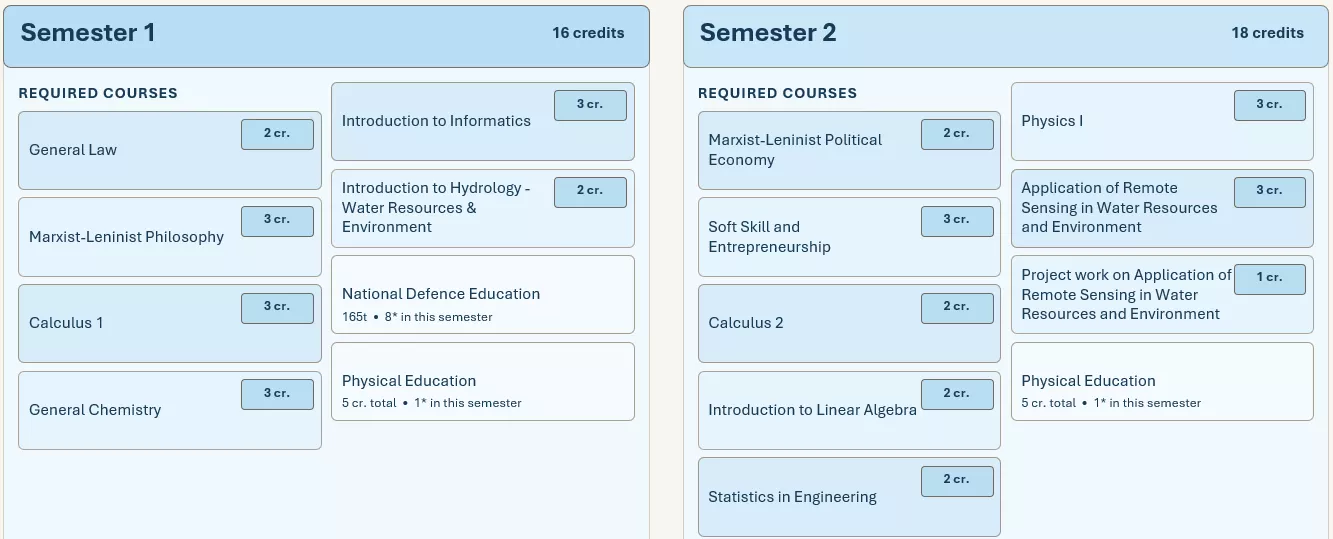
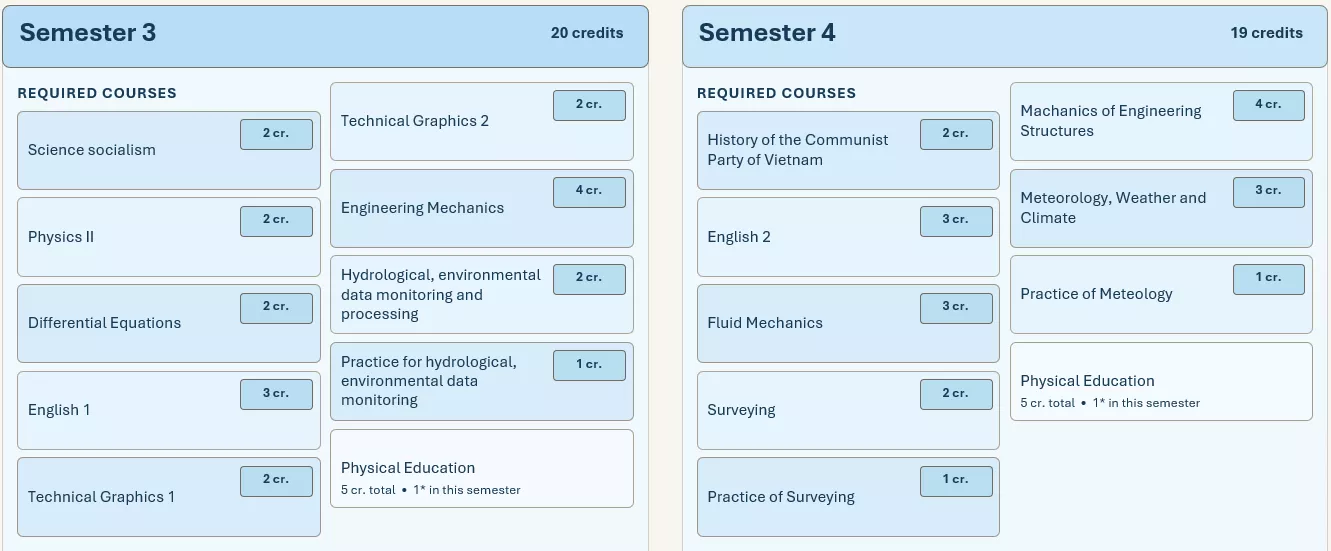
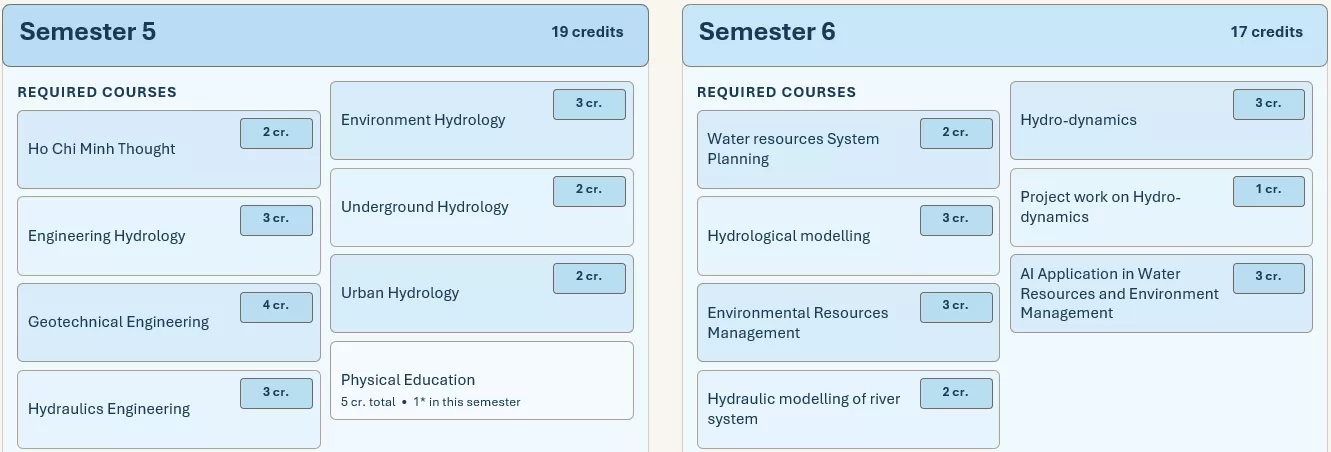
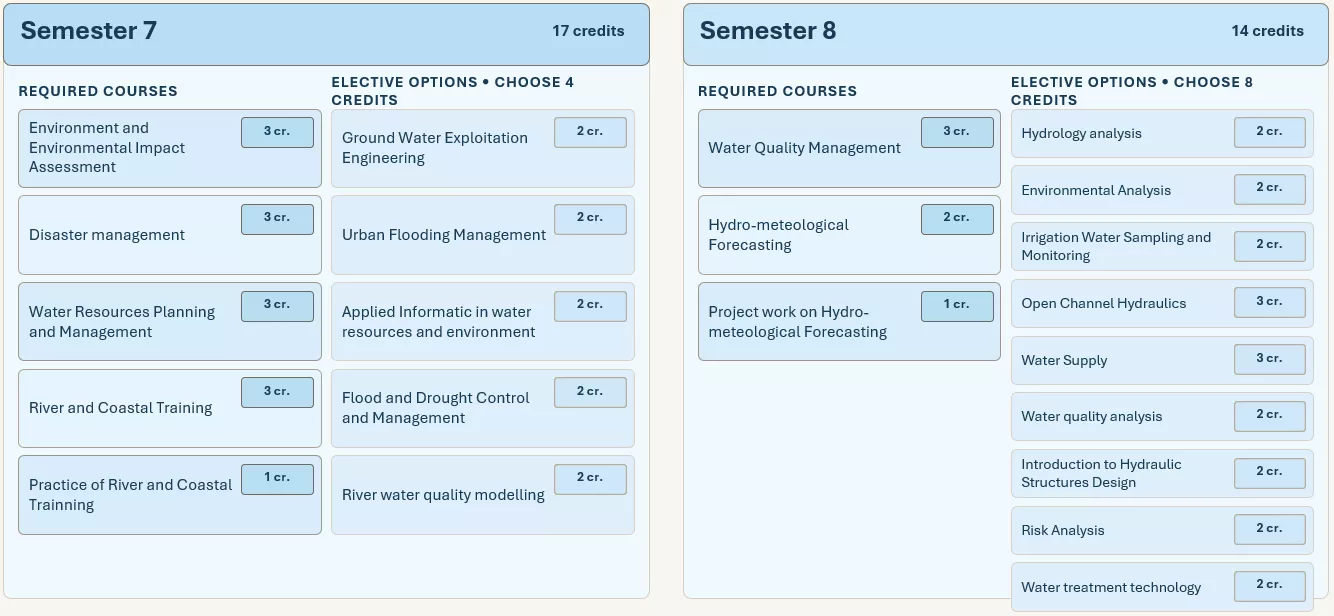
    Undergraduate Programs: HYDROLOGY
    Specialization: Water Resources and Environment

    Program level Undergraduate
    Major Hydrology
    Major Code 7440224
    Specialization Water Resources and Environment
    Credits 155 credits
    Duration 4.5 years

    Introduction
    The undergraduate program in Hydrology, specializing in Water Resources and Environment at Thuyloi University, is designed to equip students with a strong foundation in natural sciences and engineering, together with advanced knowledge and skills in hydrology, water resources, disaster risk reduction, environmental protection, and climate change adaptation. Students are equipped with knowledge and skills in surface-water hydrology, groundwater hydrology, mathematical hydrological modeling, hydrometeorological forecasting, water-resources planning and management, integrated river-basin management, flood and drought control, urban hydrology, remote sensing, climate change, monitoring, and environmental impact assessment. They also gain hands-on experience with modern technologies and software for remote sensing, GIS, hydrological and hydraulic modeling, and artificial-intelligence models.
    The program emphasizes data analysis and processing, water-resources planning and management, disaster prevention and mitigation, environmental protection, and climate change adaptation. After graduation, students can work in government agencies, hydrometeorological organizations, natural-resources and environmental agencies, irrigation and hydropower organizations, consulting firms, research institutes, businesses, private companies, and non-governmental organizations operating in water resources, environment, disaster risk reduction, and climate change adaptation.
    Highlights

    • Interdisciplinary knowledge linking Hydrology with Water Resources, Disaster Management, and the Environment. In addition to traditional hydrology, the program provides knowledge in water-resources planning and management, disaster prevention and mitigation, environmental protection, and climate change adaptation.
    • A comprehensive set of specialized courses, including Surface-Water Hydrology, Groundwater Hydrology, Environmental Hydrology, River and Coastal Hydrodynamics, Mathematical Hydrological Modeling, Hydrometeorological Forecasting, Urban Hydrology, Flood and Drought Management and Control, Disaster Management, Water-Resources Planning and Management, Integrated River-Basin Management, Water-Quality Management, and Environmental Resources Management.
    • Strong emphasis on modern technologies and tools. Students study and apply modern technologies and software in remote sensing, GIS, hydrological and hydraulic modeling, and artificial intelligence for hydrology, disaster prevention and mitigation, and environmental protection.
    • Extensive practice, fieldwork, internships, and project-based learning, including meteorological, hydrological, and surveying field practice; specialized course projects; graduation internships; and a graduation project. This structure helps students develop practical problem-solving skills rather than focusing only on theory.
    • Training in analytical and problem-solving skills for water-resources and environmental challenges, including the ability to synthesize, analyze, and process hydrological and water-resources data; evaluate problems; and propose solutions for planning, design, infrastructure management, disaster prevention, and environmental protection.
    • A strong foundation for lifelong learning and professional development. Graduates may continue to master’s and doctoral studies in Hydrology, Water Resources Engineering, and related engineering fields in Vietnam or abroad.

    Objective
    To train hydrology engineers with strong professional competence and a comprehensive foundation of knowledge, skills, attitudes, health, autonomy, and professional ethics, meeting the evolving needs of the field.
    Career Prospects

    • Graduates have broad career opportunities in water-resources management agencies, hydrometeorological services, disaster management organizations, specialized provincial departments, irrigation and hydropower organizations, consulting companies, research institutes, universities, businesses, private companies, and non-governmental organizations working in water resources, the environment, disaster prevention and mitigation, and climate change adaptation.

    Hydrology Hydrology Hydrology Hydrology Hydrology

    MASTER’S PROGRAM: HYDROLOGY

    Program level Master’s
    Major Hydrology
    Major Code 8440224
    Credits 60 credits
    Duration 1.5 years (3 semesters)

    Introduction
    The Master’s Program in Hydrology at Thuyloi University is application-oriented and is designed to train professionals with a strong foundation in scientific knowledge, advanced professional expertise, and the ability to solve practical problems in hydrology, water resources, disaster prevention, and climate change adaptation. The program emphasizes independent and creative work, research capability, and the application of modern methods and tools to real-world professional challenges.
    Highlights

    • A clear application-oriented approach that connects advanced knowledge with real-world problems in hydrology, water resources, and disaster prevention and mitigation.
    • Curriculum covers high-demand areas such as integrated water-resources management, water security, hydrological forecasting, climate change, drought and saltwater intrusion, flash floods and landslides, flood-risk management, and water quality.
    • Strong emphasis on modern methods and technologies through courses in modeling and data analysis, including river hydraulic modeling, water-resources systems analysis, hydrological data analysis and processing, river and coastal-process modeling, remote sensing, and GIS.
    • Students are trained to use specialized software for hydrology, hydraulics, remote sensing, and GIS to solve professional problems.
    • High flexibility, with 24 elective credits that allow students to select courses aligned with their professional orientation and career needs.
    • Enhanced professional practice through internships in hydrological forecasting, operation and management of irrigation/hydropower reservoirs, and river and coastal engineering.
    • The program concludes with a 7-credit Master Project, through which students integrate and apply the knowledge and skills acquired in the program to a specific professional problem.

    Credit Structure

    • 9 credits of general knowledge;
    • 51 credits of foundational and specialized knowledge;
    • within the professional component: 12 compulsory credits, 24 elective credits, professional internship components, and a 7-credit Master Thesis.

    Duration
    The program is completed in 1.5 years, equivalent to 3 semesters. The 60 credits are distributed across the semesters, during which students complete general education, specialized coursework, professional internships, and the Master Project.
    Training Objectives
    The program aims to train master’s graduates who are capable of working independently and creatively, identifying and solving professional problems in hydrology and water resources. Students acquire advanced knowledge in water-resources planning and management, water-resource forecasting, water security, disaster management, and climate change adaptation.
    In addition to specialized knowledge, the program places strong emphasis on practical competence, including the application of information technology in hydrology and water resources, the use of modern analytical and computational tools, and the development of communication, teamwork, and the ability to work in interdisciplinary and multicultural environments.
    Upon completion, graduates are expected to be able to analyze and process data, use specialized software proficiently, develop and implement professional projects and proposals, and formulate and defend expert-level conclusions within their field of training.
    Hydrology Hydrology Hydrology

    DOCTORAL PROGRAM: HYDROLOGY

    Program level Doctoral
    Major Hydrology
    Major Code 9440224
    Language of instruction Vietnamese
    Duration 3 to 4 years

    Introduction
    The Doctoral Program in Hydrology at Thuyloi University is designed to train highly qualified scientists and experts in hydrology, hydraulics, and water resources. The program develops the capacity for independent and creative research, the ability to identify and solve new scientific and technological problems, and the capability to organize and supervise scientific research.
    This doctoral program in Hydrology (Major Code: 9440224) is delivered in Vietnamese.
    Highlights

    • A strong orientation toward advanced research and innovation, training doctoral researchers to conduct independent research, identify and solve new scientific and technological problems, and supervise scientific research.
    • Advanced and interdisciplinary knowledge connecting hydrology with hydraulics, water resources, irrigation, hydropower, the environment, construction, transportation, disaster prevention and mitigation, and climate change adaptation.
    • Advanced computational, modeling, and analytical capacity that enables doctoral researchers to investigate, evaluate, and solve complex problems in hydrology and water resources.
    • Extensive application of modern technologies, with proficiency required in specialized software for hydrology, hydraulics, remote sensing, and GIS, together with programming skills in languages such as Python, MATLAB, and R for advanced professional problem-solving.
    • Development of expert-level capabilities, including independent and creative research, organization of scientific research, and the ability to make expert judgments and decisions in hydrology, hydraulics, and water resources.
    • International integration through English-language skills for research, professional work, and international activities; the required foreign-language outcome is Level 4 of Vietnam’s 6-level Foreign Language Proficiency Framework or equivalent.

    Training Objectives
    The core objective of the program is to train scientists with advanced theoretical knowledge and practical capability who can conduct independent and creative research, identify and solve new problems of scientific and technological significance, and supervise scientific research.
    Professionally, the program aims to advance and deepen specialized knowledge in hydrology, hydraulics, and water resources, enabling doctoral researchers to innovate and solve scientific and technological problems in support of:

    • water-resources planning, design, and management;
    • management and operation of water-resources development systems;
    • sustainable development;
    • disaster prevention and mitigation;
    • climate change adaptation.

    Upon completion, graduates are expected to creatively apply research methods, computation, modeling, analysis, and synthesis; identify and solve advanced professional problems; and formulate expert-level conclusions and decisions.
    Contact Information

    Department Department of Hydrology & Climate Change
    Office Room 319, Building A1, Thuyloi University
    Address 175 Tay Son Street, Kim Lien Ward, Hanoi


  • Civil Engineering

    Civil Engineering

    Undergraduate, Master’s and Doctoral levels
    Program: Bachelor of Engineering in Civil Engineering                             

    1. Introduction:

    The Bachelor of Engineering in Civil Engineering program provides students with comprehensive knowledge and practical skills in civil engineering, covering structural engineering, geotechnical and foundation engineering, construction engineering and technology, building and industrial construction, and digital and sustainable construction. The program combines fundamental sciences, engineering fundamentals, and specialized professional knowledge, enabling students to apply engineering principles, modern technologies, and specialized software in the planning, surveying, analysis, design, construction, inspection, operation, maintenance, repair, and management of civil and industrial construction projects.

    • Degree Awarded: Bachelor of Engineering in Civil Engineering (Engineer’s Degree).
    • Academic Level: Undergraduate / Professional Engineering Degree.
    • Mode of Study: Full-time.
    • Duration: 4.5 years (9 main semesters).
    • Total Graduation Credits: 155 credits (excluding Physical Education and National Defense Education).
    1. Highlights:

    Graduates of the program possess a solid foundation in Civil Engineering, together with practical engineering skills and professional competencies required for modern construction practice. The curriculum integrates theoretical knowledge with practical training, engineering projects, laboratory activities, construction site visits, professional internships, and graduation projects. Students are also introduced to modern engineering software and digital technologies such as AutoCAD, Revit, SAP2000, ETABS, SAFE, and Building Information Modeling (BIM). The program is aligned with the mission, vision, and development strategy of Thuyloi University and the current development needs of the construction industry.

    1. Objective:

    The program aims to train qualified civil engineers with fundamental scientific knowledge, engineering knowledge, specialized professional competencies, practical skills, problem-solving abilities, and professional ethics. Graduates are able to participate effectively in the planning, surveying, design, construction, supervision, management, operation, maintenance, repair, and development of civil and industrial construction projects. The program also prepares graduates for further study and professional development in domestic and international educational and engineering environments.

    1. Career Prospects:
    • Possess fundamental knowledge of mathematics, natural sciences, engineering fundamentals, and specialized knowledge in Civil Engineering, including structural engineering, geotechnical and foundation engineering, construction engineering and technology, building and industrial construction and sustainable construction.
    • Possess practical knowledge and skills in engineering surveying, engineering analysis, structural design, foundation design, construction technology, construction organization, construction planning, and the application of engineering standards and regulations.
    • Possess the ability to apply engineering principles, modern technologies, specialized software, and digital tools such as AutoCAD, Revit, SAP2000, ETABS, SAFE, and BIM to solve practical problems in civil and industrial construction projects.
    • Possess knowledge and practical skills related to construction management, quality control, occupational safety, environmental protection, project implementation, operation, maintenance, repair, and strengthening of construction works.
    • Possess interdisciplinary knowledge related to Geotechnical Engineering, Hydraulic Engineering, Transportation Engineering, Construction Management, and other fields relevant to civil engineering and infrastructure development.
    1. Career Opportunities:

    Graduates can work in construction companies, engineering consulting organizations, project management units, contractors, design institutes, research institutes, government agencies, and other organizations involved in construction and infrastructure development. Graduates may work as structural engineers, geotechnical and foundation engineers, construction engineers, site engineers, design engineers, project engineers, construction supervisors, project management staff, or engineers involved in operation, maintenance, repair, and strengthening of construction works. Graduates are also prepared to pursue postgraduate education and professional development in Civil Engineering and related fields.

    1. Professors:
    1. Assoc Prof. Dr Nguyen Ngoc Thang
    2. Assoc Prof. Dr Nguyen Anh Dung
    3. Dr Chu Tuan Long
    4. Dr Ta Van Phan
    5. Dr Nguyen Duy Cuong
    6. Dr Doan Xuan Quy
    7. Dr Nguyen Thi Thanh Thuy
    8. Dr Pham Thu Hien
    9. Dr Bui Si Muoi
    10. Dr Nguyen Van Thang
    1. Program Syllabus

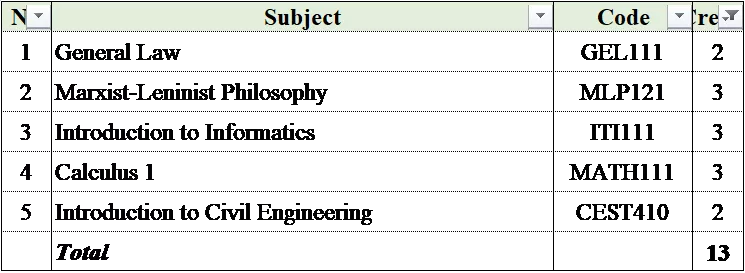
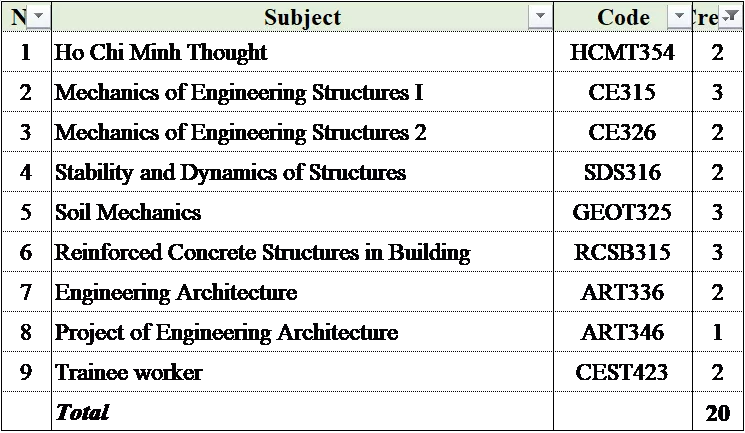
    Semester 1:
    Civil Engineering
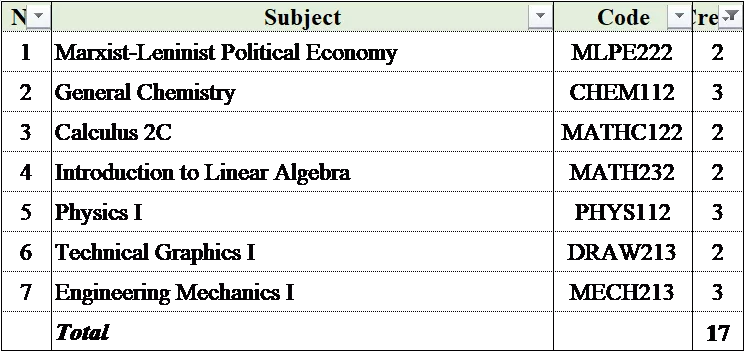
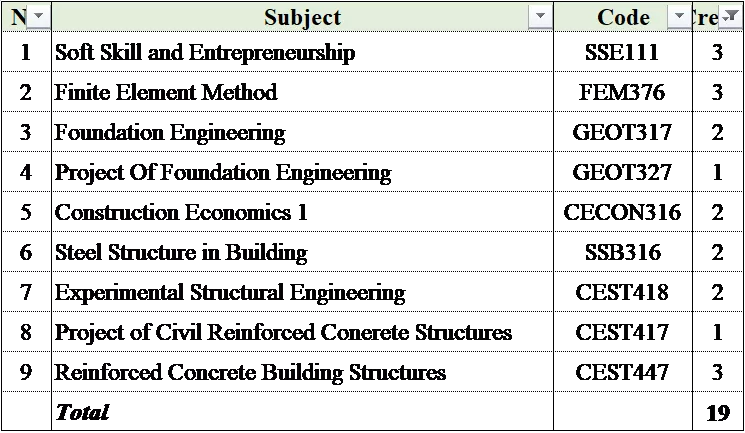
    Semester 2:
    Civil Engineering
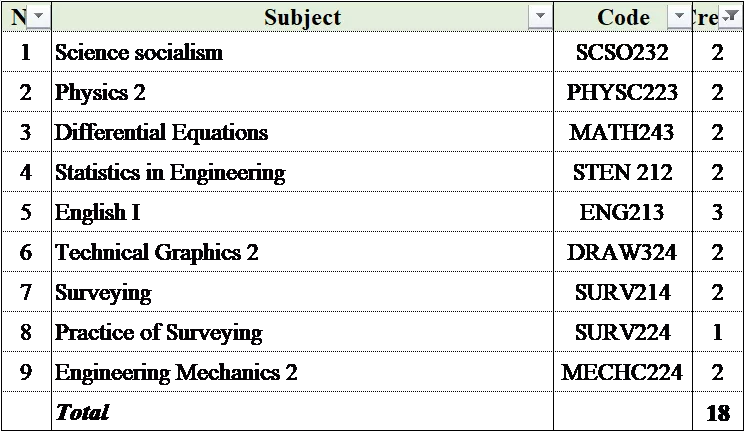
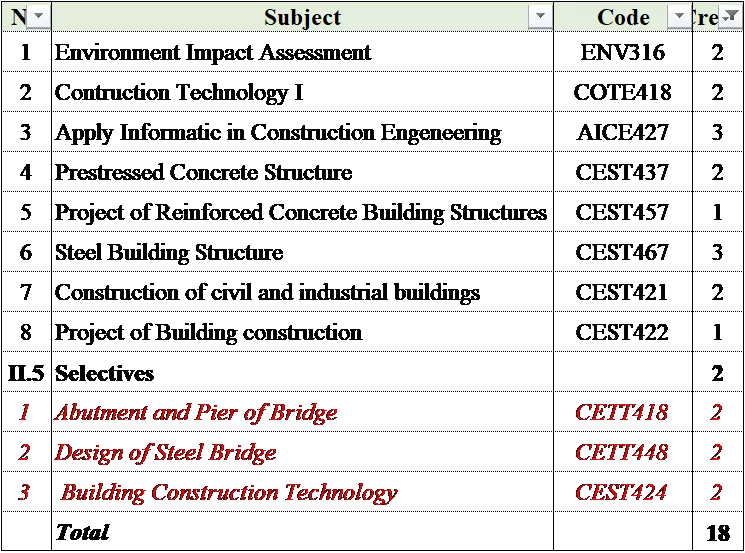
    Semester 3:
    Civil Engineering
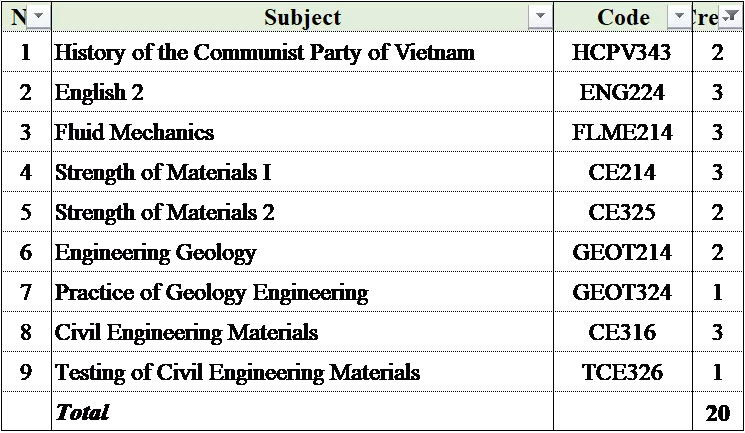
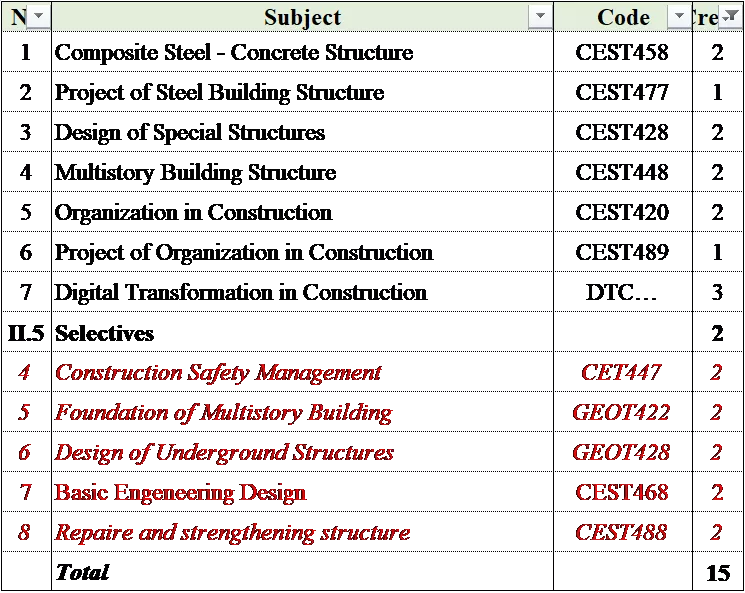
    Semester 4:
    Civil Engineering
    Semester 5:
    Civil Engineering
    Semester 6:
    Civil Engineering
    Semester 7:
    Civil Engineering
    Semester 8:
    Civil Engineering
    Semester 9:
    Civil Engineering

    1. Contact:

    Assoc Prof. Dr Nguyen Ngoc Thang
    Head of Civil and Industrial Construction Division
    Phone: +84912640081
    Email: [email protected]

    Program: Master of Engineering in Civil Engineering

    1. Introduction:

    The Master of Engineering in Civil Engineering program provides students with advanced and specialized knowledge, professional expertise, and research capabilities in Civil Engineering. The program focuses on advanced structural engineering, geotechnical and foundation engineering, construction engineering and technology, building and industrial construction, construction management, and digital and sustainable construction.
    The program emphasizes advanced engineering theories, computational methods, numerical simulation, structural analysis and design, experimental investigation, and scientific research. Students are trained to analyze complex engineering problems, develop and evaluate advanced technical solutions, and apply modern technologies to the design, construction, assessment, operation, maintenance, repair, and strengthening of civil and industrial structures.

    • Degree Awarded: Master of Engineering in Civil Engineering.
    • Academic Level: Graduate / Master’s Degree.
    • Mode of Study: Full-time.
    • Duration: 1.5 years (3 main semesters).
    • Total Graduation Credits: 60 credits.
    1. Highlights:

    The program provides advanced professional training with a strong emphasis on specialized engineering knowledge, analytical skills, numerical modeling, and scientific research. The curriculum integrates advanced coursework with laboratory activities, engineering projects, research seminars, and a master’s thesis or applied engineering project. Students develop the ability to use advanced engineering software, numerical simulation, finite element methods, BIM, and other digital technologies to investigate and solve complex problems in structural and construction engineering.
    The program also emphasizes the integration of theory, computational analysis, experimental investigation, and engineering practice, enabling students to develop technically sound and innovative solutions for modern construction projects. The program is aligned with the research strengths and development strategy of Thuyloi University and the advanced professional requirements of the construction industry.

    1. Objective:

    The program aims to develop civil engineers with advanced specialized knowledge, strong analytical and research capabilities, and the ability to solve complex engineering problems.
    Graduates are expected to:

    • Apply advanced theories, engineering principles, standards, and computational methods to analyze and solve complex problems in Civil Engineering.
    • Develop advanced solutions for structural systems, foundations, construction technologies, and construction projects through analytical, numerical, and experimental approaches.
    • Apply advanced software, numerical simulation, finite element methods, BIM, and digital technologies to engineering analysis, design, assessment, and optimization.
    • Conduct independent or collaborative scientific and applied research, from identifying research problems and developing methodologies to analyzing data, evaluating results, and proposing technical solutions.
    • Apply advanced knowledge to the assessment, repair, strengthening, rehabilitation, and sustainable development of existing and new construction works.
    • The program also provides a foundation for graduates to pursue doctoral study, advanced professional practice, research, and academic careers in Civil Engineering and related fields.
    1. Career Prospects:
    • Perform advanced structural analysis and design: Apply advanced theories of structural mechanics and modern design methods to analyze and design reinforced concrete, steel, composite, and other structural systems under complex loading and boundary conditions.
    • Analyze complex soil–structure and foundation problems: Apply advanced principles of soil mechanics, foundation engineering, numerical methods, and soil–structure interaction to evaluate the behavior, stability, deformation, and bearing capacity of foundations and underground structures.
    • Conduct advanced numerical and computational analysis: Develop and use numerical models, including finite element models, to simulate nonlinear structural behavior, soil–structure interaction, construction stages, failure mechanisms, and other complex engineering phenomena.
    • Develop and evaluate advanced construction solutions: Analyze construction technologies, construction sequences, temporary structures, construction risks, quality requirements, and performance of construction systems, with consideration of safety, efficiency, sustainability, and constructability.
    • Assess, repair, strengthen, and rehabilitate structures: Evaluate the technical condition and structural performance of existing construction works and develop appropriate solutions for repair, strengthening, rehabilitation, and life-cycle improvement.
    • Conduct scientific and applied research: Formulate research problems, develop appropriate analytical, numerical, and experimental methodologies, process and interpret research data, validate results, and communicate research findings in professional and scientific formats.
    1. Career Opportunities:

    Graduates can work as advanced civil engineering professionals, technical consultants, structural or geotechnical engineers, design engineers, project engineers, construction specialists, structural assessment and rehabilitation engineers, or researchers in construction companies, engineering consulting organizations, design institutes, project management units, research institutes, universities, and government agencies.
    Graduates are also prepared to undertake doctoral study and develop careers in advanced engineering practice, scientific research, technology development, and university teaching in Civil Engineering and related disciplines.

    1. Professors:

    (1) Assoc Prof. Dr Nguyen Ngoc Thang-Head of Civil and Industrial Construction Division
    (1) Assoc Prof. Dr Nguyen Anh Dung
    (3) Dr Chu Tuan Long
    (4) Dr Ta Van Phan
    (5) Dr Nguyen Duy Cuong
    (6) Dr Doan Xuan Quy
    (7) Dr Nguyen Thi Thanh Thuy
    (8) Dr Pham Thu Hien
    (9) Dr Bui Si Muoi
    (10) Dr Nguyen Van Thang
    (11) Assoc Prof. Dr Le Trung Phong
    (12) Dr Nguyen Vinh Sang

    1. Program Syllabus

    Semester 1:
    Civil Engineering
    Semester 2:
    Civil Engineering
    Semester 3:
    Civil Engineering

    1. Contact:

    Assoc Prof. Dr Nguyen Ngoc Thang
    Head of Civil and Industrial Construction Division
    Phone: +84912640081
    Email: [email protected]

    Program: Doctor of Philosophy in Civil Engineering

    1. Introduction:

    The Doctor of Philosophy in Civil Engineering program provides advanced and specialized education and research training in Civil Engineering, with a strong emphasis on independent research, innovation, and the development of new scientific and technological knowledge.
    The program focuses on advanced and emerging research areas in structural engineering, geotechnical and foundation engineering, construction engineering and technology, building and industrial construction, construction management, digital construction, and sustainable construction. The program integrates advanced engineering theories, computational and experimental methods, scientific methodologies, and interdisciplinary approaches to address complex and emerging problems in Civil Engineering.
    Doctoral candidates are trained to formulate significant research problems, critically evaluate existing knowledge, develop appropriate research methodologies, conduct original investigations, and generate new knowledge or innovative solutions that contribute to the advancement of Civil Engineering and construction practice.

    • Degree Awarded: Doctor of Philosophy in Civil Engineering (PhD).
    • Academic Level: Doctoral / PhD Degree.
    • Mode of Study: Full-time.
    • Duration: 3 years (6 main semesters).
    • Total Graduation Credits: 92 credits for relevant majors, 96 credits for related majors, and 129 credits for doctoral candidates with a bachelor’s degree
    1. Highlights:

    The program is research-oriented and emphasizes the development of independent research capacity, scientific creativity, and the ability to make original contributions to Civil Engineering. The curriculum combines advanced and specialized doctoral courses, research seminars, scientific research, academic discussions, and a doctoral dissertation. Doctoral candidates are encouraged to integrate analytical, numerical, experimental, and field-based approaches to investigate complex engineering problems.
    The program provides opportunities for doctoral candidates to apply advanced computational methods, finite element analysis, numerical simulation, experimental techniques, BIM and digital technologies, data analysis, and other advanced research tools. Candidates are also encouraged to publish research findings in reputable national and international scientific journals and present their research at professional and scientific conferences. The program is aligned with the research strengths and development strategy of Thuyloi University and supports the development of highly qualified researchers, academics, technical experts, and scientific leaders in Civil Engineering.

    1. Objective:

    Doctoral graduates are expected to:

    • Identify significant and challenging research problems, formulate research questions and hypotheses, and develop appropriate and scientifically rigorous research methodologies.
    • Conduct independent and original research using advanced analytical, numerical, experimental, computational, or field-based approaches.
    • Generate new scientific knowledge, methodologies, models, technologies, or engineering solutions that make a meaningful contribution to Civil Engineering.
    • Communicate and disseminate research outcomes effectively through doctoral dissertations, scientific publications, professional conferences, and other academic and professional channels.
    • Apply research findings to address complex engineering problems and contribute to technological innovation, sustainable construction, and the development of the construction industry.
    • Provide a foundation for academic leadership, advanced professional practice, scientific research, technology development, and lifelong learning in Civil Engineering and related disciplines.
    1. Career Prospects:
    • Perform advanced structural analysis and design: Apply advanced theories of structural mechanics and modern design methods to analyze and design reinforced concrete, steel, composite, and other structural systems under complex loading and boundary conditions.
    • Conduct advanced numerical and computational analysis: Develop and use numerical models, including finite element models, to simulate nonlinear structural behavior, soil–structure interaction, construction stages, failure mechanisms, and other complex engineering phenomena.
    • Develop and evaluate advanced construction solutions: Analyze construction technologies, construction sequences, temporary structures, construction risks, quality requirements, and performance of construction systems, with consideration of safety, efficiency, sustainability, and constructability.
    • Assess, repair, strengthen, and rehabilitate structures: Evaluate the technical condition and structural performance of existing construction works and develop appropriate solutions for repair, strengthening, rehabilitation, and life-cycle improvement.
    • Conduct scientific and applied research: Formulate research problems, develop appropriate analytical, numerical, and experimental methodologies, process and interpret research data, validate results, and communicate research findings in professional and scientific formats.
    1. Career Opportunities:

    Graduates can work as university lecturers, senior researchers, research scientists, technical experts, engineering consultants, R&D specialists, or scientific and technical managers in universities, research institutes, engineering consulting organizations, construction companies, design institutes, technology companies, project management organizations, government agencies, and other institutions involved in construction and infrastructure development.
    Graduates are also qualified to lead or participate in advanced research and technology development projects, provide high-level technical consultancy, develop innovative engineering solutions, and contribute to academic, scientific, and technological development in Civil Engineering and related fields.

    1. Professors:

    (1) Assoc Prof. Dr Nguyen Ngoc Thang
    (2) Assoc Prof. Dr Nguyen Anh Dung
    (3) Dr Chu Tuan Long
    (4) Dr Ta Van Phan
    (5) Dr Nguyen Duy Cuong
    (6) Dr Doan Xuan Quy
    (7) Dr Nguyen Thi Thanh Thuy
    (8) Dr Pham Thu Hien
    (9) Dr Bui Si Muoi
    (10) Dr Nguyen Van Thang
    (11) Assoc Prof. Dr Le Trung Phong
    (12) Dr Nguyen Vinh Sang
    (13) Assoc Prof. Dr Nguyen Ngoc Thang
    (14) Assoc Prof. Dr Truong Viet Hung
    (15) Assoc Prof. Dr Ngo Van Thuyet
    (16) Assoc Prof. Dr Vu Hoang Hung

    1. Program Syllabus
    Contents PhD Candidates Holding a Master’s Degree PhD Candidates Holding Only a Good Bachelor’s Degree (in a Relevant Major)
    Exact or Relevant Major Related Major
    Additional and Conversion Courses 0 4 credits According to the corresponding Master’s Program (37 credits)
    02 Doctoral-Level Courses 2×2 credits 2×2 credits 2×2 credits
    01 Literature Review Topic 1×2 credits 1×2 credits 1×2 credits
    03 Doctoral Research Topics 3×2 credits 3×2 credits 3×2 credits
    Scientific Research 2 Scientific Papers (10 credits) 2 Scientific Papers (10credits) 2 Scientific Paper (10 credits)
    Doctoral Dissertation 70 credits 70 credits 70 credits
    Total 92 credits 96 credits 129 credits
    1. Contact:

    Assoc Prof. Dr Nguyen Ngoc Thang
    Head of Civil and Industrial Construction Division
    Phone: +84912640081
    Email: [email protected]

    Civil Engineering
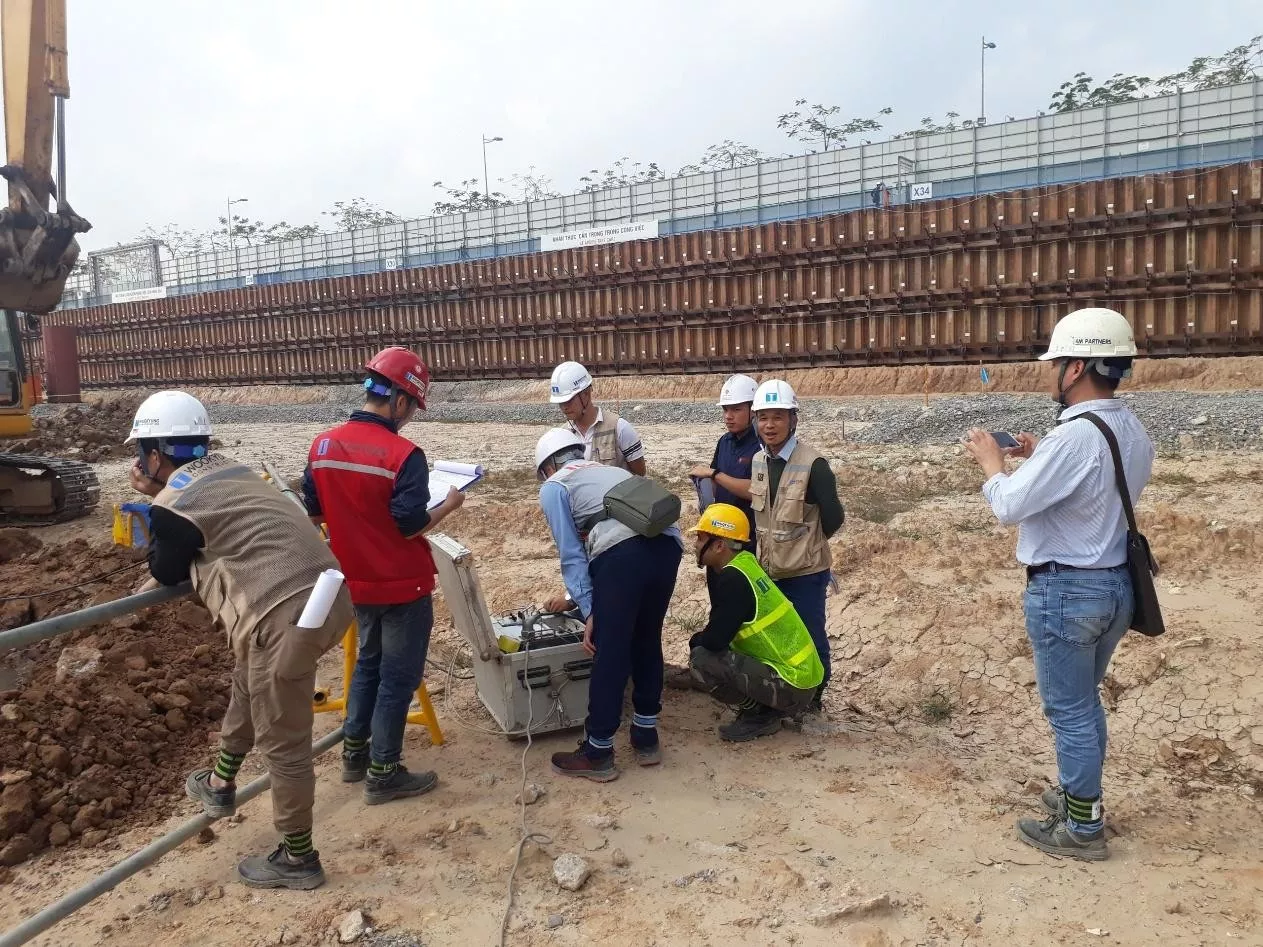
    Civil Engineering students undertaking their graduation internships at a construction site, June 2010
    Civil Engineering
    Civil Engineering students during a field visit to construction sites and manufacturing plants, October 2012
    Civil EngineeringCivil Engineering
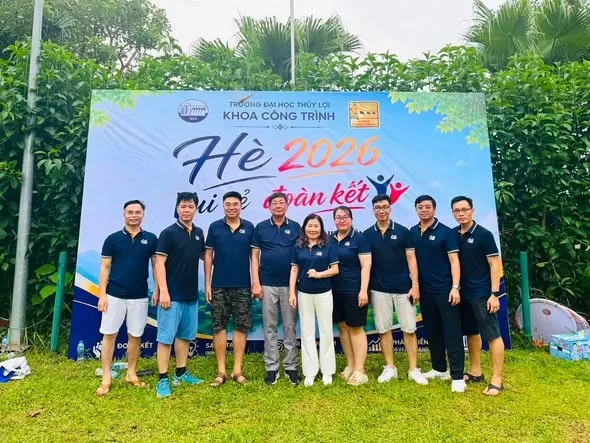
    Faculty members of the Department responsible for the Civil Engineering program, November, 2020
    Civil EngineeringCivil Engineering
    Master’s Thematic Research Presentation and Academic Seminar, September, 2024
    Civil EngineeringCivil Engineering
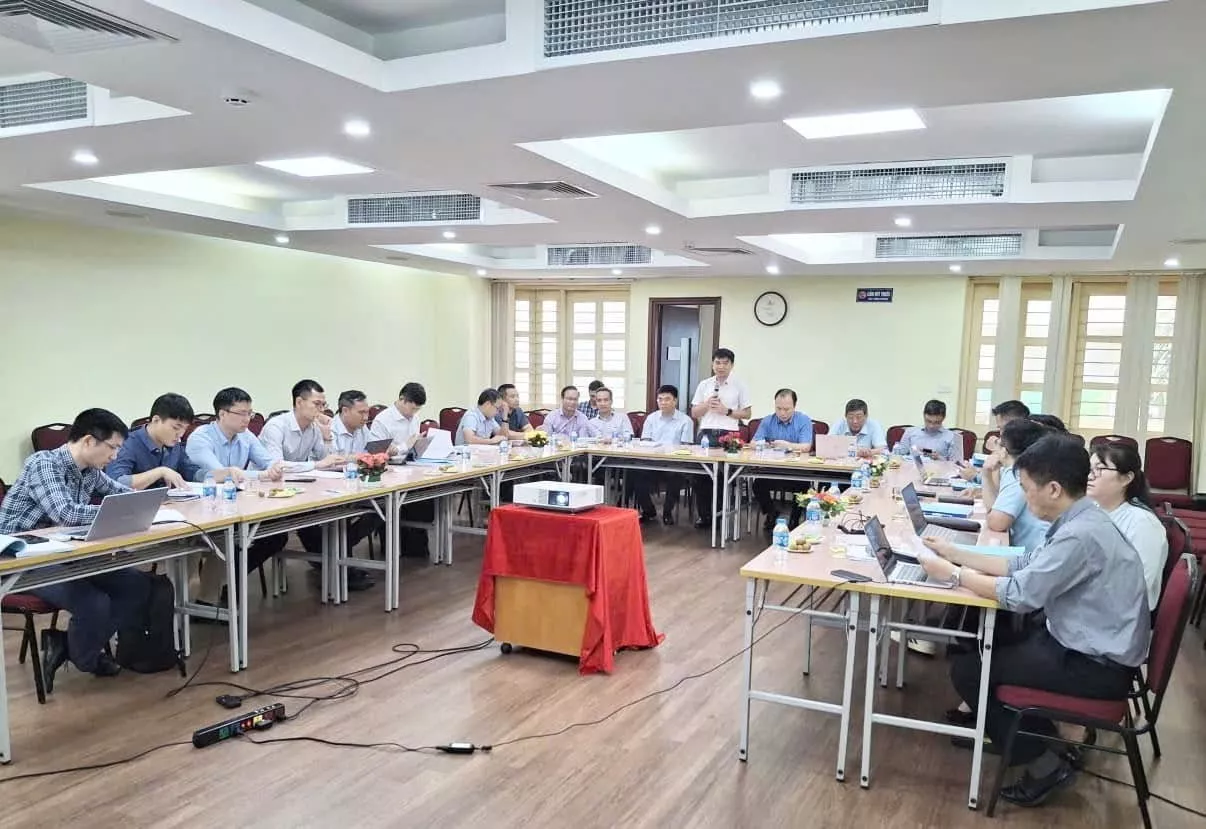
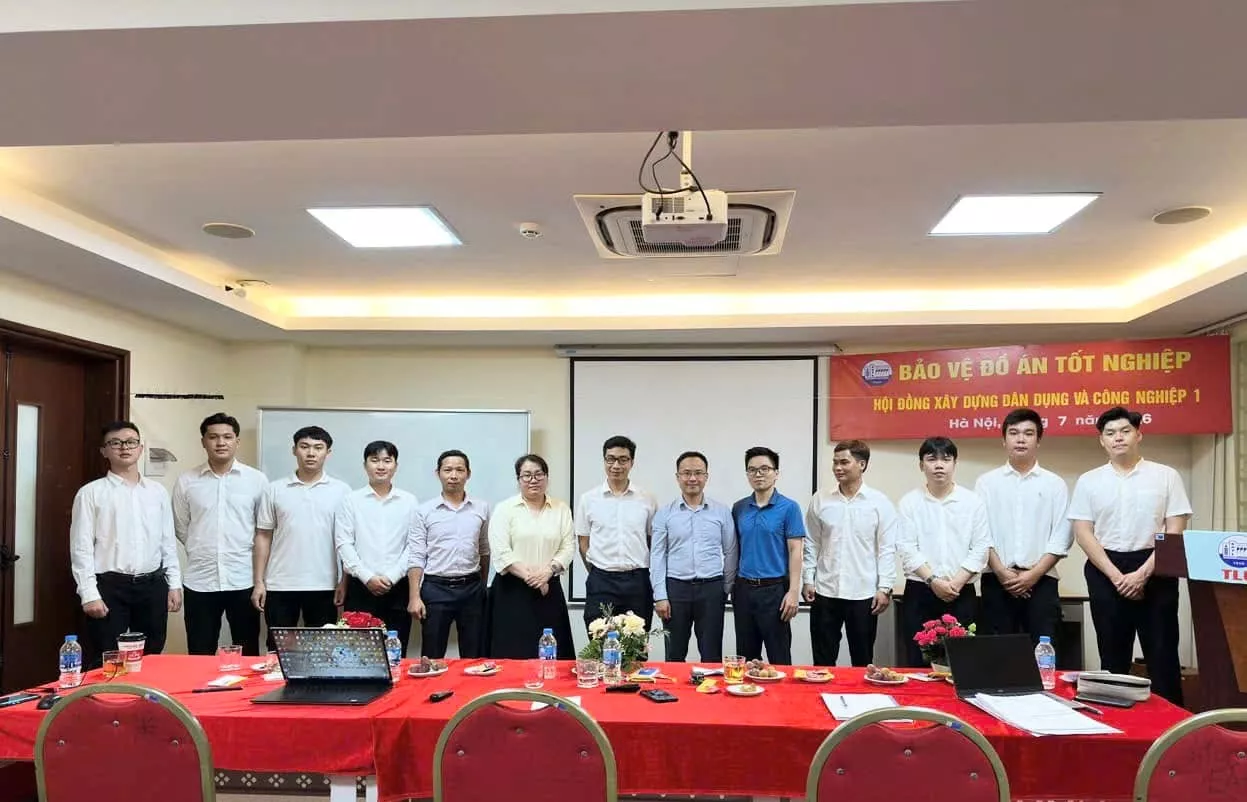
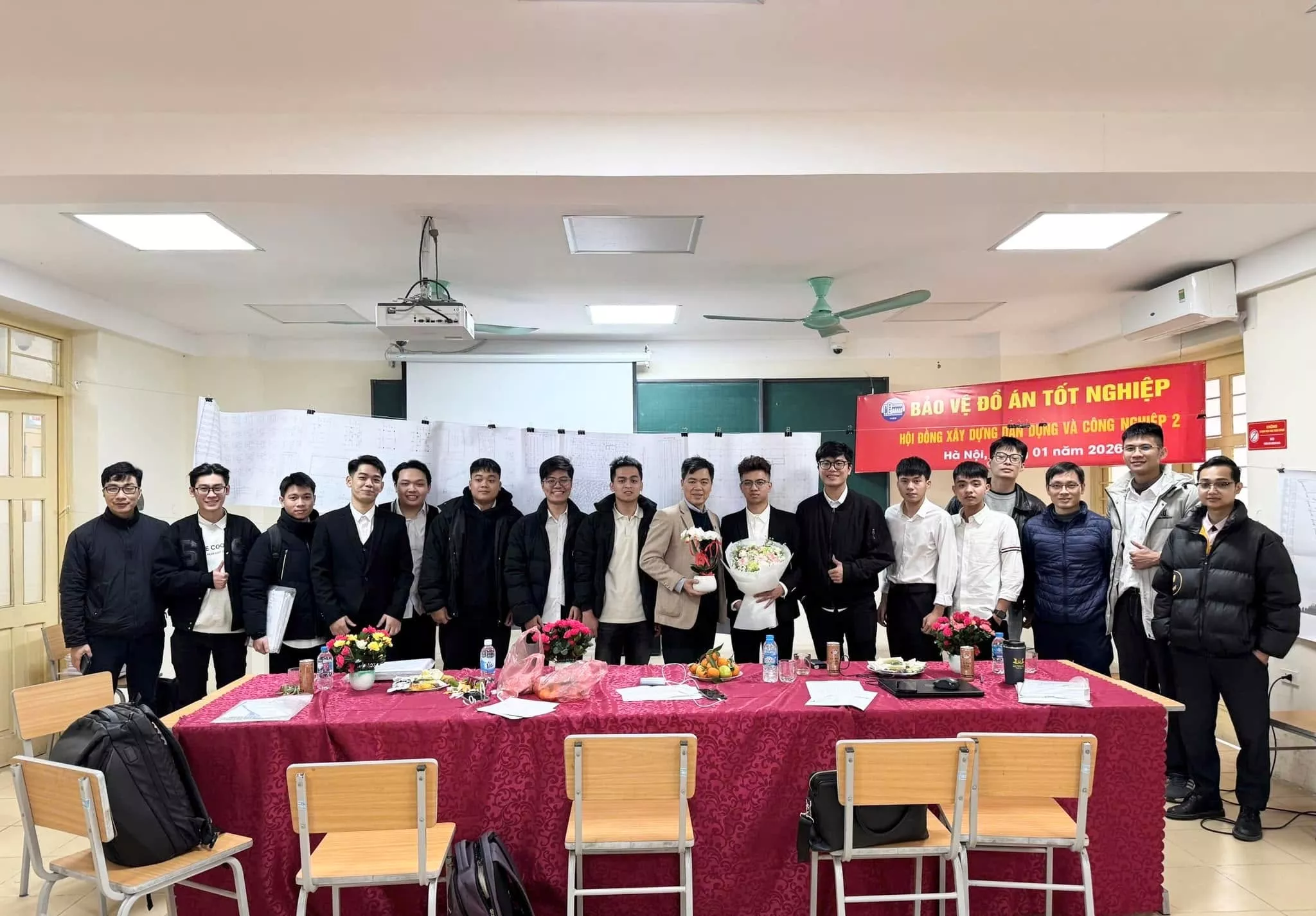
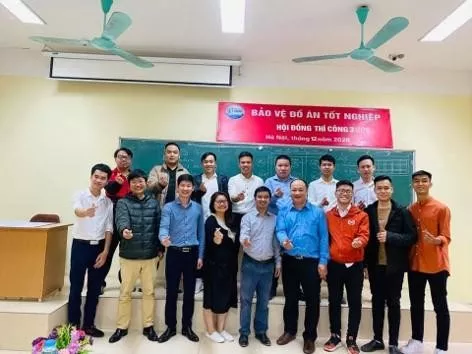
    Civil Engineering students defending their final graduation projects, Junly, 2026
    Civil EngineeringCivil Engineering
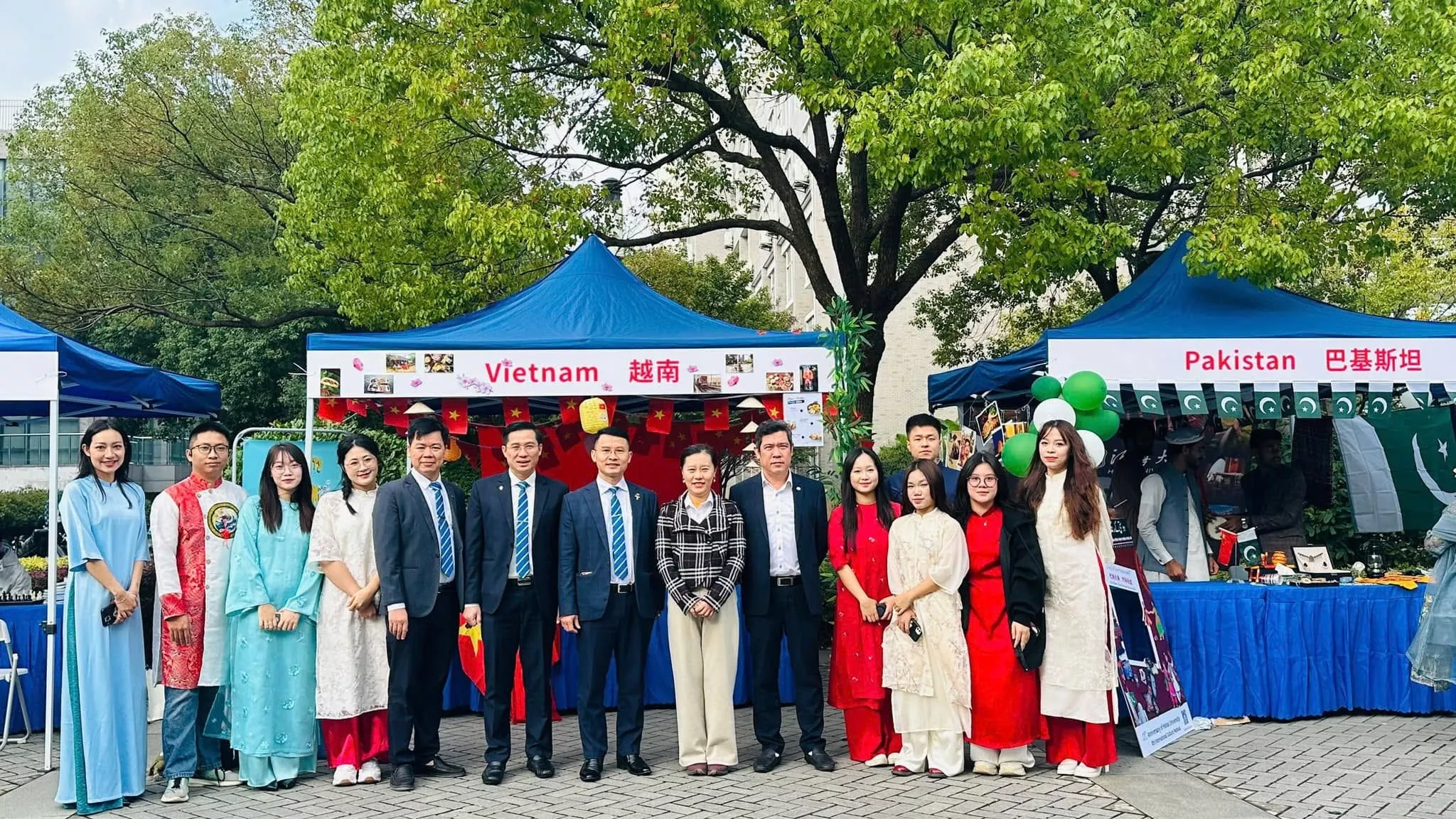
    Conferences, International Cooperation, and Academic Seminars in Civil Engineering, September, 2025
    Civil EngineeringCivil Engineering
    Specialized Research Seminar for PhD Candidates in Civil Engineering, April, 2026
    Civil EngineeringCivil Engineering
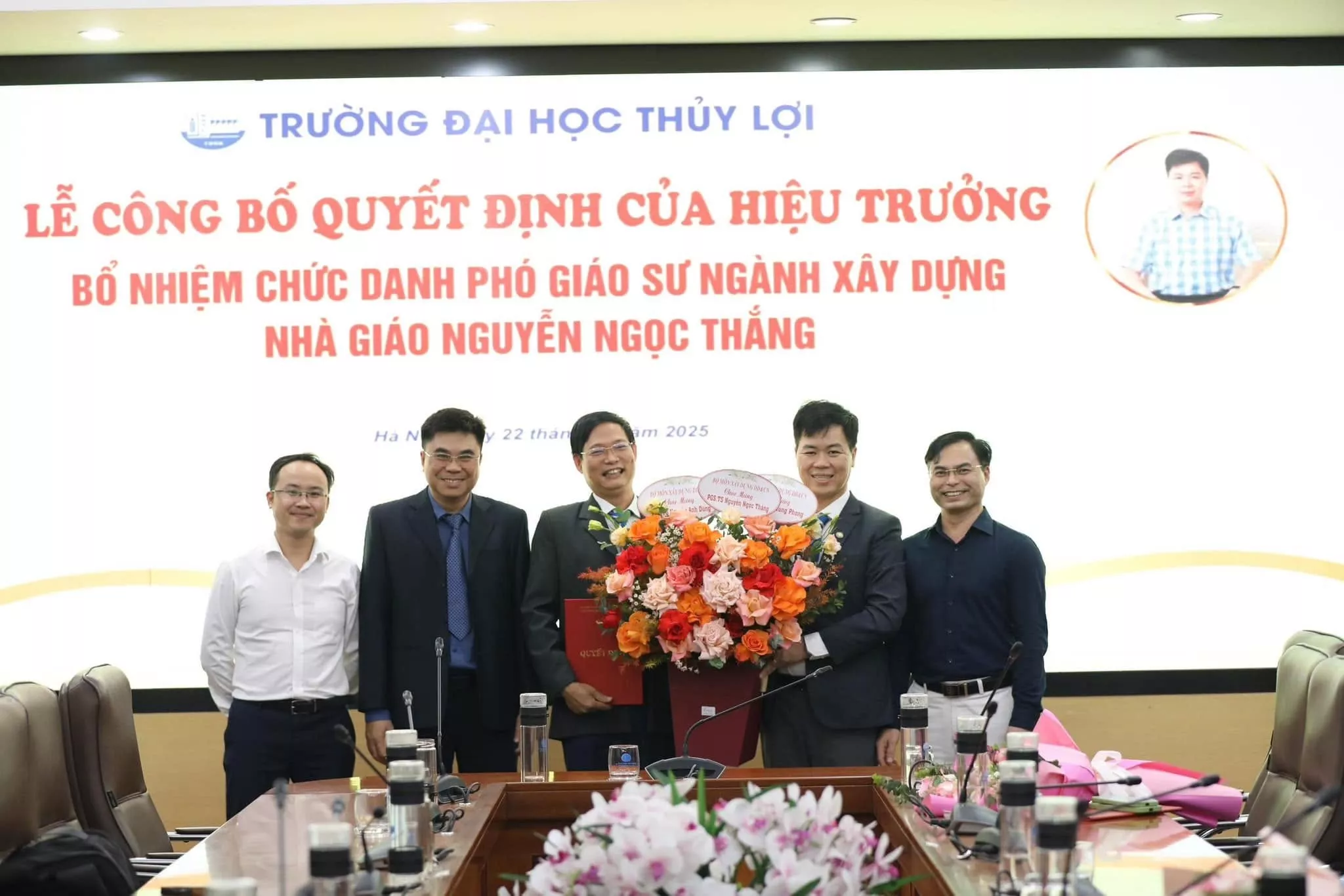
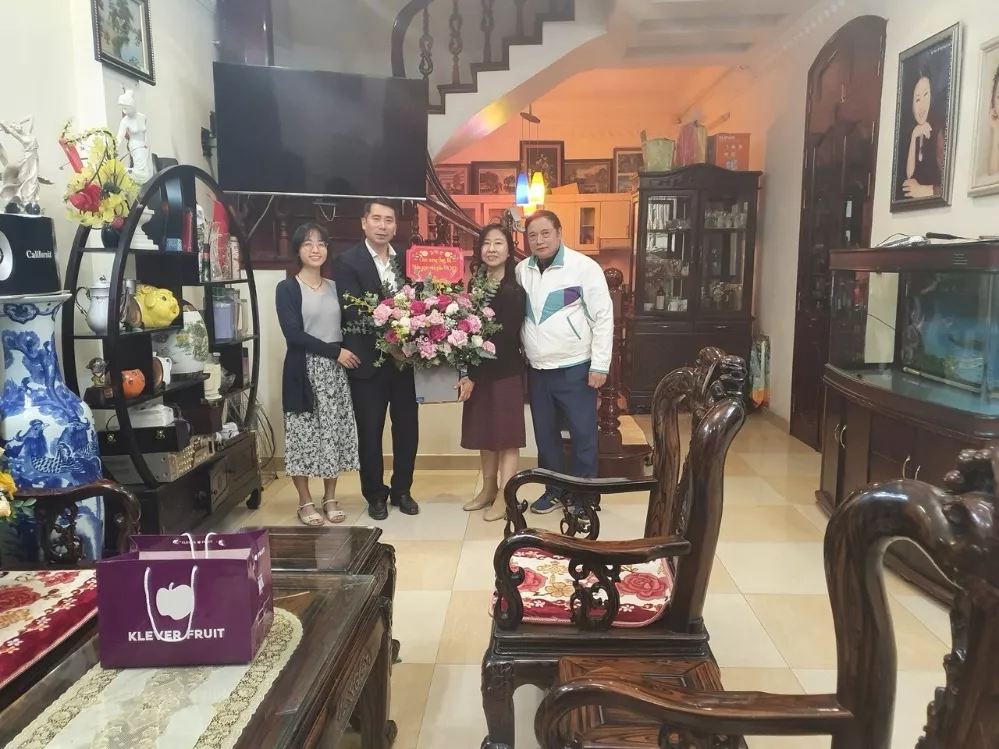
    Receiving the Associate Professor Certificate and Appointment in Civil Engineering, December, 2025
    Civil EngineeringCivil Engineering
    Other Activities of Faculty and Students in Civil Engineering
    Civil Engineering
    Other Activities of Faculty and Students in Civil Engineering
    Civil Engineering
    Civil Engineering students during a field visit to construction sites and manufacturing plants, October 2026


  • Geotechnical Engineering

    Geotechnical Engineering

    Master’s and Doctoral levels

    Field of study Geotechnical Engineering
    Managing unit Division of Geotechnical Engineering
    Institution Thuyloi University
    Levels covered Master’s and Doctoral

    MASTER’S PROGRAMME — GEOTECHNICAL ENGINEERING
    Introduction
    The application-oriented master’s programme provides advanced study in geotechnical engineering, foundation engineering and underground construction. It prepares learners to address ground-related challenges arising in transport, buildings, hydraulic and hydropower works, marine and port infrastructure, and other construction sectors.
    Highlights
    The programme connects specialist theory with professional practice. Learners develop the capacity to evaluate soil and rock behaviour, select appropriate investigation and design methods, assess foundation and underground works, and formulate technically sound solutions for complex site conditions. Interdisciplinary links with hydraulic, civil and transportation engineering broaden the programme’s practical relevance.

    Credits 60 credits
    Duration 2 years
    Orientation Application-oriented

    Objectives
    The programme aims to develop geotechnical professionals who can apply advanced knowledge and analytical methods to foundation, underground and environmental geotechnical problems; plan and evaluate investigations; contribute to safe and sustainable design, construction, operation and rehabilitation; and communicate technical decisions effectively in multidisciplinary settings.
    Career Prospects
    Graduates may work as geotechnical engineers, foundation or underground-works specialists, design consultants, site and quality-control engineers, project managers, researchers or lecturers. Employment opportunities are available in consulting firms, contractors, laboratories, research institutes, universities, public authorities and infrastructure organisations in Vietnam and abroad.
    Academic Staff
    Assoc. Prof. Dr. Hoàng Việt Hùng; Assoc. Prof. Dr. Bùi Văn Trường; Assoc. Prof. Dr. Nguyễn Hồng Nam; Dr. Hoàng Thị Lụa; Dr. Nguyễn Quang Tuấn; Dr. Nguyễn Trung Kiên; Dr. Phan Khánh Linh.
    SELECTED MASTER’S PROGRAMME ACTIVITIES
    Geotechnical Engineering

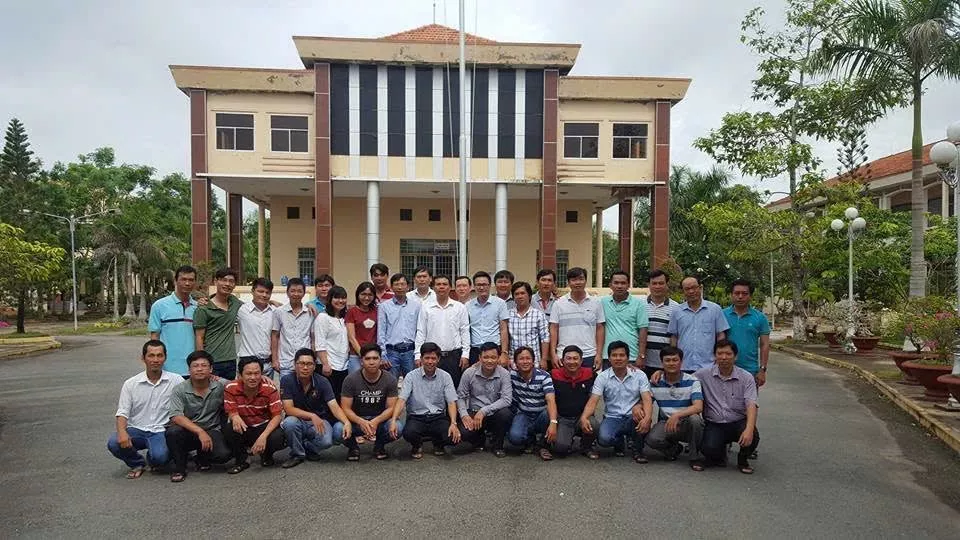
    Geotechnical Engineering master’s cohort at the conclusion of a course in Soc Trang, June 2017.

    Geotechnical Engineering

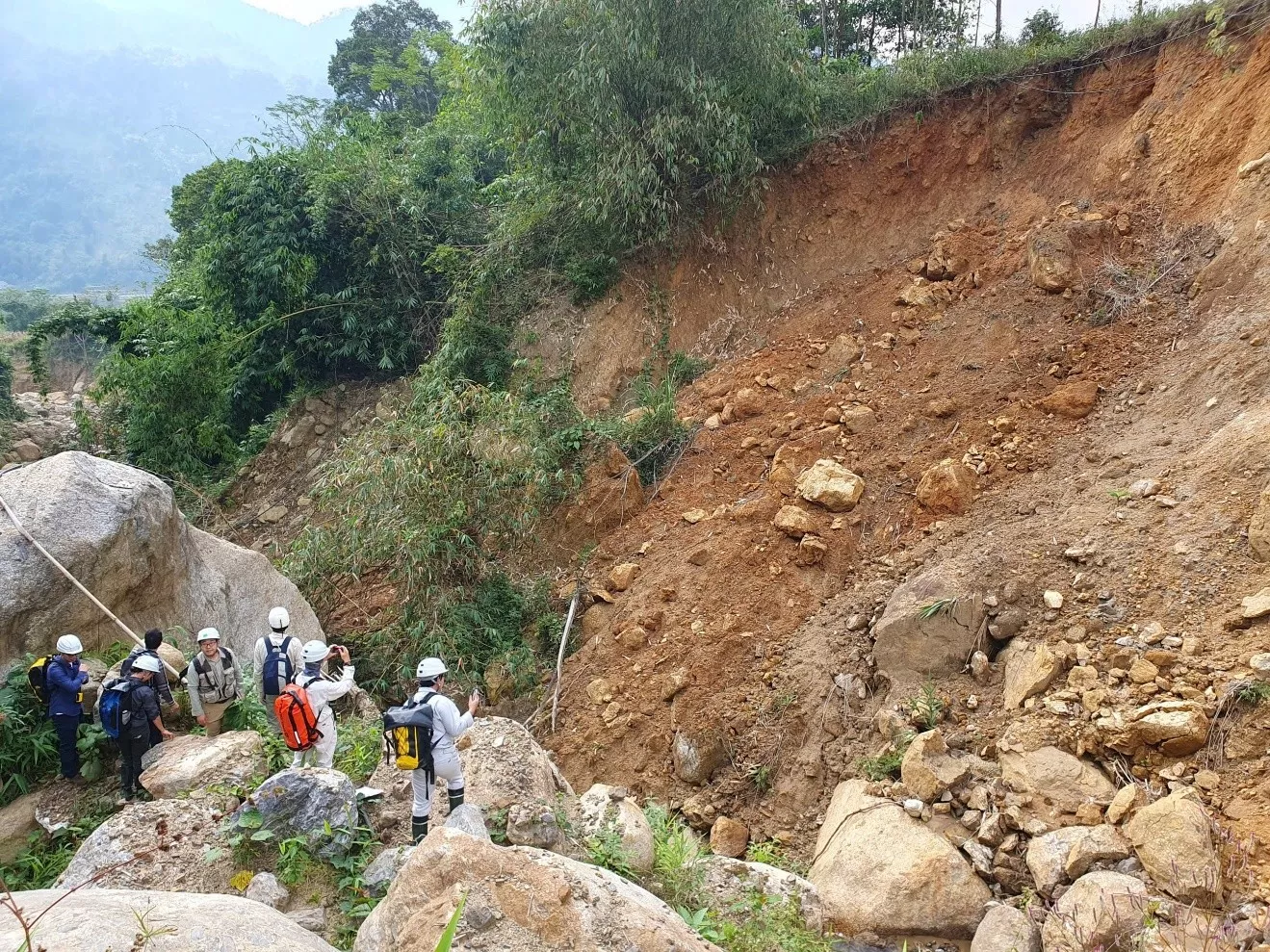
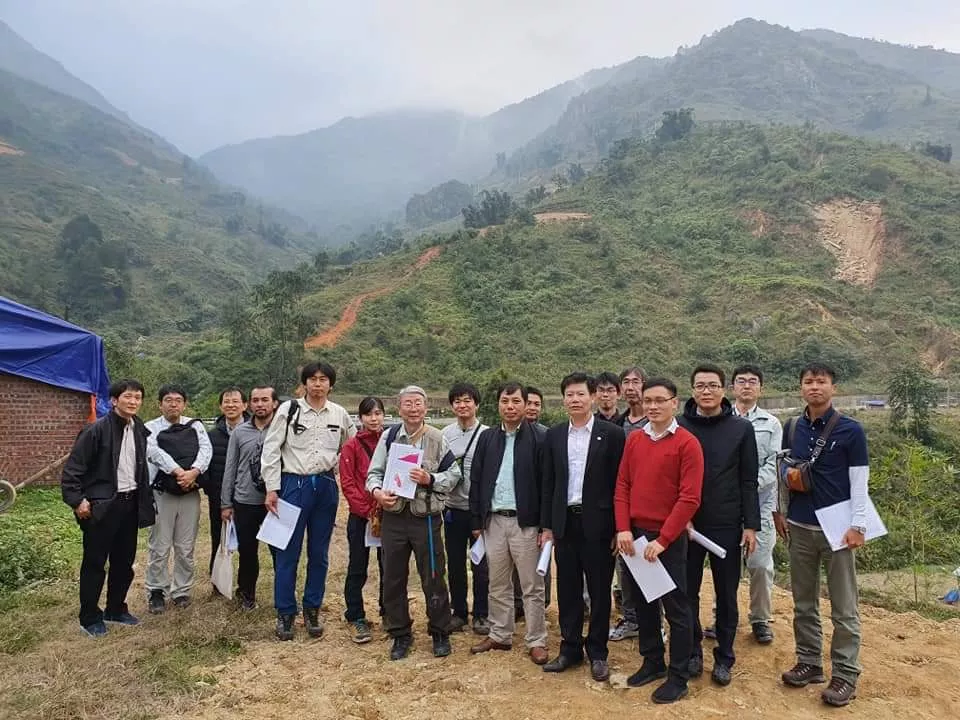
    Field investigation of landslide and debris-flow hazards with academic partners from Gunma University, Japan, in Thai Nguyen, December 2025.

    DOCTORAL PROGRAMME — GEOTECHNICAL ENGINEERING
    Introduction
    The doctoral programme prepares researchers and senior specialists to conduct independent, original research in geotechnical engineering. Candidates develop advanced theoretical and practical competence, strengthen their command of scientific methods, and investigate complex problems associated with construction, environmental protection, mineral development, and disaster prevention and mitigation.
    Highlights
    The programme emphasises original research with scientific and practical significance. Candidates work on emerging geotechnical problems, engage with academic and professional networks, and are expected to generate knowledge or methods that advance engineering analysis, design, risk reduction and infrastructure resilience.

    Credits 92 credits for candidates from relevant disciplines; 96 credits for candidates from related disciplines; 129 credits for candidates entering with a bachelor’s degree
    Duration 3 years for candidates holding a master’s degree; 4 years for candidates entering with a bachelor’s degree

    Objectives
    Doctoral training develops scientists capable of identifying consequential research questions, designing and conducting rigorous investigations, producing original contributions, solving new scientific and technological problems, communicating research findings, and providing academic or professional leadership in geotechnical engineering.
    Career Prospects
    Graduates may pursue teaching and research careers at universities and institutes; serve as senior experts or managers in ministries, public authorities and infrastructure agencies; or work in consulting and construction organisations responsible for planning, investigation, design, construction, management and operation of civil and geotechnical works.
    Academic Staff
    Prof. Dr. Trịnh Minh Thụ; Assoc. Prof. Dr. Hoàng Việt Hùng; Assoc. Prof. Dr. Bùi Văn Trường; Assoc. Prof. Dr. Nguyễn Hồng Nam; Dr. Hoàng Thị Lụa; Dr. Nguyễn Quang Tuấn; Dr. Nguyễn Trung Kiên; Dr. Phan Khánh Linh.
    SELECTED DOCTORAL RESEARCH ACTIVITIES
    Geotechnical Engineering

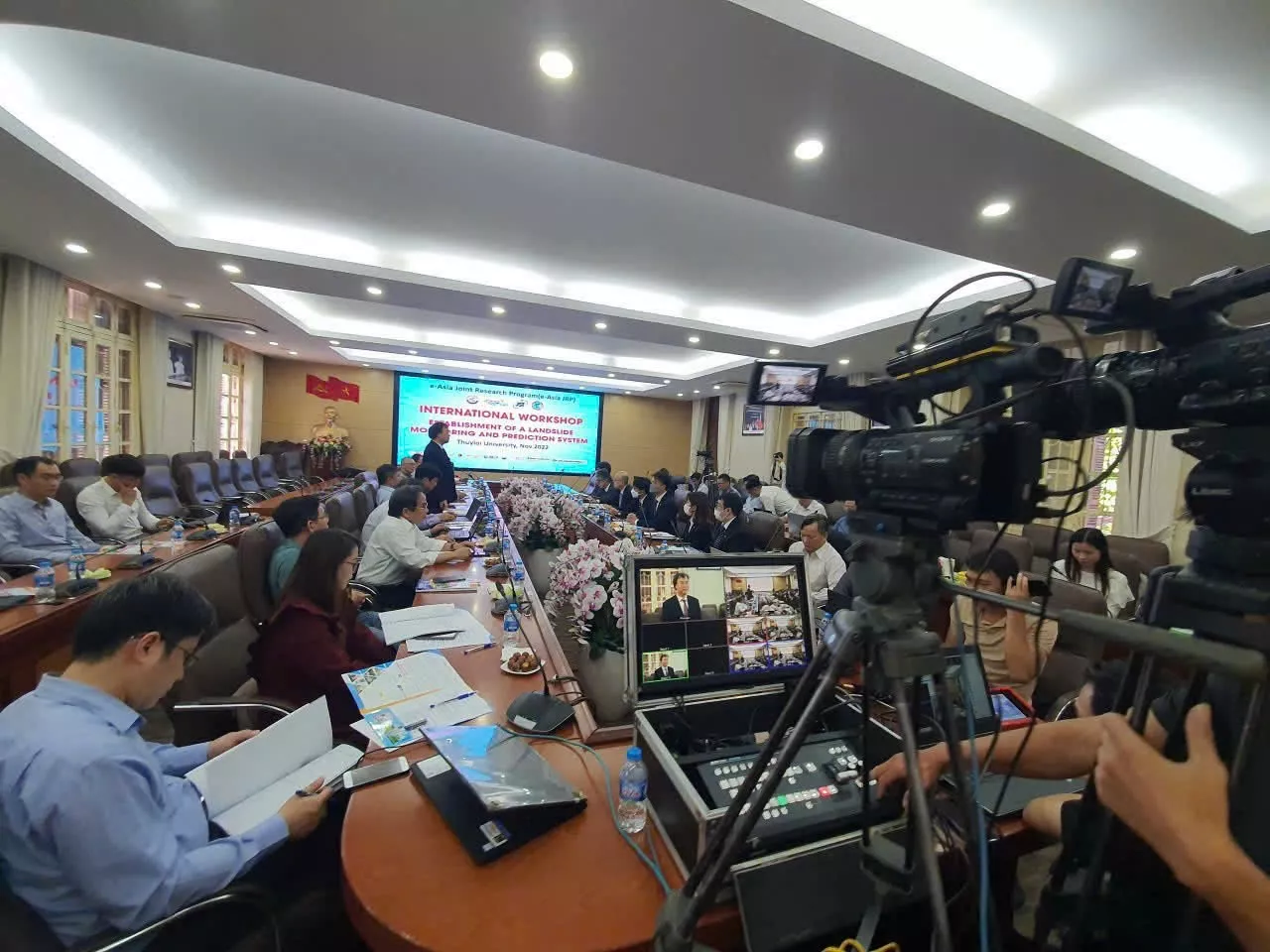
    International workshop associated with a geotechnical engineering research project on landslides.

    Geotechnical Engineering

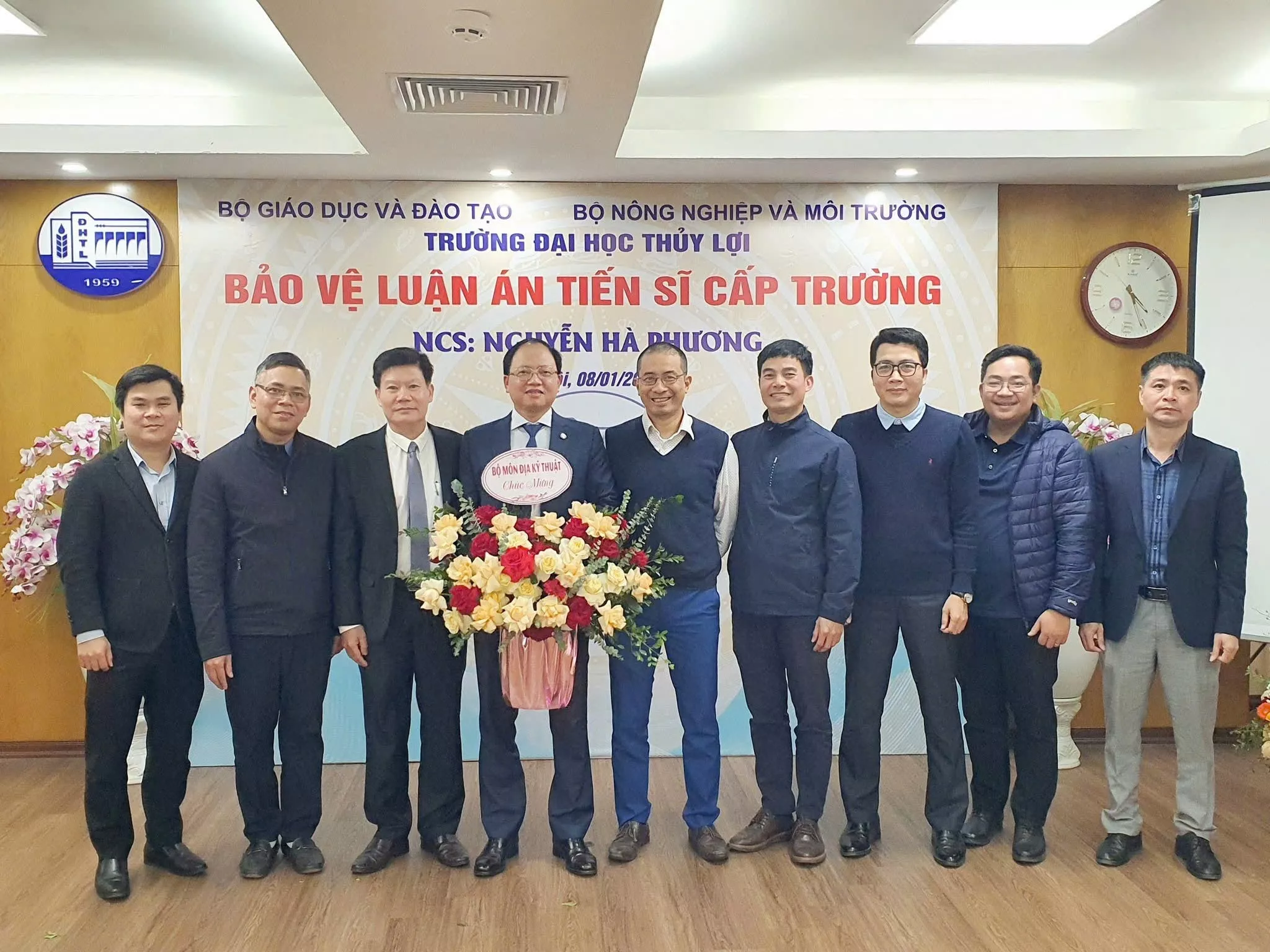
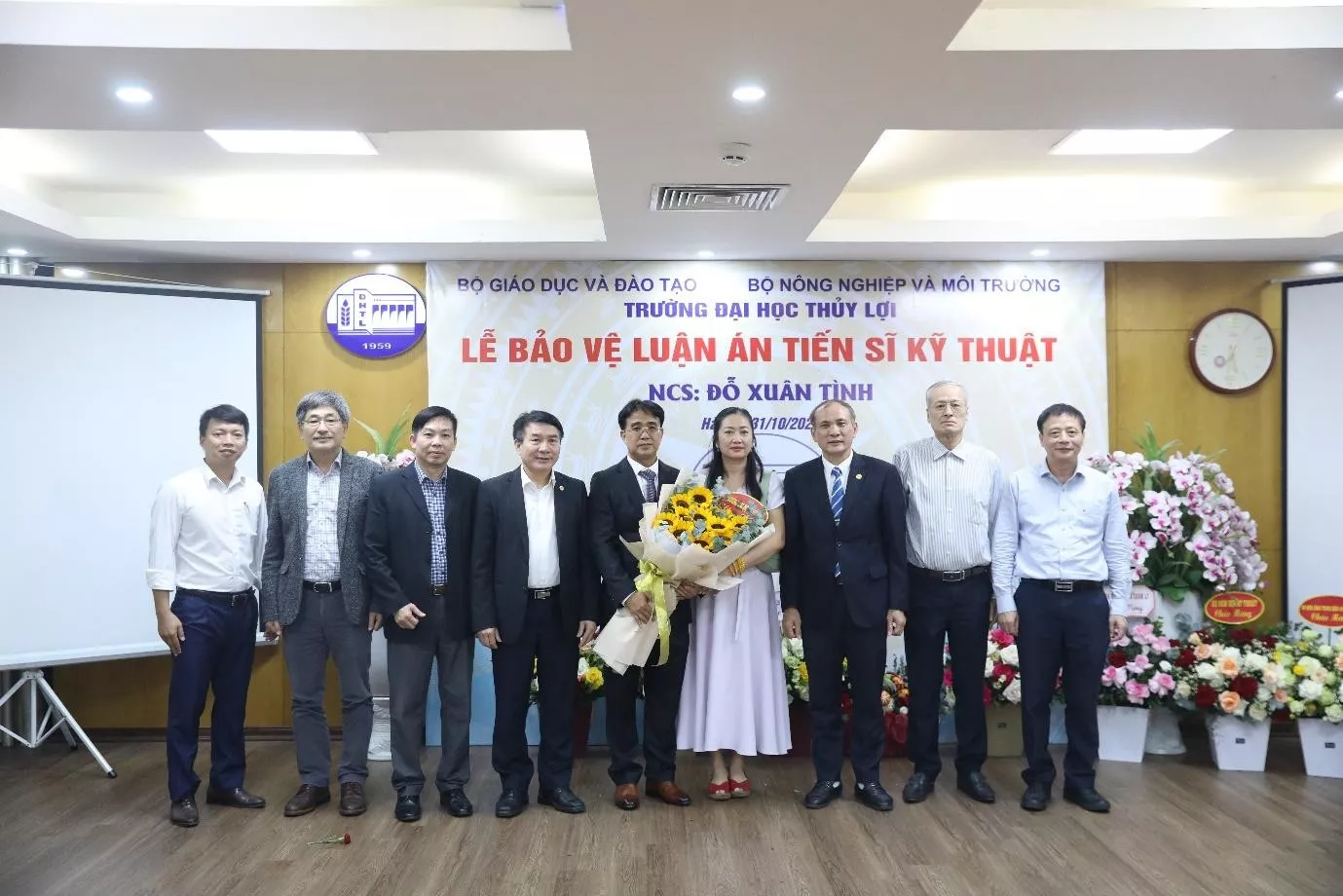
    Doctoral thesis defence in Geotechnical Engineering.

    Geotechnical Engineering

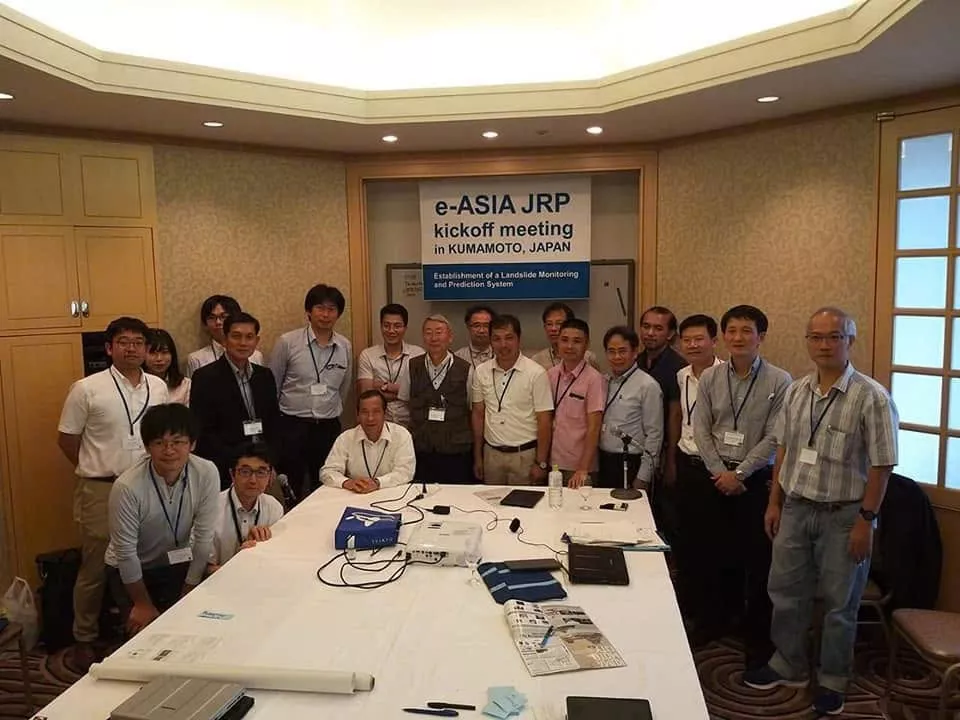
    Kick-off meeting of a Vietnam–Japan–Thailand multilateral research project on landslides and debris flows.

    Geotechnical Engineering

    Presentation of research findings by the Vietnamese project team.

    CONTACT

    Contact person Assoc. Prof. Dr. Hoàng Việt Hùng
    Role Head, Division of Geotechnical Engineering
    Telephone +84 912 723 376
    Email [email protected]


  • Solid Mechanics

    Doctoral Programme Profile 

    Programme level Doctoral
    Field of study Solid Mechanics
    Specialisations Mechanics of Deformable Solids; Engineering Mechanics; Mechanics of Materials and Structures
    Managing unit Division of Strength of Materials and Structures, Thuyloi University

    PROGRAMME OVERVIEW

    Introduction: The doctoral programme in Solid Mechanics provides advanced, research-led training across the discipline and its principal specialisations. It strengthens candidates’ command of fundamental and contemporary theory, rigorous research design, and methods for investigating complex problems in mechanics. Coursework establishes the conceptual and methodological foundation for independent doctoral research.

    Highlights: The programme integrates theoretical depth with application-oriented inquiry. Candidates are expected to generate original knowledge, develop or refine analytical, computational, and experimental approaches, and propose innovative solutions to scientific, engineering, and socio-economic challenges.

    Credits: The programme comprises 90 credits for candidates from relevant or closely related disciplines, 98 credits for candidates from related disciplines, and 127 credits for candidates admitted with a bachelor’s degree.

    Duration: 

    • Full-time: three consecutive years for candidates holding a master’s degree, or four consecutive years for candidates holding a bachelor’s degree.
    • Part-time: four years for candidates holding a master’s degree, or five years for candidates holding a bachelor’s degree. The programme includes at least 12 consecutive months of full-time study at Thuyloi University for the doctoral research project.

    Objectives: The programme prepares candidates to conduct independent, high-quality scientific research and to engage critically with advanced knowledge in Solid Mechanics. Graduates are equipped to formulate physical and mathematical models of mechanical processes; select and apply appropriate analytical, numerical, and experimental methods; create new knowledge and technological solutions; and provide expert leadership in research and professional practice.

    Career Prospects: Graduates may pursue academic and research careers at universities and research institutes; specialist or leadership roles in government agencies, including science, technology, environmental, agricultural, and rural development bodies; and advanced positions in engineering consultancy, structural design, construction, and technology organisations.

    RESEARCH AREAS

    • Structural analysis under uncertainty, with input parameters represented by fuzzy numbers, random variables, and hybrid fuzzy–random models.
    • Structural safety and reliability assessment using probabilistic methods and fuzzy-set theory.
    • Stability of underground structures and their interaction with the surrounding ground and environment.
    • Vibration mitigation and control for structures and mechanical equipment.
    • Thermal behaviour of mass-concrete structures.
    • Detection and diagnosis of structural damage and defects.
    • Structural optimisation and performance-based design.
    • Numerical and physical modelling of structural behaviour.
    • Structural response to impact loading.
    • Strengthening and rehabilitation of existing structures.

    ACADEMIC STAFF

    Academic Staff: The programme is supported by faculty members and external specialists with expertise across solid mechanics, structural mechanics, engineering mechanics, and related fields.

    Academic staff Academic staff
    Nguyễn Ngọc Thắng — Assoc. Prof., PhD, Thuyloi University Nguyễn Hùng Tuấn — PhD, Thuyloi University
    Nguyễn Công Thắng — PhD, Thuyloi University Phạm Ngọc Khánh — Prof., PhD, Thuyloi University
    Phạm Viết Ngọc — PhD, Thuyloi University Dương Văn Thứ — Assoc. Prof., PhD, Thuyloi University
    Nguyễn Tiến Chương — Prof., PhD, Thuyloi University Hoàng Đình Trí — Assoc. Prof., PhD, Thuyloi University
    Đào Văn Hưng — Assoc. Prof., PhD, Thuyloi University Trịnh Đình Châm — Assoc. Prof., PhD, Thuyloi University
    Vũ Hoàng Hưng — Assoc. Prof., PhD, Thuyloi University Nguyễn Phương Lâm — PhD, National University of Civil Engineering
    Nguyễn Quang Cường — Assoc. Prof., PhD, Thuyloi University Đào Tuấn Anh — PhD, Thuyloi University
    Lý Trường Thành — PhD, Thuyloi University Trần Mạnh Tuân — Assoc. Prof., PhD, Thuyloi University
    Nguyễn Anh Dũng — PhD, Thuyloi University Trương Quốc Bình — PhD, Dong Do University
    Hồ Sỹ Tâm — Assoc. Prof., PhD, Thuyloi University Nguyễn Hữu Thọ — PhD, Thuyloi University
    Nguyễn Thái Hoàng — PhD, Thuyloi University Nguyễn Đức Hậu — PhD, Thuyloi University

    CONTACT INFORMATION

    Website: https://cms.tlu.edu.vn/

    Doctoral admissions: https://ts.tlu.edu.vn/tin-tuyen-tien-si

  • Transportation Engineering

    Transportation Engineering

    Undergraduate and Master’s levels

    Field Transportation Engineering
    Managing unit Department of Transportation Engineering, Faculty of Civil Engineering
    Institution Thuyloi University

    UNDERGRADUATE PROGRAMME
    Introduction
    The undergraduate programme prepares engineers to plan, survey, design, construct, test, operate and maintain transportation infrastructure. It combines engineering fundamentals with specialised study in bridges, highways, tunnels and railway systems, supported by design projects, field experience and a capstone thesis.
    Highlights
    Learning is organised around authentic infrastructure problems and the use of contemporary design, analysis and digital tools. Sustainability, environmental assessment, safety, risk management and interdisciplinary coordination are integrated across the curriculum.

    Credits 155 credits, excluding Physical Education and National Defence Education
    Duration 4.5 years (9 semesters)
    Mode Full-time
    Degree Engineer in Transportation Engineering

    Objectives
    Graduates are expected to apply advanced engineering knowledge to complex transportation problems; use appropriate computational and digital tools; communicate and collaborate effectively; act with professional responsibility; and adapt through innovation and lifelong learning.
    Career Prospects
    Graduates may work in government transport agencies, project management units, design and supervision consultancies, contractors, infrastructure operators, research institutes and higher-education institutions. Roles include design engineer, site engineer, project coordinator, inspection or maintenance engineer, technical consultant and infrastructure manager.
    Major 1 — Bridge, Highway and Tunnel Engineering
    This major integrates highway and airport infrastructure, bridge systems and underground works. Students develop competence in route and geometric design, structural analysis, foundation and pavement engineering, bridge and tunnel design, construction methods, maintenance and project evaluation.
    Major 2 — High-Speed and Urban Railway Engineering
    This major focuses on railway alignment, subgrade and track systems, bridges, tunnels and underground stations, together with operations, safety, BIM, structural monitoring and system integration for high-speed and urban rail networks.
    Curriculum Structure

    Knowledge block Credits Share
    General education 43 27.7%
    Engineering fundamentals 31 20.0%
    Core-area fundamentals 18 11.6%
    Major core requirements 36 23.2%
    Major electives 12 7.7%
    Internship and capstone thesis 15 9.7%
    Total 155 100%
    • Transportation Engineering

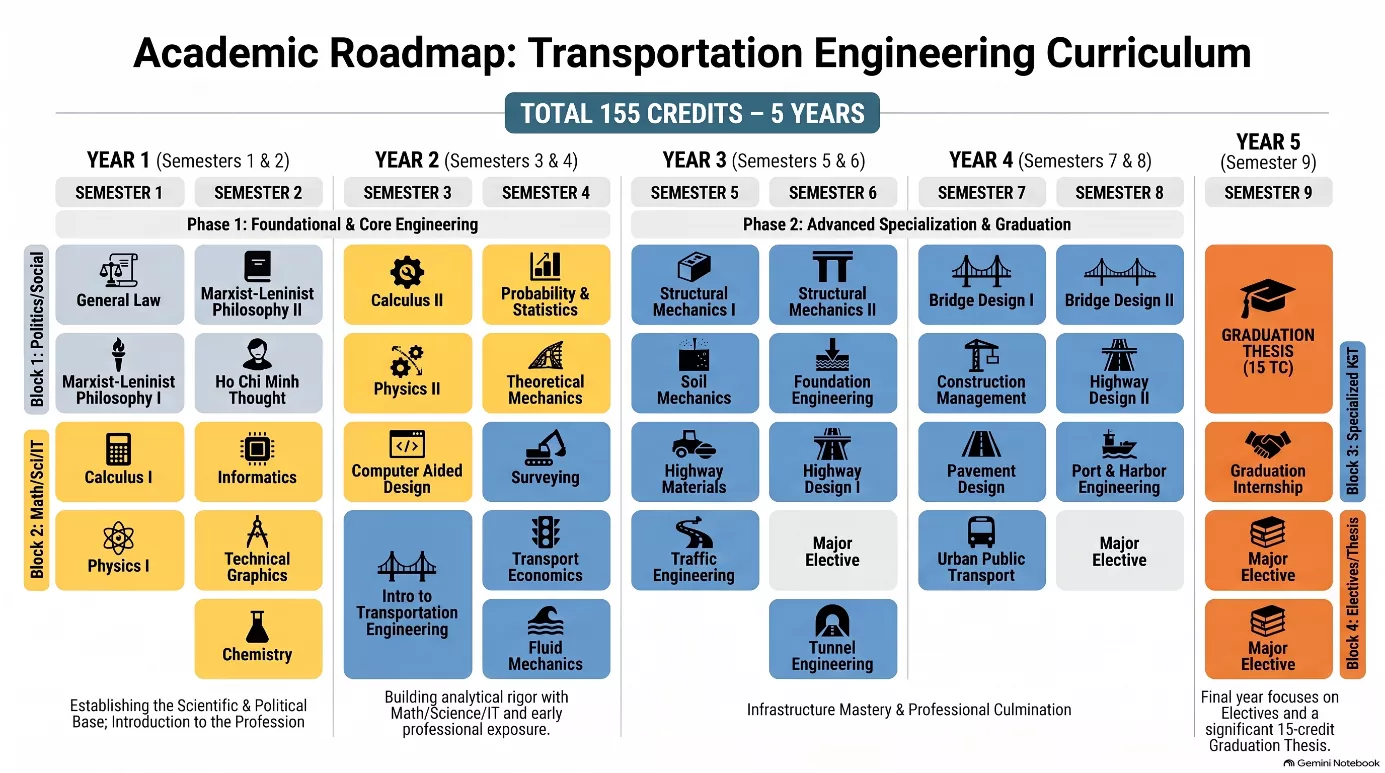
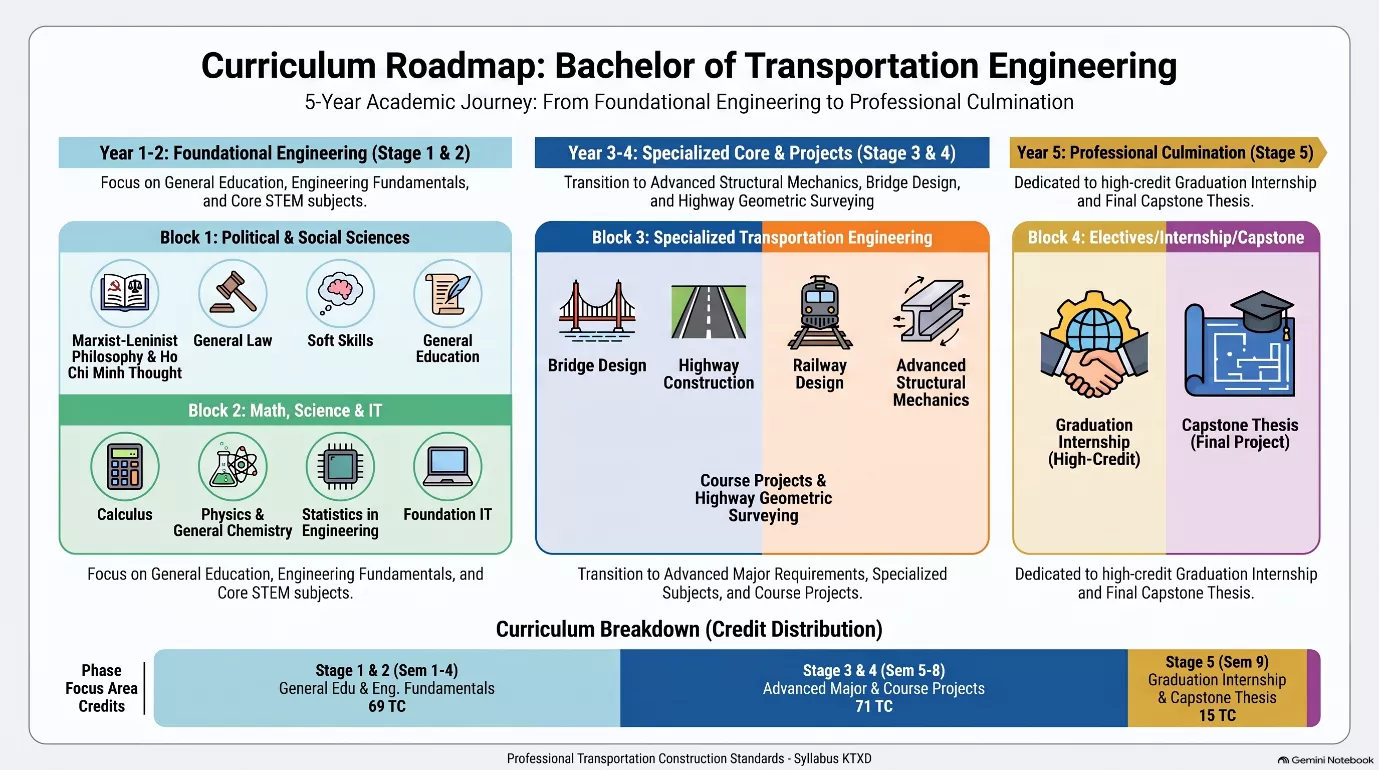
    Academic roadmap supplied for Transportation Engineering.

    • Transportation Engineering

    Detailed undergraduate curriculum roadmap supplied with the source.

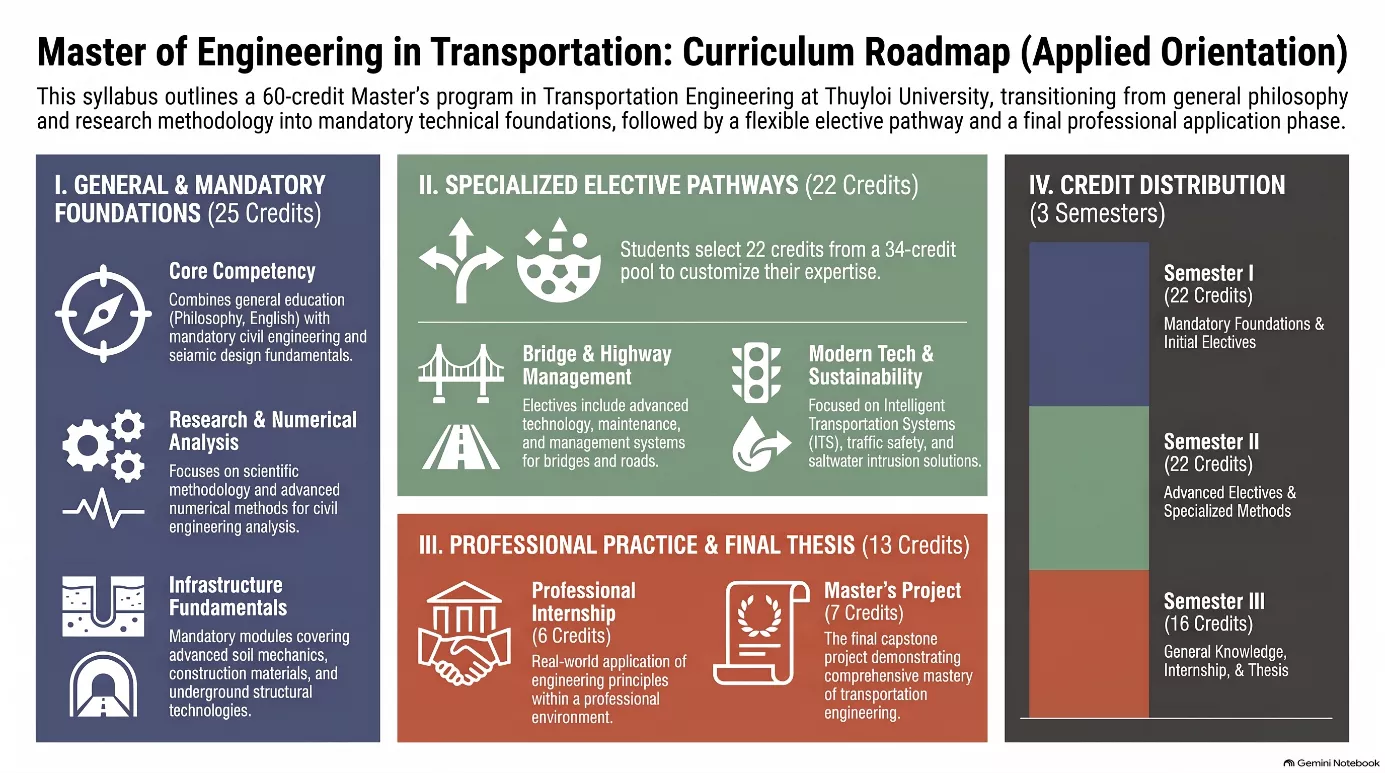
    MASTER’S PROGRAMME — TRANSPORTATION ENGINEERING
    Introduction
    This application-oriented programme develops advanced expertise in the design, construction, management, operation and maintenance of bridges, highways, railways, tunnels and urban transport systems. Advanced analysis is combined with digital technologies such as BIM, GIS and intelligent transportation systems.
    Highlights
    The programme links rigorous engineering methods with professional practice. Learners use contemporary numerical and geotechnical tools, engage with experienced faculty and industry partners, complete a professional internship, and undertake an applied master’s project addressing a real infrastructure challenge.

    Credits 60 credits
    Duration 1.5–2 years
    Orientation Application-oriented

    Objectives
    Graduates are prepared to analyse and solve complex transportation-engineering problems, select and use advanced software and digital workflows, conduct applied research, manage technical risk and project implementation, and communicate effectively in professional and international settings.
    Career Prospects
    Graduates may progress to senior technical, consulting, project-management and operational roles in public agencies, project management units, design consultancies, contractors and infrastructure operators. The degree also supports careers in research and teaching and provides preparation for doctoral study.
    Programme Structure

    Knowledge block Credits Share
    General knowledge 9 15.0%
    Core and specialised knowledge 38 63.3%
    Professional internship and master’s project 13 21.7%
    Total 60 100%
    • Transportation Engineering

    Master’s programme curriculum roadmap supplied with the source.

    Academic Staff
    The source reports four associate professors, one doctoral-level lecturer and one master’s-level lecturer. Individual names are not listed in the programme description.
    Contact

    • Department of Transportation Engineering, Faculty of Civil Engineering.
    • Room 422, A1 Building, 175 Tay Son Street, Kim Lien Ward, Hanoi.
    • Head: Assoc. Prof. Dr. Ngô Trí Thường — [email protected]
    • Deputy Head: Assoc. Prof. Dr. Lương Minh Chính — [email protected]


  • Coastal Engineering

    Coastal Engineering

    Master’s and Doctoral levels

    Field Coastal Engineering
    Managing unit Division of Coastal and Waterway Engineering
    Institution Thuyloi University

    MASTER’S PROGRAMME — COASTAL ENGINEERING
    Introduction
    The master’s programme develops highly qualified professionals for the sustainable development of marine and coastal areas. It responds to national priorities in the marine economy, coastal resilience and the responsible management of maritime infrastructure.
    Highlights
    Designed with an applied orientation, the curriculum combines advanced coastal-engineering knowledge with practical problem-solving. It draws on international academic experience, including the marine-engineering tradition of Delft University of Technology, while addressing the environmental and infrastructure conditions of Vietnam.

    Credits 60 credits
    Duration 1.5 years (18 months)
    Orientation Application-oriented

    Objectives
    Learners develop advanced competence in the investigation, planning, design, construction, operation and management of nearshore and offshore infrastructure. The programme addresses fixed and floating structures, hydrodynamic and seabed–structure interaction, numerical modelling and modern construction methods, while strengthening communication, teamwork and construction-investment management skills.
    Career Prospects
    Graduates may undertake research, teaching, consulting, management and specialist engineering roles in government agencies, universities, research institutes and enterprises concerned with coastal and marine engineering. They are also prepared to lead focused technical teams and develop independent lines of applied research.
    Academic Staff
    Prof. Dr. Thiều Quang Tuấn; Assoc. Prof. Dr. Nghiêm Tiến Lam; Assoc. Prof. Dr. Trần Thanh Tùng; Assoc. Prof. Dr. Mai Văn Công; Assoc. Prof. Dr. Lê Hải Trung.
    DOCTORAL PROGRAMME — COASTAL ENGINEERING
    Introduction
    The doctoral programme prepares researchers and senior specialists to conduct independent, original inquiry and solve complex problems in coastal and marine engineering. Its emphasis is on creating knowledge and technologies that support resilient infrastructure, sustainable coastal development and national maritime priorities.
    Highlights
    Research themes include coastal and island infrastructure, estuarine and marine dynamics, coastal protection, and engineering solutions that contribute to the conservation and restoration of coral reefs and mangrove ecosystems.

    Credits 92 credits for applicants from relevant disciplines; 96 for related disciplines; 129 for candidates entering with a bachelor’s degree
    Duration 3 years for candidates with a master’s degree; 4 years for candidates entering with a bachelor’s degree

    Objectives
    Candidates acquire the theoretical depth, methodological independence and practical judgement required to advance marine and coastal engineering. Research may address coastal protection and estuarine regulation, ports and offshore platforms, storm-shelter and anchorage facilities, transport and defence infrastructure, and civil or hydraulic works in coastal and island settings.
    Career Prospects
    Graduates may work as academics, researchers, senior consultants or technical leaders in universities, research institutes, ministries, science and technology agencies, agriculture and environment authorities, construction bodies and companies engaged in the planning, design, construction, management and operation of coastal, marine and hydraulic infrastructure.
    Academic Staff
    Prof. Dr. Nguyễn Trung Việt; Prof. Dr. Thiều Quang Tuấn; Assoc. Prof. Dr. Nghiêm Tiến Lam; Assoc. Prof. Dr. Trần Thanh Tùng; Assoc. Prof. Dr. Mai Văn Công; Assoc. Prof. Dr. Lê Hải Trung.
    SELECTED RESEARCH AND ACADEMIC ACTIVITIES
    Coastal Engineering

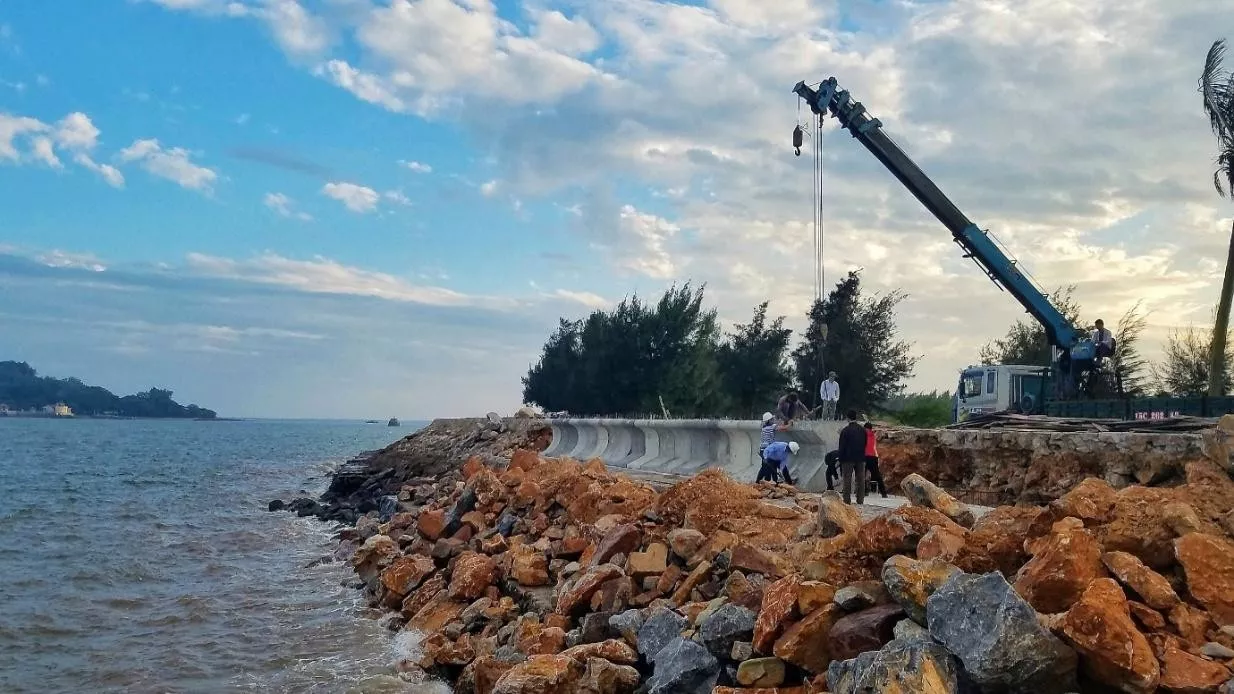
    Field and experimental work on coastal protection infrastructure

    .Coastal Engineering

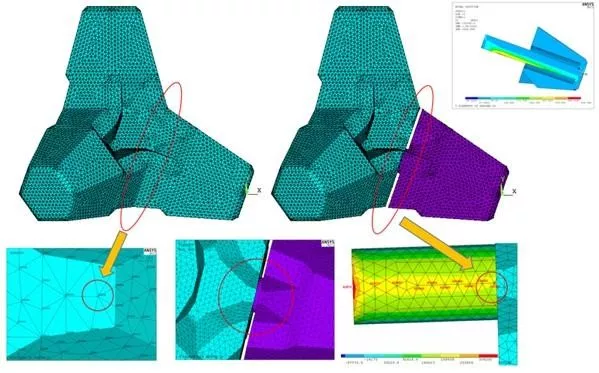
    Numerical modelling associated with the RAKUNA-IV armour-unit study.

    Coastal Engineering

    Doctoral thesis defence of Nguyễn Quang Lương.

    Coastal Engineering

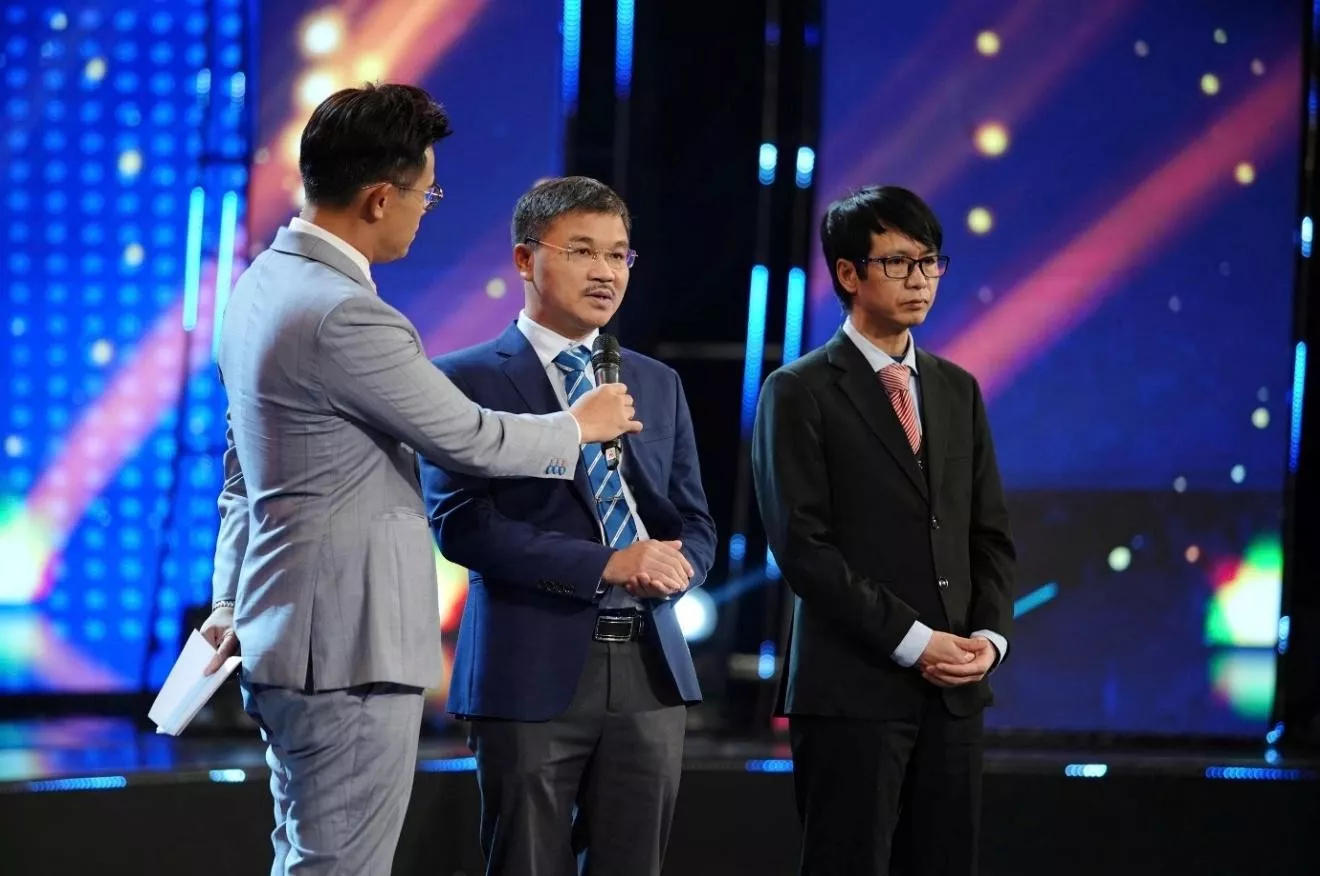
    Professor Thiều Quang Tuấn at the “Light of Knowledge” Gala 2025.

    Coastal Engineering

    Members of the Division of Coastal and Waterway Engineering, July 2026.

    Contact

    • Division of Coastal and Waterway Engineering, Room 417, A1 Building.
    • Thuyloi University, 175 Tay Son Street, Kim Lien Ward, Hanoi.


  • Hydraulic Structures Engineering

    Undergraduate, Master’s and Doctoral levels

    Institution Thuyloi University
    Academic unit Faculty of Civil Engineering
    Field Hydraulic Structures Engineering
    Programme identifier TLA101 at undergraduate level

    UNDERGRADUATE PROGRAMME — HYDRAULIC STRUCTURES ENGINEERING

    Introduction

    The undergraduate programme prepares engineers to analyse, design, construct, manage, operate, maintain and assess the safety of hydraulic structures and related infrastructure. Its scope includes dams and reservoirs, disaster-prevention works, hydropower and renewable-energy facilities, ports and waterways, coastal and marine structures, and shoreline protection. Digital technology, data analysis, sustainability and professional practice are integrated throughout the curriculum.

    Highlights

    The programme combines a strong foundation in mathematics, mechanics, hydraulics, hydrology, geotechnical and structural engineering with specialised study in water infrastructure. Three study pathways allow students to focus on hydraulic structures, hydropower and energy, or coastal and waterway engineering. Project work, field practice, digital modelling and engineering software support the transition from theory to professional application.

    Programme code TLA101
    Field code 7580202
    Credits 155 credits, including 15 credits for the graduation internship and graduation project
    Duration 4.5 years (9 semesters)
    Language Vietnamese
    Mode Full-time

    Objectives

    The programme develops engineers with a sound scientific foundation, professional judgement and a strong sense of responsibility. Graduates are expected to formulate and solve complex hydraulic-engineering problems, select safe and sustainable solutions, use modern digital tools, communicate effectively, work independently or in teams, and adapt to technological and professional change.

    Career Prospects

    Graduates may work in public agencies, design and supervision consultancies, contractors, project management units, research institutes, universities and infrastructure operators. Typical responsibilities include planning, surveying, design, construction management, safety assessment, operation, maintenance and asset management for hydraulic, hydropower, waterway, coastal and disaster-prevention infrastructure.

    Study Pathways

    1. Hydraulic Structures Engineering — construction, management, operation and safety of dams, reservoirs and water infrastructure.
      2. Hydropower and Energy Structures — hydropower resources, technological equipment, renewable energy and facility operation.
      3. Coastal and Waterway Engineering — ports, waterways, coastal structures, breakwaters, shoreline protection and coastal-zone management.

    Curriculum by Semester

    Semester Credits Main focus
    1 16 Law, philosophy, chemistry, calculus, digital skills and programme introduction
    2 18 Political economy, soft skills, mathematics, physics, graphics and engineering mechanics
    3 18 Social sciences, physics, differential equations, data processing, English, surveying and technical drawing
    4 20 English, fluid mechanics, strength of materials, geology, construction materials and laboratories
    5 18 Structural mechanics, soil mechanics, hydraulics, hydrology and hydraulic-structure design fundamentals
    6 19 Foundations, steel and reinforced-concrete structures, project economics, computing, dams and hydropower
    7 16 Environmental assessment, hydraulic-system structures, waterways, construction, coastal protection and electives
    8 15 Energy structures, hydraulic construction, riverbank protection, ports and electives
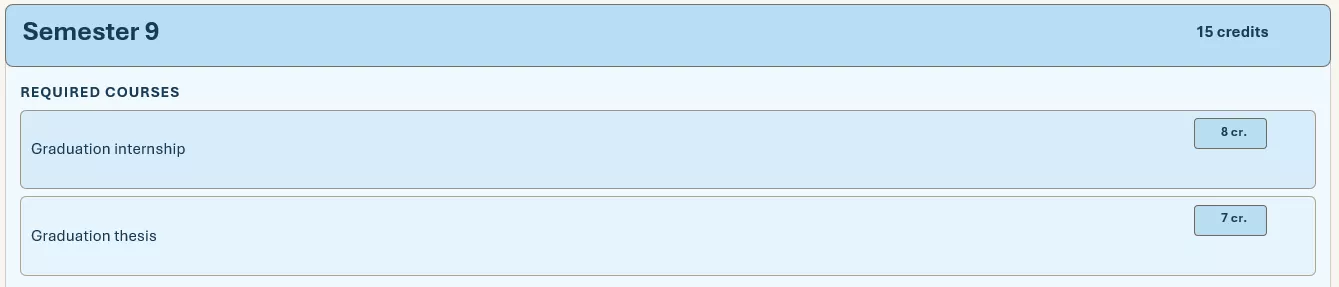
    9 15 Graduation internship and graduation project

    Academic Staff

    The source documents do not provide a named academic staff list. Teaching assignments are determined through the University’s approved annual teaching plan.


    MASTER’S PROGRAMME — HYDRAULIC STRUCTURES ENGINEERING

    Introduction

    The master’s programme advances learners’ capacity to analyse, evaluate and select engineering solutions for the design, construction, operation and management of hydraulic structures. Advanced methods, professional practice and an applied master’s project enable students to address complex scientific and technical problems using contemporary engineering approaches.

    Highlights

    The 60-credit programme combines advanced core study with a broad specialist-elective portfolio in dams and reservoirs, hydraulics, geotechnical engineering, hydropower, coastal and river engineering, numerical modelling, structural safety and risk. A professional internship and master’s project provide a direct connection between advanced study and practice.

    Programme code 8580202
    Qualification Master’s degree
    Credits 60 credits
    Duration 3 semesters
    Language Vietnamese
    Orientations Hydraulic Structures Engineering; Hydraulic Structures Construction and Management

    Objectives

    Graduates develop the ability to analyse and assess complex engineering conditions, interpret monitoring and experimental data, use advanced numerical and computational methods, justify technical decisions, and undertake applied research or professional projects. Solutions are expected to address safety, economic, environmental, risk and sustainability requirements.

    Career Prospects

    Graduates may work as senior engineers, consultants, project managers, researchers or lecturers in organisations responsible for the design, construction, inspection, operation, management and safety assessment of hydraulic structures. The degree also provides preparation for doctoral study.

    Programme Structure

    Semester Credits Components
    I 23 7 general-knowledge credits and 16 compulsory core/specialist credits
    II 22 Specialist electives selected from the approved portfolio
    III 15 Scientific Research Methodology (2), Professional Internship (6), Master’s Project (7)
    Total 60 9 general; 16 compulsory core; 22 specialist electives; 13 graduation

    Representative Specialist Areas

    • Advanced soil, rock and foundation engineering; embankment and concrete dams; reservoir safety.
    • Advanced hydraulics and hydrology; spillways, tunnels, gates and hydropower facilities.
    • Numerical modelling, monitoring, experimental methods, reliability and structural verification.
    • Sediment transport, estuaries, shorelines, coastal and riverbank protection, and disaster-risk reduction.

    Academic Staff

    Courses are delivered by qualified staff from the Faculty of Civil Engineering and relevant academic units. Individual lecturer names are not included in the supplied profile.


    DOCTORAL PROGRAMME — HYDRAULIC STRUCTURES ENGINEERING

    Introduction

    The doctoral programme develops independent and creative researchers capable of identifying and addressing new scientific, technological and management problems in hydraulic structures engineering. Advanced specialist study, research methodology, scholarly communication and an original dissertation form the core of the programme.

    Highlights

    Research is central to the programme: scientific research accounts for 10 credits and the doctoral dissertation for 70 credits. Doctoral coursework, a literature review essay and three seminars support the development of the dissertation and require candidates to engage critically with current knowledge, methods and evidence.

    Programme code 9580202
    Qualification Doctoral degree
    Credits 92 credits for candidates with a master’s degree in the same or an appropriate discipline; 96 for a closely related discipline; 129 for candidates entering from a bachelor’s degree
    Duration 3 years with a master’s degree; 4 years from a bachelor’s degree
    Language Vietnamese
    Research orientations Hydraulic Structures Engineering; Hydraulic Structures Construction and Management

    Objectives

    The programme prepares researchers who can formulate significant questions, design rigorous investigations, generate original knowledge or innovative solutions, publish and defend scholarly findings, and lead research in hydraulic structures engineering and management.

    Career Prospects

    Graduates may pursue academic, research and supervisory careers at universities and institutes; serve as senior specialists, consultants or research leaders in enterprises and public agencies; lead research and development projects; or continue with postdoctoral research.

    Programme Structure

    Component Credits
    Doctoral-level coursework 4
    Doctoral seminars 6
    Literature review essay 2
    Scientific research 10
    Doctoral dissertation 70
    Core total 92

    Doctoral Course Portfolio

    Code Edited English course title
    EHS 701 Experimental Hydraulics for Hydraulic Structures
    AEHS 702 Thermal and Seismic Effects on Hydraulic Structures
    MSHS 703 Monitoring and Surveillance of Hydraulic Structures
    CRFS 704 Supercritical-Flow Control on Spillways
    GIF 705 Gates and Hoisting Equipment
    LAS 706 Limit Analysis of Structures
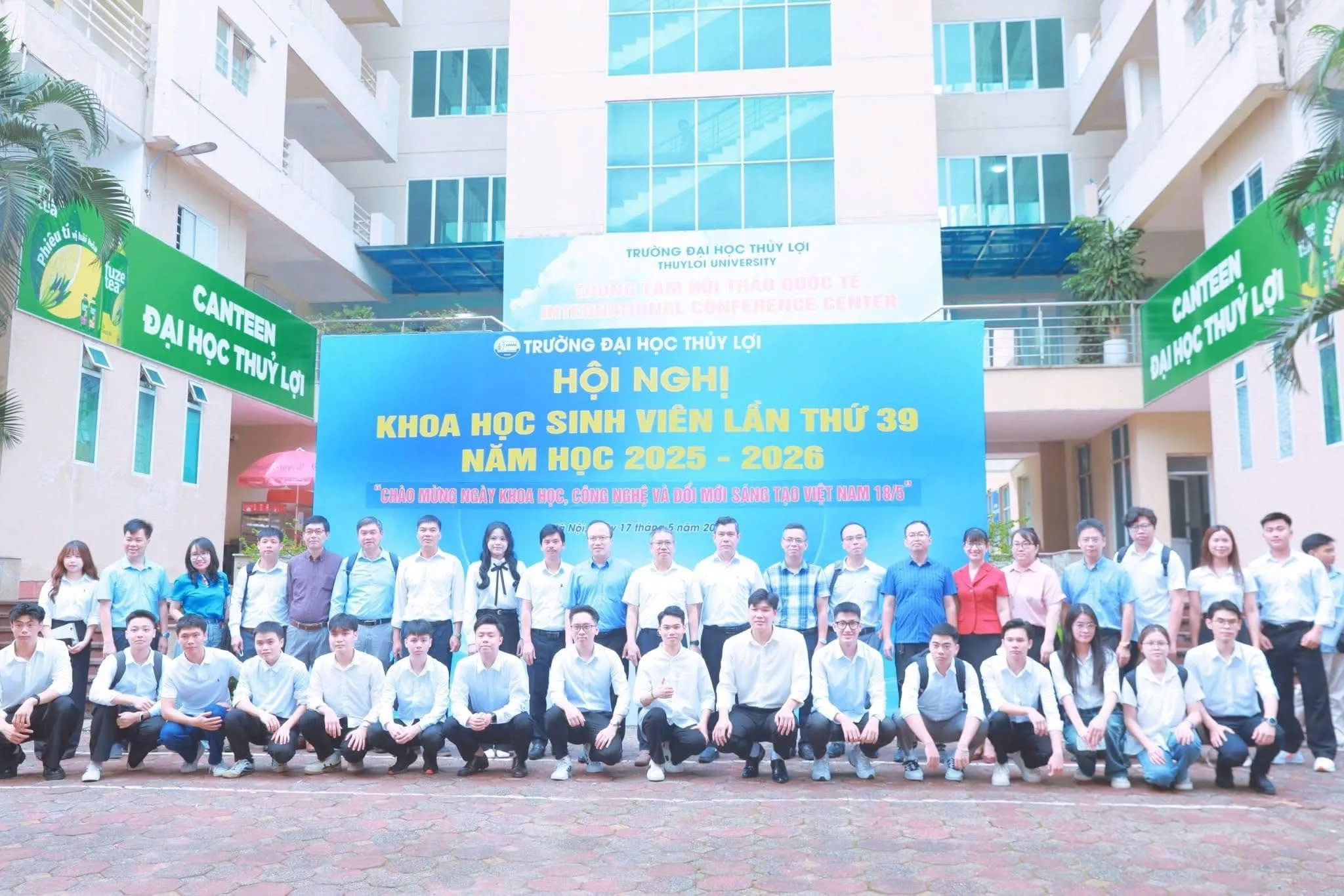
    ESCC 709 Computer-Based Experimental Structural Research
    NTME 727 New Technologies for Estuary and Coastal Research and Management
    NSSE 718 Numerical Simulation of Shoreline Evolution
    AFC 719 Concrete Admixtures
    ED 721 Embankment Dams
    NMCH 722 Numerical Methods for Hydraulic-Structure Analysis
    NM 724 Nearshore Morphodynamics
    MDH 726 Multi-Criteria Decision-Making in Hydraulic Engineering
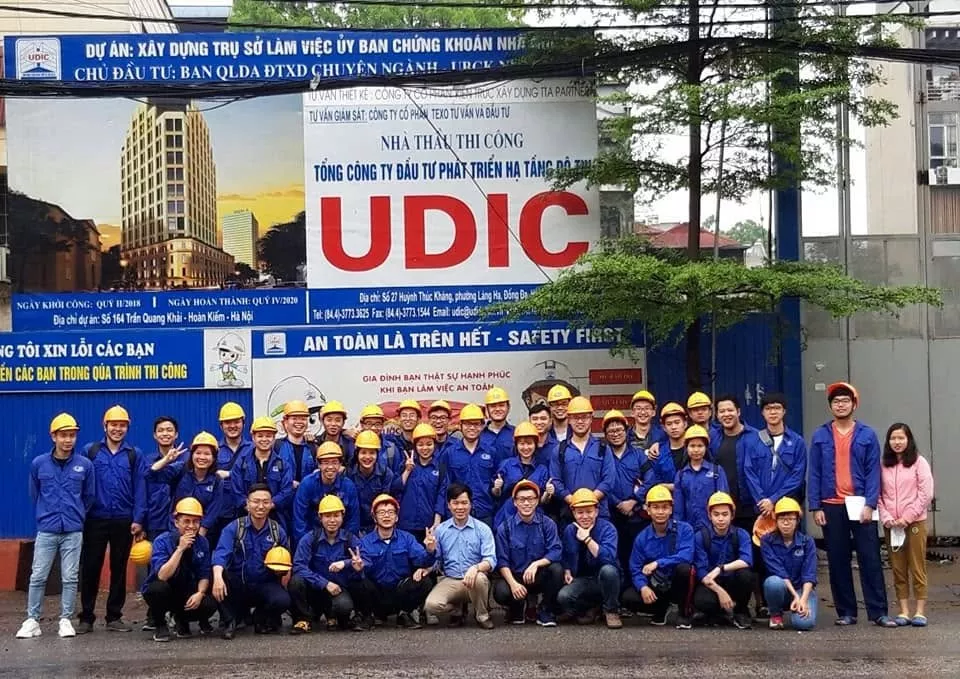
    PACE 728 Reliability Analysis in Civil Engineering
    CS 729 Coastal Protection Structures

    Academic and Research Supervision

    Teaching and supervision are provided by qualified academics and researchers appointed in accordance with current regulations and each candidate’s research topic. The supplied profile does not contain a named list of lecturers or supervisors.

    CONTACT

    Faculty of Civil Engineering, Thuyloi University. Additional contact details were not provided in the source documents.

  • Construction Technology and Management

    Construction Technology and Management

    Undergraduate, Master’s and Doctoral levels

    Managing unit Department of Construction Technology and Management, Faculty of Civil Engineering
    Programmes covered Construction Engineering Technology; Construction Management
    Institution Thuyloi University

    UNDERGRADUATE PROGRAMME 1 — CONSTRUCTION ENGINEERING TECHNOLOGY
    Introduction
    The programme develops engineers who can analyse, plan, organise and supervise construction activities across hydraulic, civil, industrial, transport and underground projects. Its curriculum combines scientific foundations, engineering analysis, construction technology, project delivery and field-based learning.
    Highlights
    A 155-credit, practice-oriented curriculum integrates construction methods, organisation, investment management, quality control, safety and foundation treatment. Digital capability is embedded through AI-enabled digital skills, BIM applications and elective study in artificial intelligence and digital transformation for construction management.

    Credits 155 credits, excluding Physical Education and National Defence Education requirements
    Duration 4.5 years (9 semesters)
    Degree Engineer in Construction Engineering Technology

    Objectives
    Graduates are prepared to apply engineering principles to construction analysis, planning and organisation; make sound technical decisions; work independently and in multidisciplinary teams; and continue learning throughout their careers. The programme also cultivates professional ethics, communication, research awareness and leadership potential.
    Career Prospects
    Graduates may work for contractors, design and supervision consultancies, testing and quality-control organisations, materials producers, project management units and public construction authorities. Typical roles include site engineer, construction planner, quality or safety engineer, project coordinator and technical manager; graduates may also pursue teaching or research.
    Academic Contacts
    Assoc. Prof. Dr. Nguyễn Trọng Tư; Assoc. Prof. Dr. Đồng Kim Hạnh; Assoc. Prof. Dr. Dương Đức Tiến.
    Curriculum Structure

    • Nine-semester plan with semester totals of 16, 17, 17, 19, 19, 17, 18, 17 and 15 credits.
    • Six elective credits are selected across Semesters 5, 7 and 8.
    • The final semester comprises an 8-credit professional internship and a 7-credit graduation thesis.

    Construction Technology and Management
    Curriculum roadmap supplied for Construction Engineering Technology.
    UNDERGRADUATE PROGRAMME 2 — CONSTRUCTION MANAGEMENT
    Introduction
    The programme prepares students to plan, organise, coordinate and control construction investment projects throughout their life cycle. Engineering foundations are combined with economics, finance, law, procurement, cost management, project organisation and digital construction.
    Highlights
    Its interdisciplinary design connects technical decision-making with commercial and managerial practice. Students develop competence in contracts and bidding, construction pricing, financial and risk management, quality assurance, BIM and data-informed project delivery, supported by projects, field visits, an internship and a graduation thesis.

    Credits 150 credits, excluding Physical Education and National Defence Education requirements
    Duration 4.5 years (9 semesters)
    Programme code 7580302 (admissions identifier TLA114 in the source)

    Objectives
    The programme aims to produce construction-management professionals who can evaluate technical, economic, legal and organisational information; manage cost, schedule, quality, safety and risk; communicate effectively with project stakeholders; and apply digital tools to complex construction decisions.
    Career Prospects
    Career pathways include project management, quantity surveying, cost and financial control, procurement and contract administration, construction planning, investment appraisal, quality management, consulting and public administration. Emerging opportunities include BIM coordination, digital project controls and data-driven construction management.
    Academic Contacts
    Assoc. Prof. Dr. Nguyễn Trọng Tư; Assoc. Prof. Dr. Dương Đức Tiến; Assoc. Prof. Dr. Đồng Kim Hạnh.
    Curriculum Structure

    • Nine-semester plan with semester totals of 15, 17, 17, 16, 18, 16, 18, 18 and 15 credits.
    • Eight elective credits are selected in Semesters 7 and 8.
    • The final semester comprises an 8-credit graduation internship and a 7-credit graduation thesis.

    Construction Technology and Management
    Curriculum roadmap supplied for Construction Management.
    MASTER’S PROGRAMME — CONSTRUCTION MANAGEMENT (8580302)
    Introduction
    This application-oriented master’s programme develops advanced professional competence in construction investment, project delivery and organisational management. It combines contemporary management theory with methods that can be applied directly to planning, coordination, cost control, technology, safety and environmental performance.
    Highlights
    Learners address authentic construction-management problems through advanced coursework, professional practice and an applied master’s project. The programme emphasises resource optimisation, schedule and cost control, risk-informed decision-making, digital technology and responsible management.

    Credits 60 credits: 9 general, 12 foundational, 24 specialised, 7 internship and 8 master’s project
    Duration 1.5 years (3 semesters)
    Orientation Application-oriented

    Objectives
    Graduates are expected to formulate and implement management strategies, organise and supervise project activities, apply scientific methods to professional problems, and update their knowledge as technologies and regulatory requirements evolve.
    Career Prospects
    Graduates may advance into specialist and leadership positions with project owners, contractors, consultancies, public agencies and research or training organisations. They are equipped for project planning, coordination, supervision, cost and risk management, and other high-level functions in construction investment.
    Curriculum Overview

    Semester Credits Main components
    1 22 English; quantitative and management methods; quality, progress, cost, investment, risk and standards
    2 23 Research methods; BIM; procurement; enterprise, safety, environment, technology and specialist electives
    3 18 Philosophy; two professional intensive modules; 8-credit master’s project

    DOCTORAL PROGRAMME — CONSTRUCTION MANAGEMENT (9580302)
    Introduction
    The doctoral programme develops independent researchers with advanced theoretical knowledge and the capacity to investigate emerging questions in construction management. Doctoral work is expected to contribute original and practically relevant knowledge to the management of construction investment and development.
    Highlights
    Research is grounded in rigorous methods and directed towards consequential problems in construction policy, organisations, projects, technology and investment. Candidates are expected to produce academically significant findings with clear value for professional practice.

    Credits Not stated in the supplied source
    Duration 3–4 years

    Objectives
    Candidates develop the ability to frame original research questions, select and defend appropriate methodologies, generate and communicate new knowledge, and provide academic or professional leadership in construction management.
    Career Prospects
    Graduates may pursue academic and research careers or senior expert and leadership roles in construction enterprises, consulting organisations, project management units and public bodies responsible for construction investment and development.
    Academic Contacts
    Assoc. Prof. Dr. Nguyễn Trọng Tư; Assoc. Prof. Dr. Dương Đức Tiến; Assoc. Prof. Dr. Đồng Kim Hạnh.
    Programme Activities
    Construction Technology and ManagementConstruction Technology and ManagementConstruction Technology and ManagementConstruction Technology and Management
    Contact

    Name Role Telephone Email
    Assoc. Prof. Dr. Nguyễn Trọng Tư Head of Department +84 (0)945 055 455 [email protected]
    Assoc. Prof. Dr. Dương Đức Tiến Deputy Head 024 3563 6455 [email protected]
    Assoc. Prof. Dr. Đồng Kim Hạnh Deputy Head 024 3563 6455 [email protected]