- Electrical Engineering
- Introduction: The program provides education in electrical engineering, electric power systems, renewable energy, and industrial and residential electrical engineering.
- Highlights: The curriculum combines electrical engineering foundations with three specialist orientations: Electric Power Systems, Renewable Energy Engineering, and Industrial and Residential Electrical Engineering.
- Credits: 155
- Duration: 4.5 years (9 semesters)
- Objective: To equip learners with foundational and professional knowledge and practical skills for analyzing, designing, operating and managing electrical and energy systems.
- Career Prospects: Electrical utilities; power plants and substations; electrical design and consultancy firms; renewable-energy companies; industrial and building electrical systems.
- Professors: Assoc. Prof. Nguyen Minh Y (Head of Department), Assoc. Prof. Pham Van Hoa and teaching staff of the Department of Electrical and Electronic Engineering
Curriculum blocks
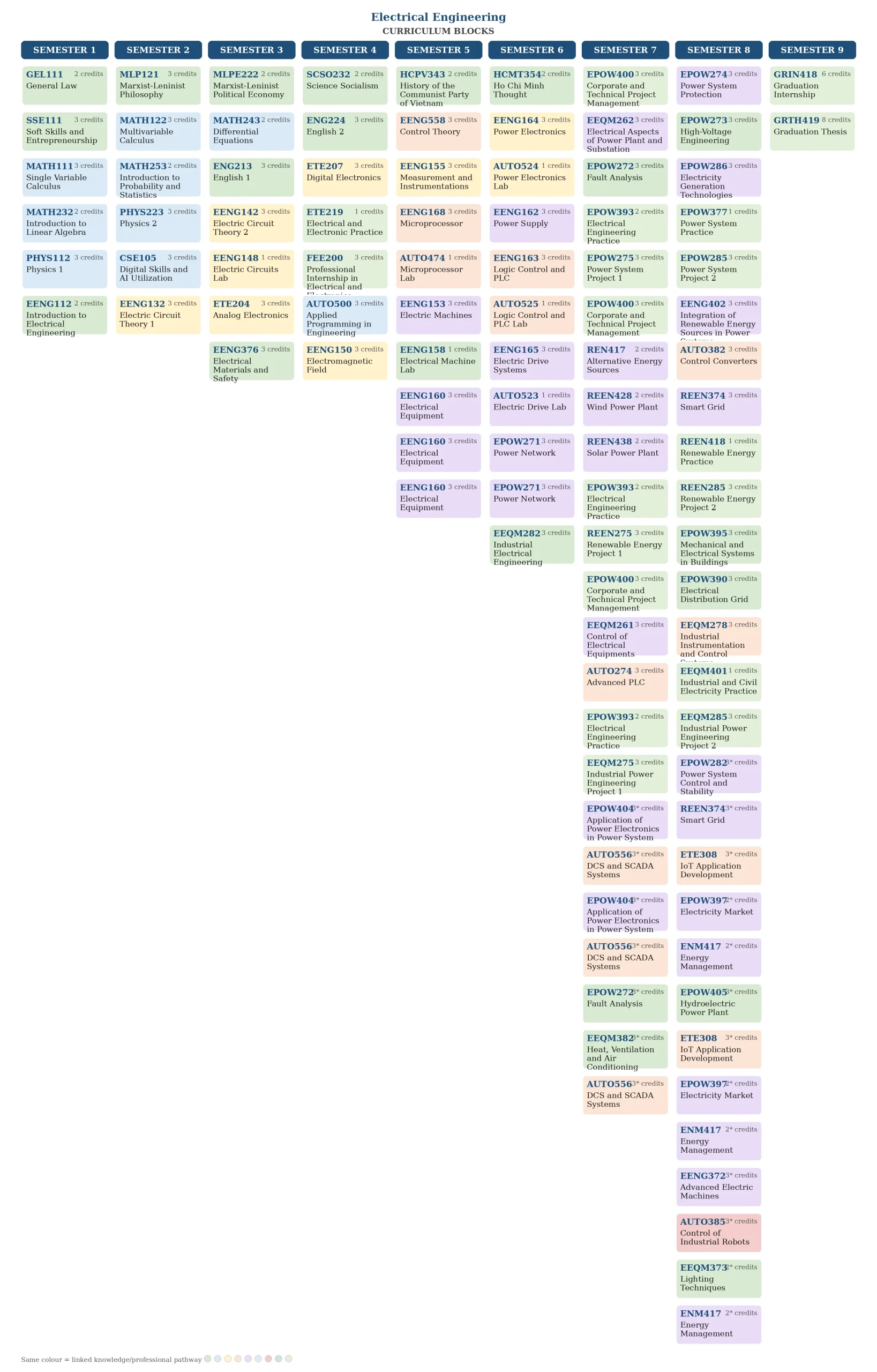
Same colours identify related curriculum pathways. Course code, title, credits and semester placement follow the supplied 2025 curriculum framework.
- 2. Control Engineering and Automation
- Introduction: The program develops knowledge and practical skills in control, automation, industrial systems, embedded systems and the Internet of Things.
- Highlights: The curriculum includes control theory, PLC/SCADA, process control, electric drives, power electronics and embedded/IoT applications.
- Credits: 155
- Duration: 4.5 years (9 semesters)
- Objective: To prepare engineers to analyze, design, integrate, operate and maintain automatic control and industrial automation systems.
- Career Prospects: Manufacturing plants; automation system integrators; industrial control and instrumentation companies; water supply and drainage facilities; embedded and IoT companies.
- Professors: Prof. Than Ngoc Hoan, Assoc. Prof. Pham Duc Dai (Head of Department) and teaching staff of the Department of Control Engineering and Automation.
Curriculum blocks
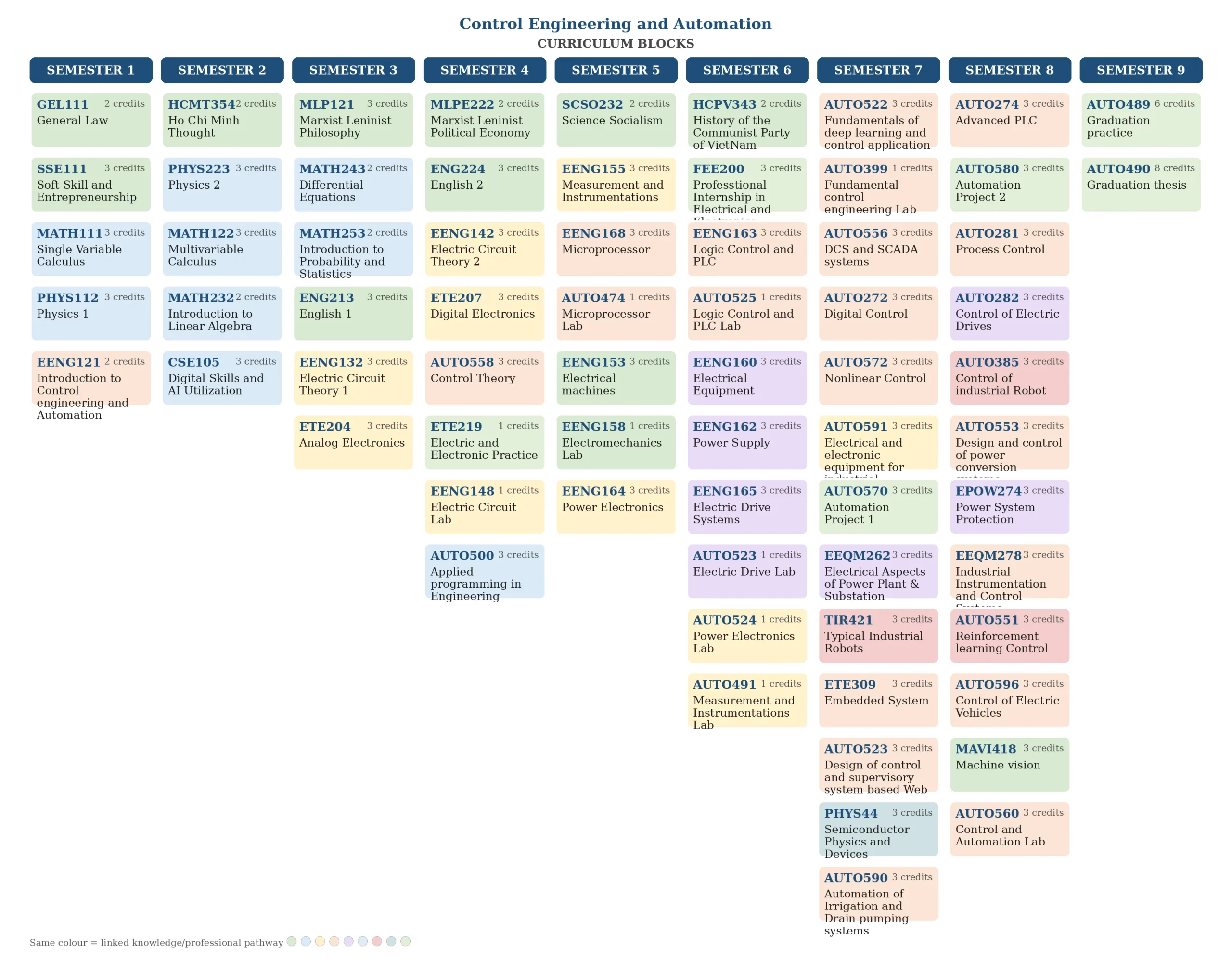
Same colours identify related curriculum pathways. Course code, title, credits and semester placement follow the supplied 2025 curriculum framework.
- 3. Electronics and Telecommunications Engineering
- Introduction: The program provides foundations and professional knowledge in electronics, telecommunications, antennas, microwave engineering, signal processing and embedded systems.
- Highlights: Students undertake laboratory and project work in electronic circuits, communication systems, antennas, microwave engineering and embedded applications.
- Credits: 155
- Duration: 4.5 years (9 semesters)
- Objective: To prepare engineers capable of analyzing, designing, deploying and operating electronic, telecommunications and embedded systems.
- Career Prospects: Telecommunications operators; electronic equipment companies; embedded-system and IoT companies; communication, antenna and remote-monitoring technology organizations.
- Professors: Dr. Tran Van Hoi (Head of Department), Prof. Bach Gia Duong, Assoc. Prof. Trinh Anh Vu and teaching staff of the Department of Electronics and Telecommunications.
Curriculum blocks
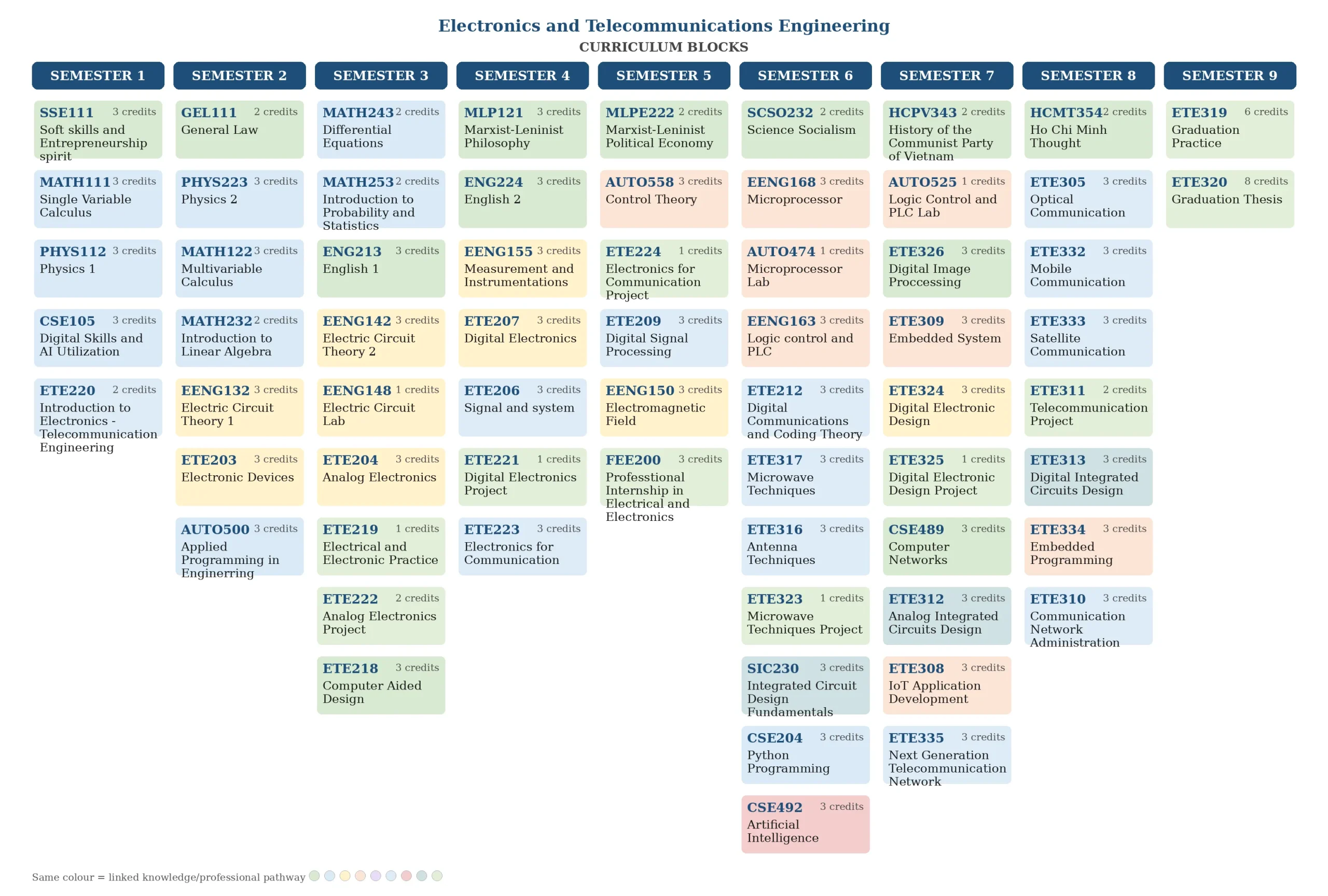
Same colours identify related curriculum pathways. Course code, title, credits and semester placement follow the supplied 2025 curriculum framework.
- 4. Robotics Engineering and Intelligent Control
- Introduction: The program integrates robotics, automatic control, artificial intelligence, computer vision and intelligent systems.
- Highlights: The curriculum emphasizes robot design and programming, intelligent control, computer vision, AI and practical projects.
- Credits: 155
- Duration: 4.5 years (9 semesters)
- Objective: To prepare engineers to design, integrate, program and operate robots and intelligent control systems.
- Career Prospects: Robotics and automation companies; AI and computer-vision companies; smart manufacturing; autonomous systems; technology start-ups.
- Professors: Dr. Le Trung Dung (Head of Department), Assoc. Prof. Nguyen Tien Ban and teaching staff of the Department of Robotics Engineering and Intelligent Systems.
Curriculum blocks
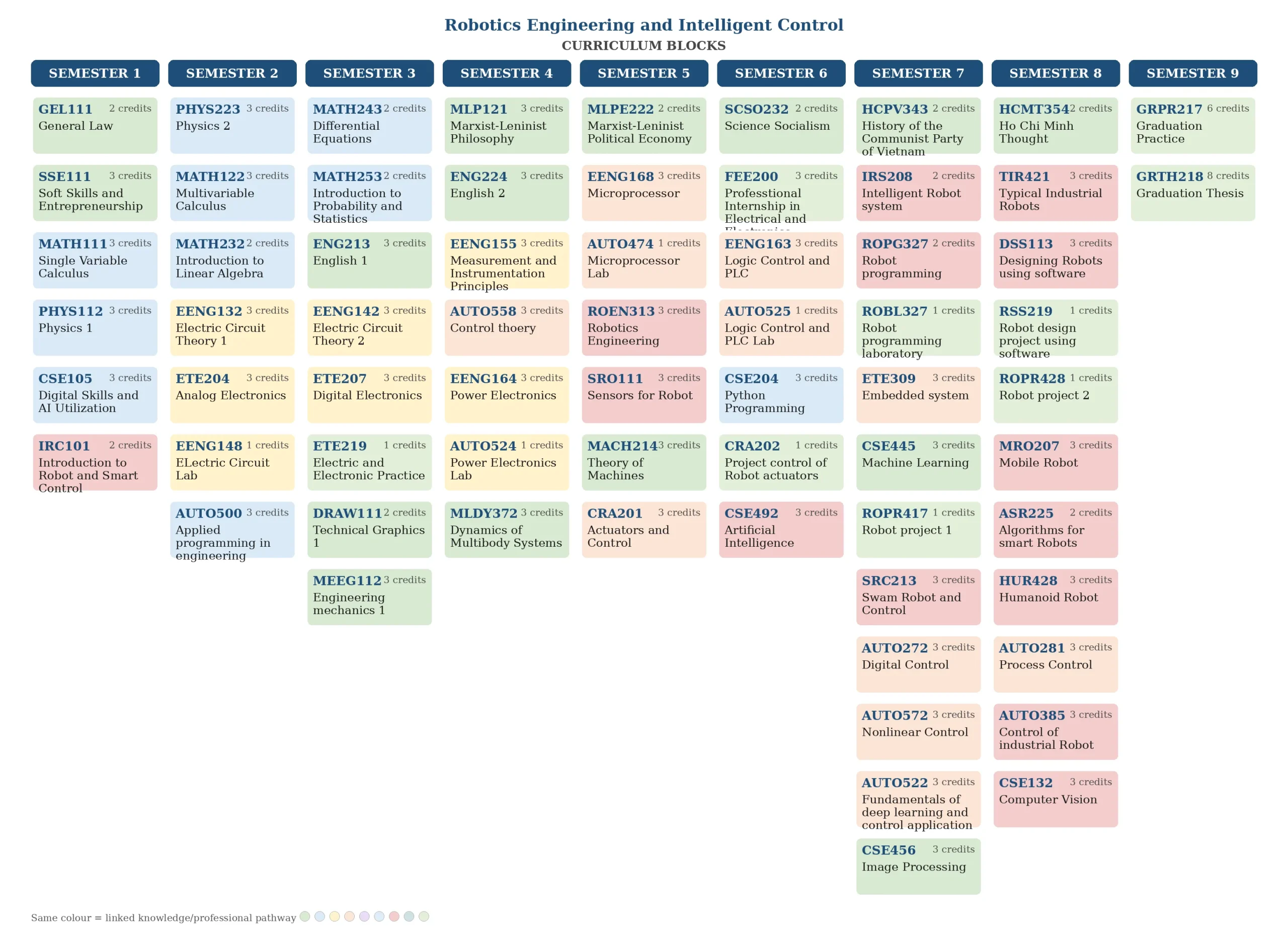
Same colours identify related curriculum pathways. Course code, title, credits and semester placement follow the supplied 2025 curriculum framework.
- 5. Semiconductor Technology and Integrated Circuit Design
- Introduction: This engineering program belongs to Electronics and Telecommunications Engineering (code 7520207) and is delivered in Vietnamese. It focuses on semiconductor materials and devices, integrated-circuit design, packaging, testing and IC applications.
- Highlights: The official proposal states a practice-oriented curriculum and two specialist directions: IC design, and semiconductor packaging/testing. The curriculum comprises 43 credits of general education and 112 credits of professional education, including 97 compulsories and 15 elective credits.
- Credits: 155 credits
- Duration: 4.5 years
- Objective: To educate engineers with specialized knowledge and practical skills in IC design, semiconductor materials and devices, packaging, testing and IC applications, particularly in electronics and telecommunications.
- Career Prospects: IC and semiconductor design, fabrication, packaging and testing; semiconductor production-line operation and quality management; electronic and optoelectronic equipment; technical consulting and maintenance; research institutions; further master’s or doctoral study.
- Professors: Assoc. Prof. Phan Van Do (Program Coordinator), Dr. Doan Huu Chuc (Program Coordinator) teaching staff assigned in the official program-opening proposal.
Curriculum blocks
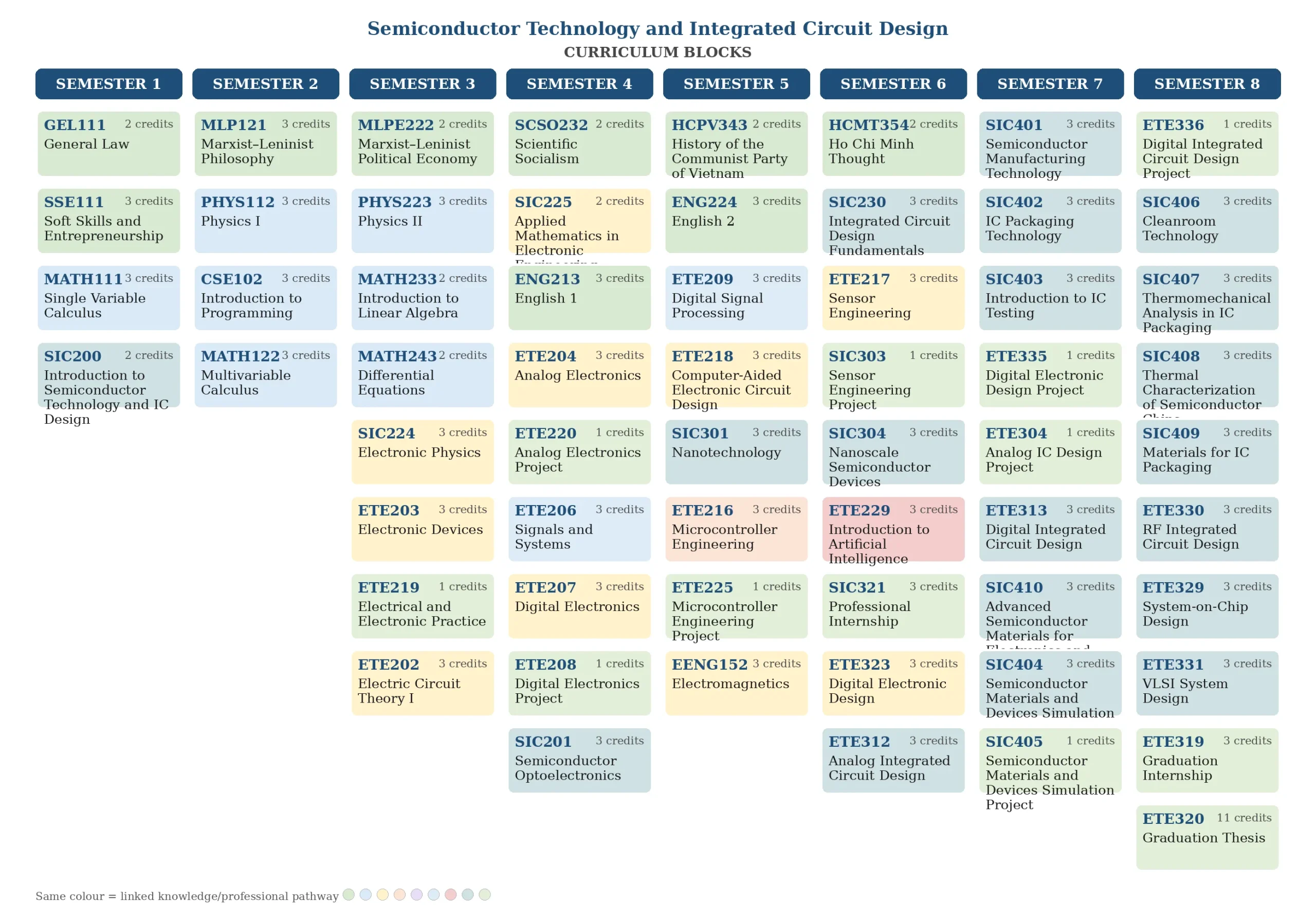
Same colours identify related curriculum pathways. Data follow the June 2025 official program-opening proposal.
Master’s Programs
- Master of Engineering in Electrical Engineering – Application-oriented
- Introduction: The program is structured over three semesters and combines advanced electrical engineering, energy, control and automation with engineering practice and a master project.
- Highlights: Two elective orientations: Power Systems and Renewable Energy; Electrical Control and Automation.
- Credits: 60 credits
- Duration: 3 semesters
- Objective: To develop advanced professional and applied-research capacity for practical electrical engineering problems.
- Career Prospects: Senior technical and management positions; consulting and project management; research, teaching and further doctoral study.
- Professors: Teaching staff assigned by Faculty of Electrical and Electronic Engineering, Thuyloi University.
Curriculum blocks by semester
| SEMESTER 1 | ||
| WUPH501 | 3 credits
Philosophy |
WUEL502 | 2 credits
English |
EE-M03 | 2 credits
Scientific Research Methodology |
| EE-ET08 | 2 credits
Energy Transition |
EE-MSEE31 | 2 credits
Modeling and Simulation in Electrical and Electronic Engineering |
EE-PQ04 | 2 credits
Power Quality |
| EE-AEM06 | 2 credits
Advanced Electric Machines |
EE-OM09 | 2 credits
Optimization Methods |
EE-PM10 | 2 credits
Project Management |
| EE-APE25 | 2 credits
Application of Power Electronics in Power System |
EE-CC32 | 2 credits
Control of Converters |
EE-PC33 | 2 credits
Process Control |
| EE-DSS34 | 2 credits
DCS and SCADA Systems |
EE-APLC35 | 2 credits
Advanced PLC |
EE-CED36 | 2 credits
Control of Electric Drivers |
| EE-SG16 | 2 credits
Smart Grids |
EE-EST37 | 2 credits
Energy Storage Technology |
|
| SEMESTER 2 | ||
| WUEL502 | 2 credits
English |
EE-SMN20 | 2 credits
Seminar |
EE-AIEE22 | 2 credits
Application of Artificial Intelligence in Electrical Engineering |
| EE-AEDC38 | 2 credits
Advanced Electric Drive Control |
EE-FSNN39 | 2 credits
Fuzzy System and Neural Network |
EE-EM11 | 2 credits
Electricity Market |
| EE-PSRA15 | 2 credits
Power System Reliability Analysis |
EE-IRES23 | 2 credits
Integration of Renewable Energy Sources in Power Systems |
EE-PSSC26 | 2 credits
Power System Stability and Control |
| EE-CPSA40 | 2 credits
Computer-Aided Power Network Analysis |
EE-APSP41 | 3 credits
Advanced Power System Protection |
EE-PSP42 | 3 credits
Power System Planning |
| EE-FHS43 | 3 credits
FACTS and HVDC Systems |
EE-PSO44 | 3 credits
Power System Optimization |
EE-ARLC45 | 3 credits
Advanced Reinforcement Learning Control |
| EE-ACEV46 | 3 credits
Advanced Control of Electric Vehicle |
EE-APC47 | 3 credits
Advanced Process Control |
EE-AESD48 | 3 credits
Advanced Embedded System Design |
| EE-ANSC49 | 3 credits
Analysis of Nonlinear System and Control |
EE-DC50 | 2 credits
Digital Control |
EE-CIR51 | 2 credits
Control of Industrial Robots |
| EE-AC52 | 2 credits
Advanced Control |
||
| SEMESTER 3 | ||
| EE-EP29 | 6 credits
Engineering Practice |
EE-GT30 | 9 credits
Master Project |
|
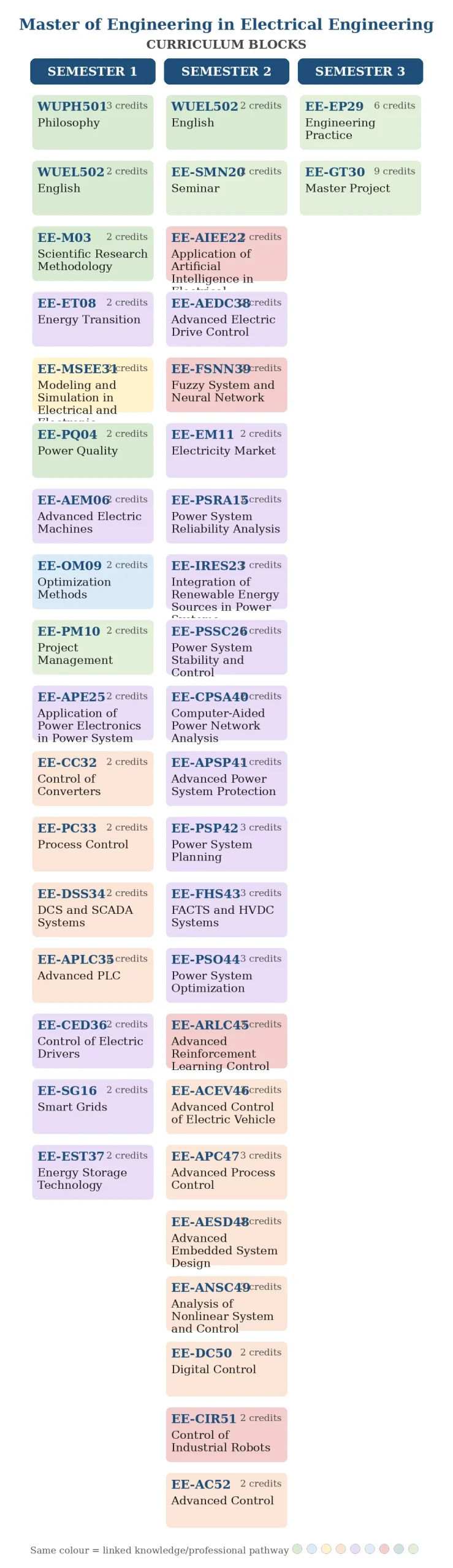
Same colours identify related curriculum pathways. Data follow the supplied 2026 application-oriented Master’s curriculum framework.
Photos
Professional and scientific research: Use approved photographs of laboratories, seminars and research projects.
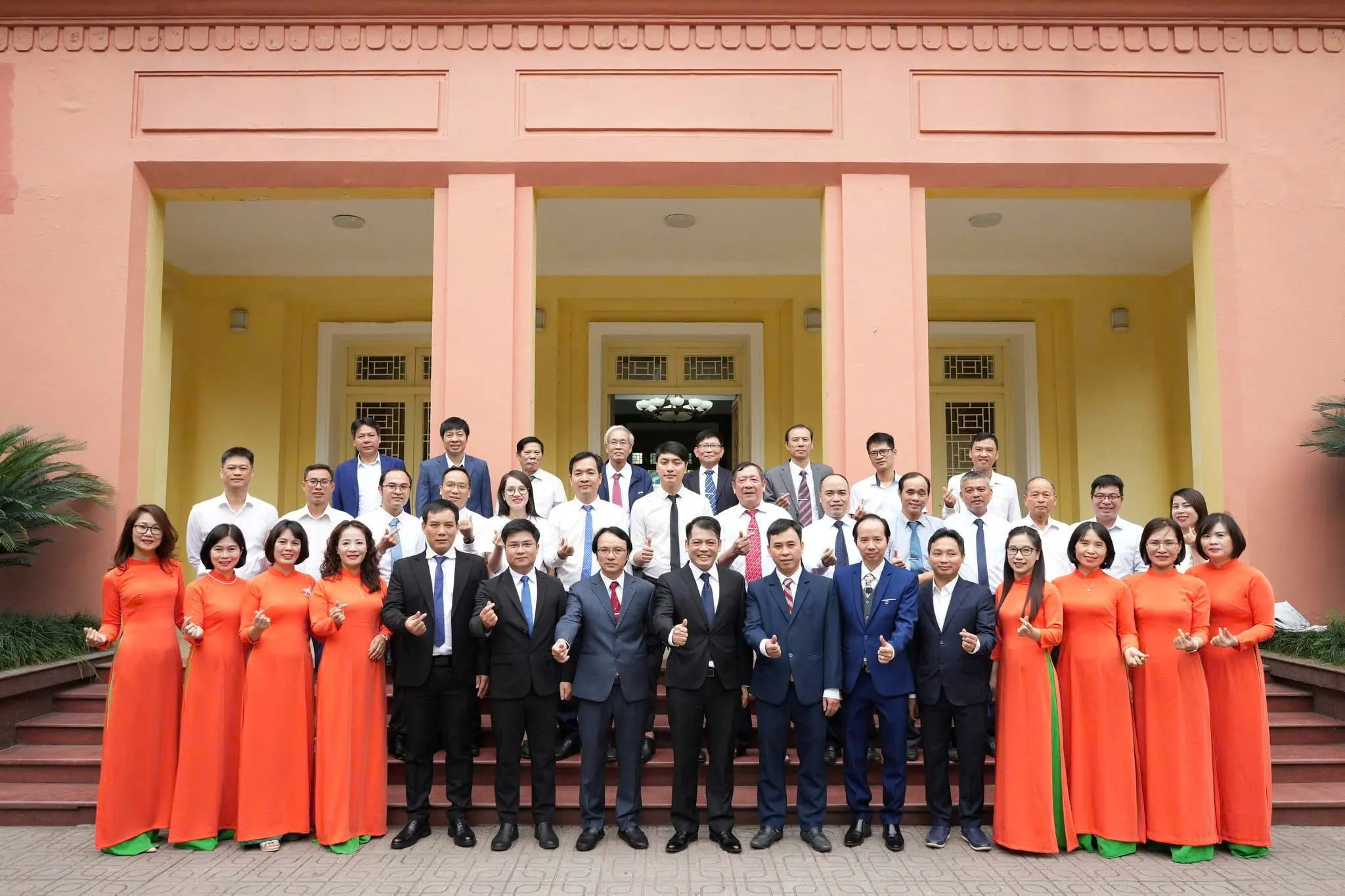
Training programs: Use approved photographs of teaching, practical classes and laboratory activities.
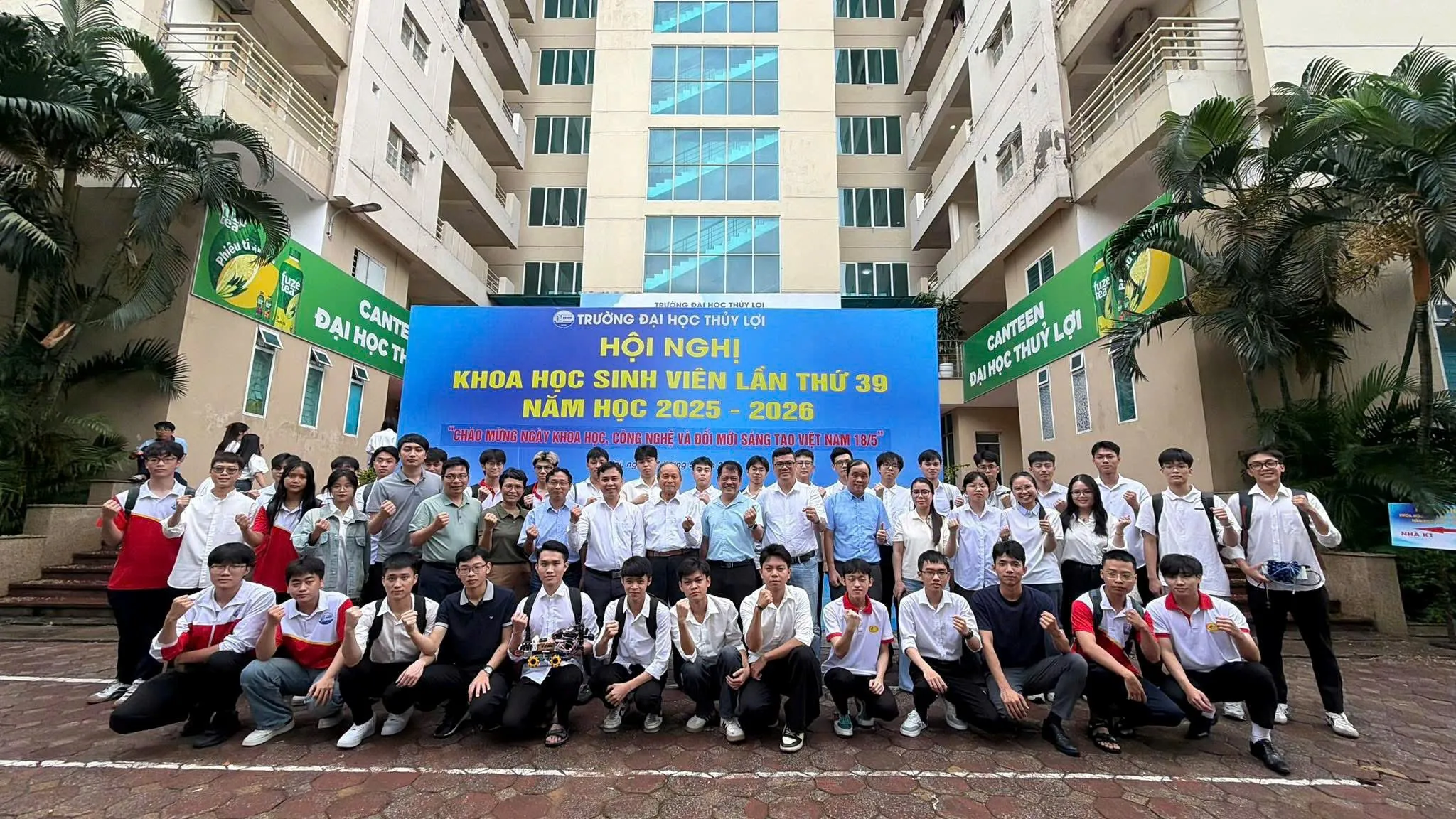
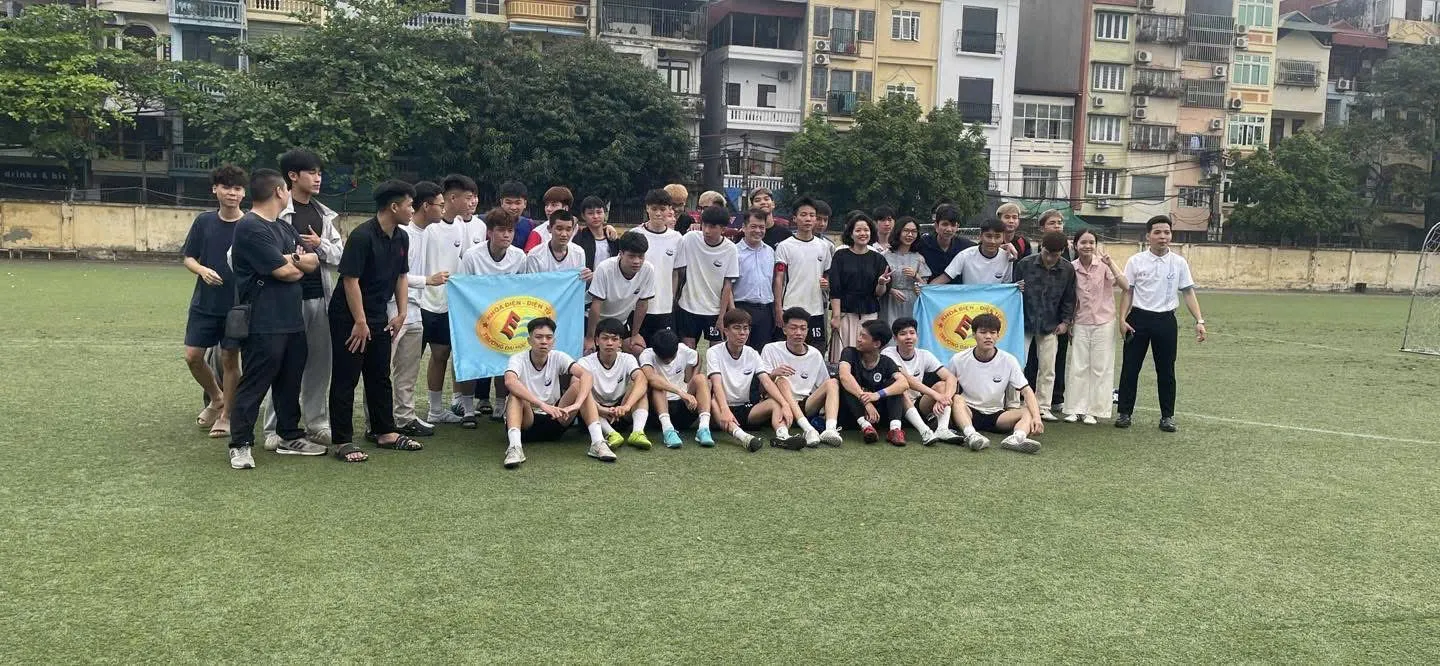
Professors, students and Faculty activities: Use approved portraits and activity photographs with publication permission.
Contact
- Faculty: Faculty of Electrical and Electronic Engineering, Thuyloi University
- Contact Address: Administrative Office Room 401- A1; Thuyloi University
- Faculty website: https://ee.tlu.edu.vn
- University website: https://www.tlu.edu.vn