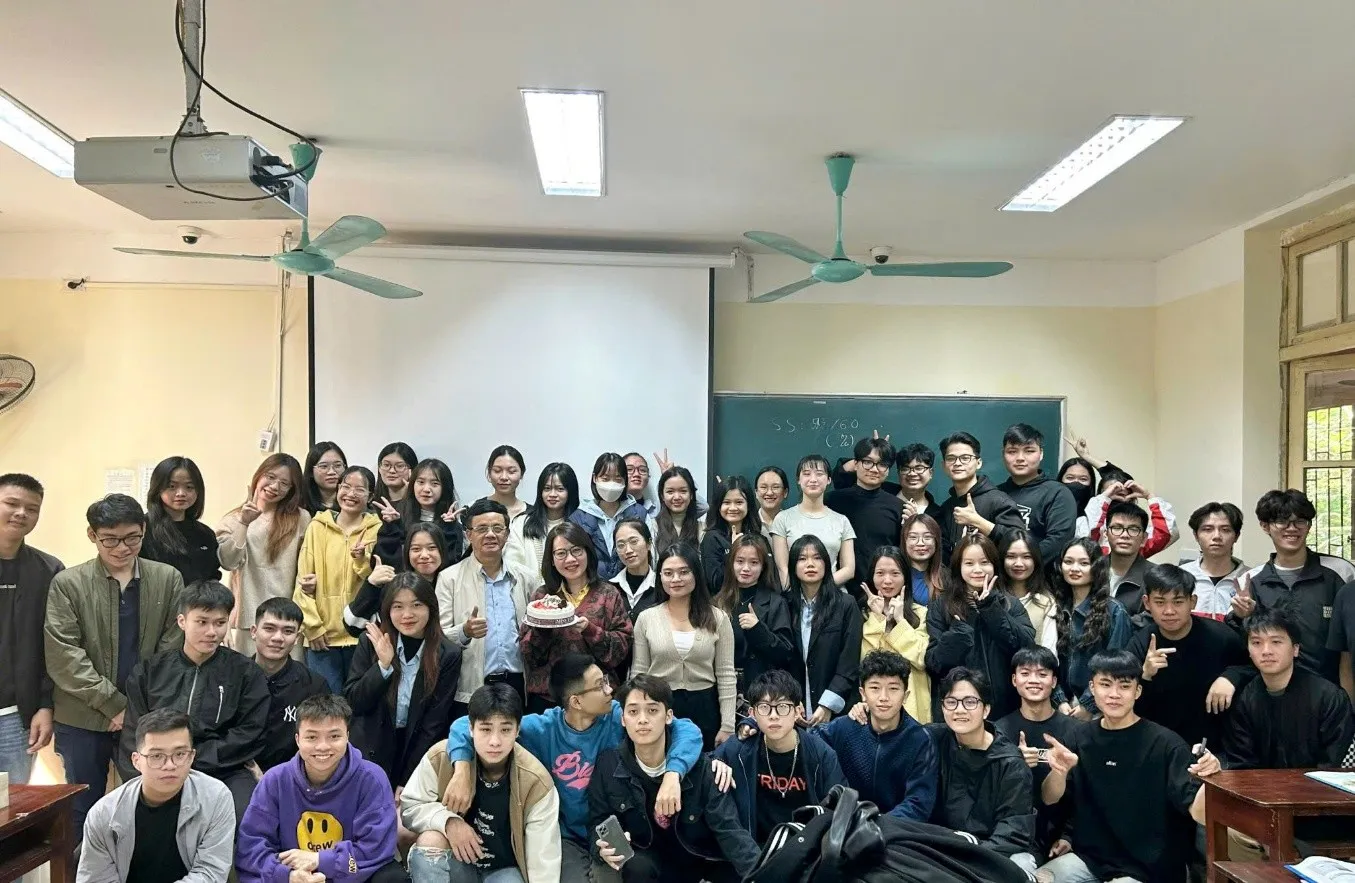
Author: Lê Quang Tuấn

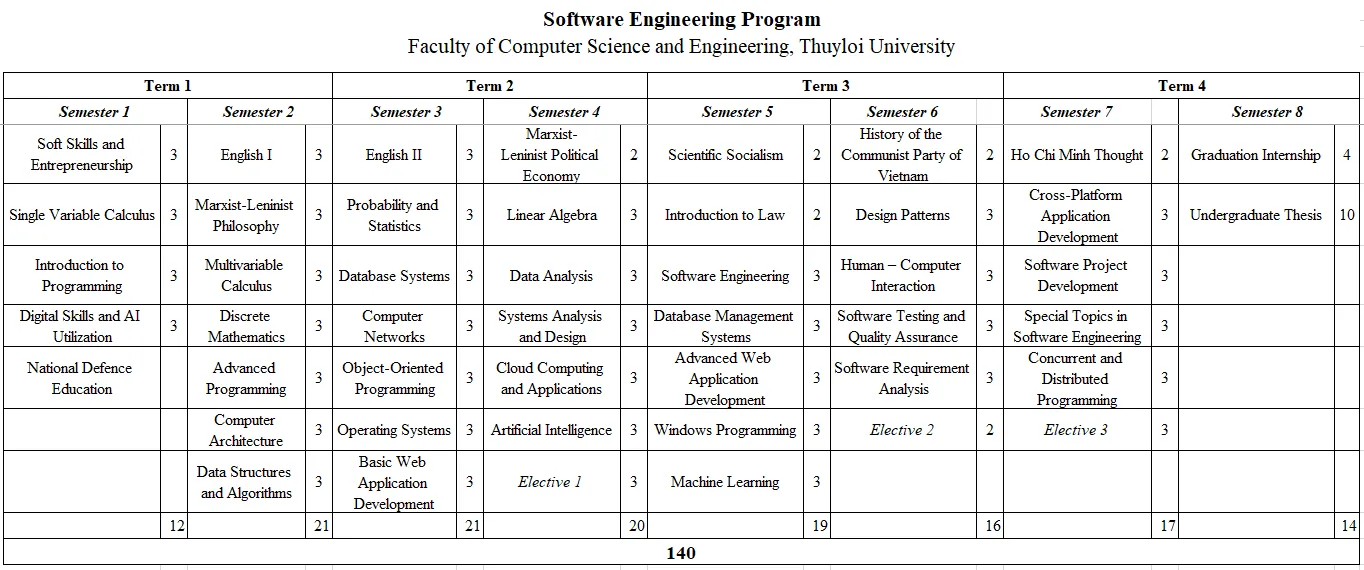
  • Software Engineering

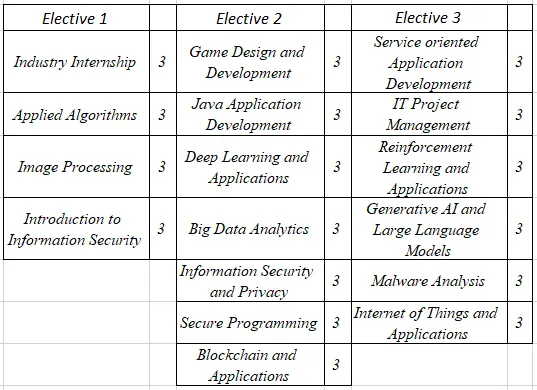
    Software Engineering

    Introduction: The Bachelor’s degree program in Software Engineering is designed to train students with sound political qualities and good ethical conduct, proficiency and skills in software development, the capacity of applying technologies to real-world applications, the physical fitness, academic – research capabilities, and social skills necessary to work effectively in interdisciplinary, multicultural, and multinational environments.

    Highlights: The Software Engineering program is continuously updated with new, cutting-edge knowledge and technologies. Students are equipped with the essential skills needed for real-world work, such as the ability to collaborate in teams on software projects and the ability to self-learn new technologies.

    Credits: 140

    Duration: 4 years

    Objective: The Bachelor’s degree program in Software Engineering is designed to train students with sound political qualities and good ethical conduct, proficiency and skills in software development, the capacity of applying technologies to real-world applications, the physical fitness, academic – research capabilities, and social skills necessary to work effectively in interdisciplinary, multicultural, and multinational environments.

    Career Prospects: After graduating from the Software Engineering program, students can work at organizations and enterprises in information technology or in IT application, particularly software development companies. Career positions include: Software Business Analyst, Software Designer, Software Development Engineer, Software Tester, Software Quality Assurance Engineer, Software Maintenance and Operations Engineer, Software Project Manager, Technology Consultant, Software Cost Estimator, IT Staff in agencies and enterprises, Lecturers, Researchers, and IT application specialists at universities and colleges nationwide.

    Professors: Associate Professor, Dr. Le Van Hung, Dr. Le Nguyen Tuan Thanh, Dr. Ly Anh Tuan, Dr. Nguyen Thi Phuong Dung, Dr. Chu Thi Minh Hue, Dr. Cu Viet Dung, Dr. Nguyen Tho Thong, MSc. Nguyen Thi Thu Huong.

    Software Engineering Software Engineering

  • Artificial Intelligence and Data Science

    Artificial Intelligence and Data Science


    General Information

    • Department: Artificial Intelligence
    • Head: Dr. Ta Quang Chieu
    • Slogan: Master Artificial Intelligence, Create Value from Data
    • Degree level: Full-time undergraduate program

    Overview

    Artificial Intelligence and Data Science prepares graduates to turn data into knowledge and develop AI systems for digital transformation. At Thuyloi University, students build strong foundations in mathematics, programming, computer science, and data while advancing to machine learning, deep learning, computer vision, natural language processing, generative AI, and big data. The program connects academic knowledge with projects, research, and industry needs, preparing graduates for careers in technology, finance, manufacturing, agriculture, water resources, the environment, and public services.

    Program Introduction

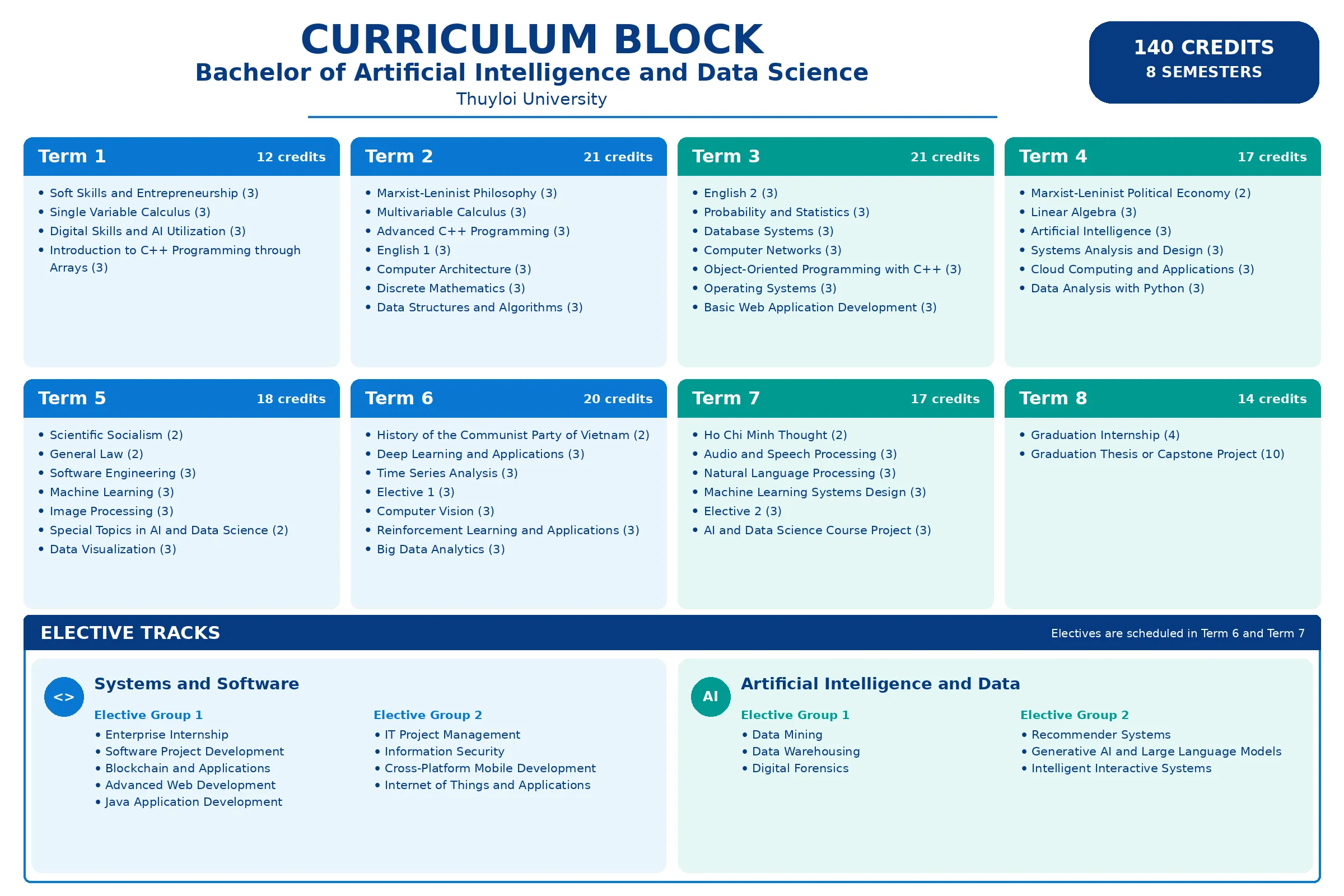
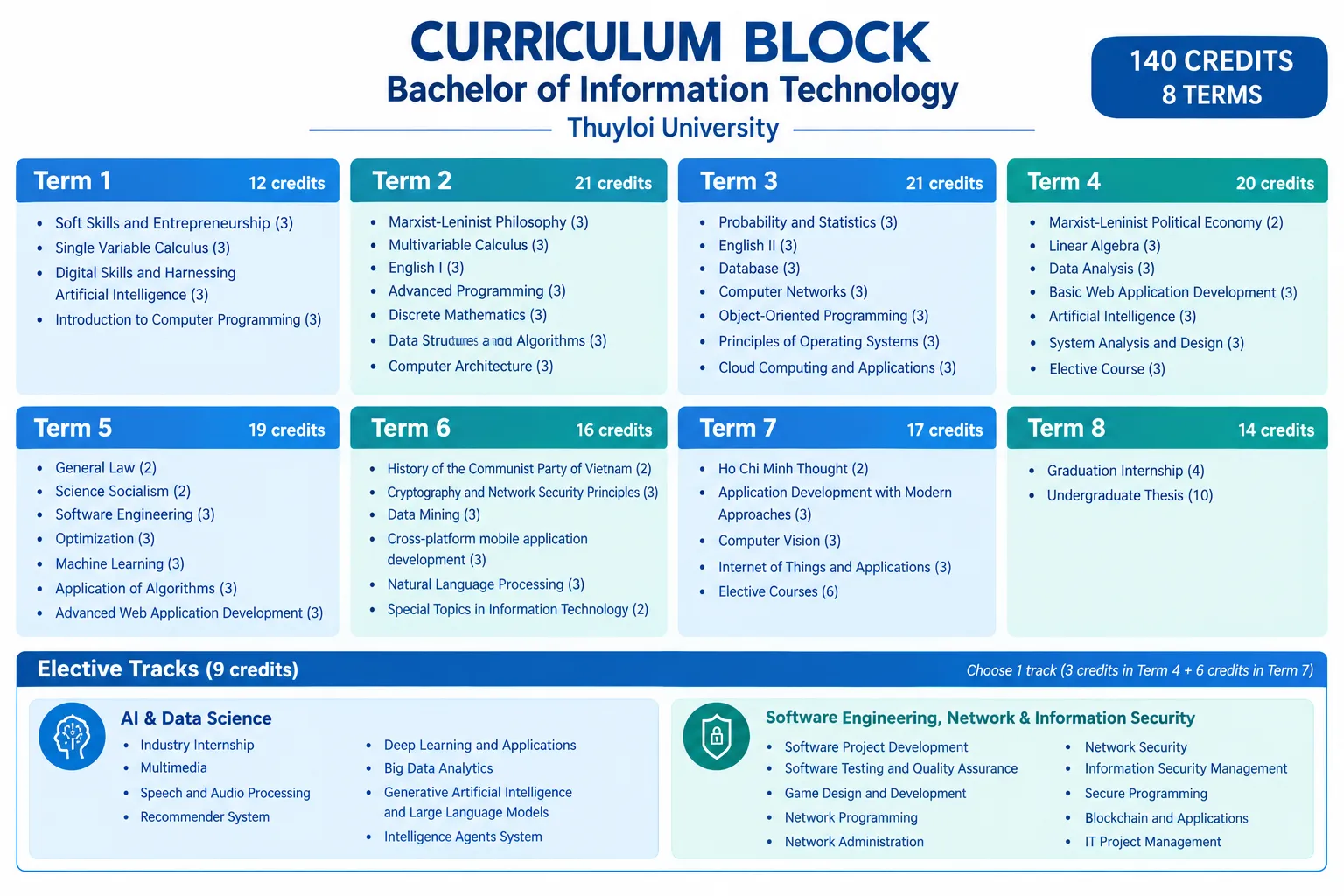
    The 140-credit curriculum follows an eight-semester pathway from core foundations to the development and deployment of AI and data solutions. Practical work, special topics, projects, and internships are combined with electives in Generative AI and Large Language Models, recommender systems, intelligent interaction, cloud computing, blockchain, and the Internet of Things.

    Highlights

    • AI and data in one pathway. Mathematics, programming, and computer science foundations support progressive learning in data analytics, machine learning, and deep learning.
    • Current technologies. The curriculum covers generative AI, Large Language Models, computer vision, natural language processing, and big data analytics.
    • Project-based learning. Special topics, course projects, internships, and graduation work develop practical problem-solving skills.
    • Interdisciplinary and responsible applications. Students learn to create safe and transparent AI solutions for diverse sectors, including agriculture, water resources, and the environment.

    Program Objectives

    • Knowledge. Apply mathematics, statistics, computer science, and data foundations to model and solve AI problems.
    • Technical capability. Collect, prepare, and visualize data; build, evaluate, and deploy machine learning, deep learning, and AI applications.
    • Professional capability. Work in teams, communicate technical results, read professional English, and present evidence for decision-making.
    • Responsible practice. Pursue lifelong learning and research while using AI and data safely, transparently, lawfully, and ethically.

    Curriculum Structure

    The program comprises 140 credits organized across a standard eight-semester plan. The pathway below summarizes the curriculum proposed for Cohort K67 from 2025; implementation follows the program formally approved by the University.

    Artificial Intelligence and Data Science

    Career Prospects

    • AI engineer. Develop machine learning, deep learning, computer vision, natural language processing, speech, and generative AI systems.
    • Data professional. Work as a data scientist, data engineer, data analyst, or big data analyst.
    • Intelligent product developer. Build recommender systems, intelligent interaction, and AI-enabled products and services.
    • Domain AI specialist. Apply AI in technology, banking, insurance, manufacturing, agriculture, water resources, the environment, and public administration.
    • Research and education. Pursue research, teaching, or postgraduate study in Vietnam or abroad.

    Academic Staff

    The Department’s academic staff have expertise in artificial intelligence, machine learning, deep learning, data science, big data, and computer vision. They contribute to teaching and research and supervise student projects and applied AI work.

    No Name Academic title and role
    1 Ta Quang Chieu PhD, Head of Department
    2 Pham Tri Cong PhD
    3 Nguyen Trinh Dong PhD
    4 Nguyen Quang Hoan Associate Professor, PhD
    5 Tran Anh Dat MSc, PhD Candidate
    6 Tran Thi Cam Giang MSc, PhD Candidate
    7 Nguyen Dac Phuong Thao MSc

    Images and Video

    • Video: https://youtu.be/WC2VO-czA4w?si=2DCGaX1xYh19Sdo4
    • Photos:

    Artificial Intelligence and Data Science Artificial Intelligence and Data Science Artificial Intelligence and Data Science Artificial Intelligence and Data Science Artificial Intelligence and Data Science Artificial Intelligence and Data Science Artificial Intelligence and Data Science

    Contact Information

    • Unit: Department of Artificial Intelligence, Faculty of Computer Science and Engineering, Thuyloi University
    • Address: Room 208, Building C1, 175 Tay Son Street, Kimlien, Hanoi, Vietnam
    • Email: [email protected]
    • Telephone: (+84) 024 35632211
    • Website: cse.tlu.edu.vn


  • Information Systems

    Information Systems

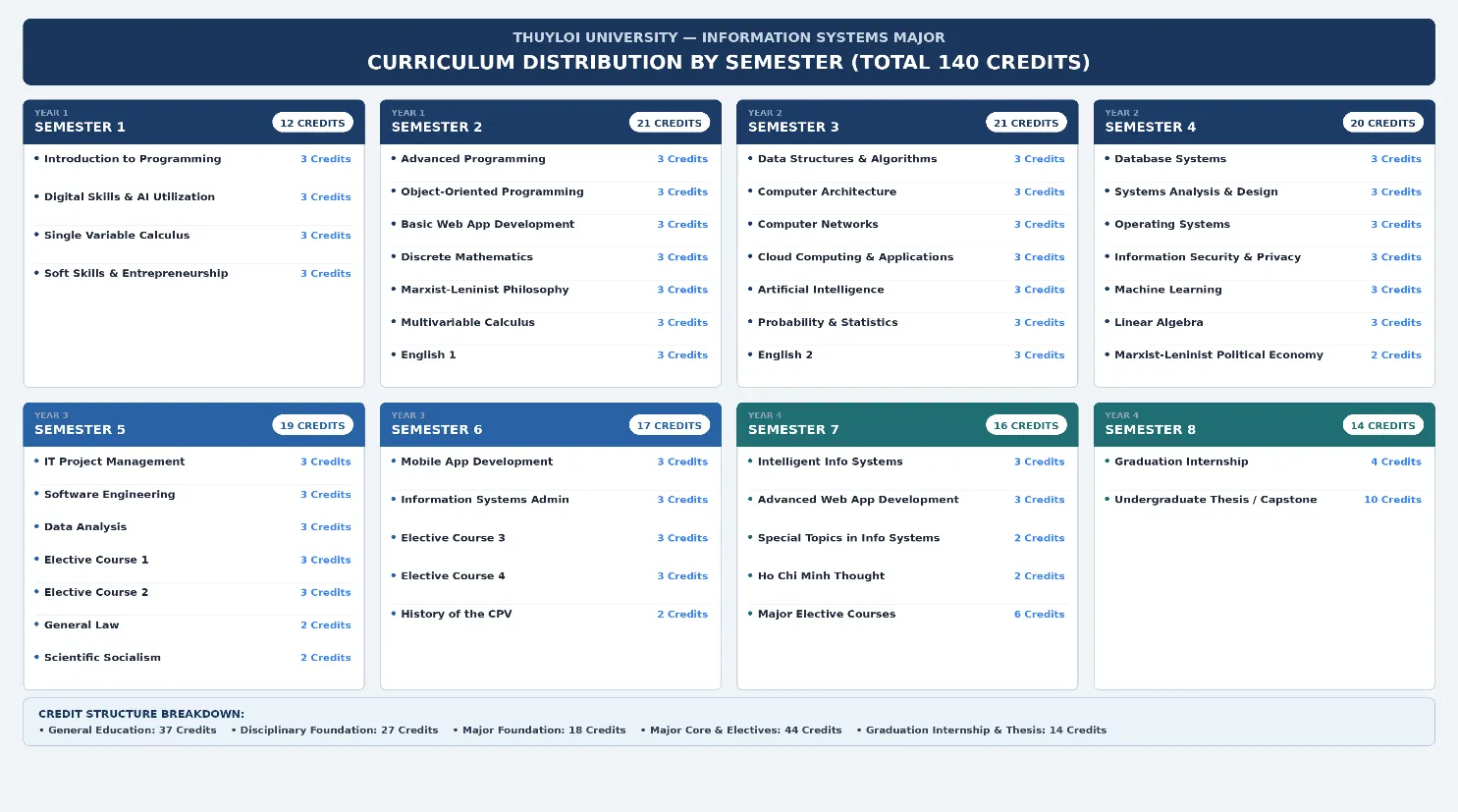
    Introduction The Bachelor’s degree program in Information Systems at Thuyloi University equips students with solid professional knowledge in information systems and essential skills required for the digital transformation process. The program comprises a total of 140 credits, harmoniously integrating general education and professional education.

    Highlights

    • Key Slogan: “Mastering Technology – Leading the Trends!”.
    • Core Skills: Information Systems Development, Data Analysis and Mining, Intelligent Systems Development, System Administration, Digital Transformation, and Project Management.
    • Advanced Technologies: The curriculum integrates cutting-edge technologies including Generative AI & Large Language Models (LLMs), Machine Learning, Deep Learning, Blockchain, Cloud Computing, Data Warehousing, Natural Language Processing, Computer Vision, and Internet of Things (IoT).

    Credits

    • Total Credits: 140 credits.
    • Credit Structure:
      • General Education: 37 credits.
      • Professional Education: 103 credits (including Disciplinary Foundation Units: 27 credits, Major Foundation Units: 18 credits, Graduation Internship & Undergraduate Thesis: 14 credits).

    Duration

    • Training Duration: 4 years (structured according to a standard 8-semester academic plan).

    Objectives

    • Qualities & Ethics: Educate graduates with proper political, ideological, and living attitudes; professional ethics, social responsibility, and awareness of personal data protection.
    • Professional Competence: Apply mathematical and computer science foundations to solve information systems problems; analyze, design, and manage feasible management information systems.
    • Skills & Self-learning Capacity: Cultivate digital transformation skills, self-learning capability, scientific research, and innovation.

    Career Prospects

    • Job Positions:
      • Information Systems Analysis and Design Specialist / Business Analyst (BA).
      • Software and Systems Solutions Developer / Programmer.
      • Data & Big Data Analyst / Data Specialist.
      • AI and Intelligent Information Systems Engineer.
      • Information Systems Administrator / System Administrator.
      • IT Project Manager.
      • IT Specialist.
      • Researcher or Academic Lecturer in the field of information systems at research institutes and higher education institutions
      • Graduates possess the competencies to found their own startups in information technology, data services, and digital transformation solutions.
    • Higher Education: Provide a solid foundation for pursuing postgraduate studies and research after graduation.
    • Professional Certifications: Easily pursue additional international technology certifications (e.g., Google Cloud, Data Science) to expand career opportunities.

    Academic Staff

    • The faculty dedicated to the Information Systems major currently includes 6 PhDs and 4 Master’s degree holders, ensuring high-quality academic and research resources.

    Information Systems Curriculum

    Information Systems

    Photos:

    Information Systems Information Systems Information Systems

  • Information Technology (IT)

    Information Technology (IT)

    Introduction: The Information Technology program at Thuy Loi University provides students with solid fundamental and specialized knowledge in the field, preparing them to meet the demands of digital transformation and current technological development. Students develop the skills to analyze, design, develop, and manage information systems and software projects,… together with effective communication, teamwork, problem-solving, and foreign language skills. The program also emphasizes professionalism, discipline, ethical responsibility, and lifelong learning, enabling graduates to adapt to technological changes and work effectively in regional and international environments. It prepares graduates for professional practice as well as further study, research, and technological development.

    Highlights:

    • The curriculum is regularly updated to reflect emerging technological trends and practical applications.
    • The program integrates theoretical knowledge, practical training, scientific research, and real-world projects.
    • Students have opportunities to undertake internships, interact with, and collaborate with industry partners.
    • The Faculty provides well-equipped classrooms, laboratories, and facilities to support teaching, learning, and research in Information Technology.
    • The program is supported by a highly qualified academic staff, including many faculty members with doctoral degrees.

    Credits: 140 credits

    Duration: 4 years (8 semesters) for the full-time undergraduate program.

    Objective: The program prepares IT engineers with a strong foundation in computing and professional competencies in programming, system analysis, problem-solving, software development, and IT applications. Students are also equipped with the ability to pursue self-directed learning, conduct research, collaborate effectively in teams, and adapt to rapid technological advancements. The program aims to develop highly qualified IT professionals who can meet the workforce needs of enterprises, government agencies, and other organizations in both domestic and international contexts.

    Career Prospects: Graduates of the Information Technology program can pursue a wide range of career opportunities, including:

    • Software Developer / Programmer
    • Software Engineer
    • Network and Systems Engineer
    • Database Administrator / Database Specialist
    • Information Systems Analyst / Developer
    • IT Specialist / IT Engineer in government agencies, organizations, and enterprises
    • Professionals in emerging technology fields, such as Artificial Intelligence, Big Data, Cloud Computing, and other digital technologies, depending on their areas of specialization.

    Curriculum by year

    Information Technology (IT)

    Photos:

    Information Technology (IT)

    Information Technology (IT)

    Video: https://www.youtube.com/watch?v=qib4cXvTQ04

    Contact:

    Information Technology: Room 309, Building C1, Thuyloi University, 175 Tay Son, Kim Lien, Hanoi

  • Chinese language

    Chinese language

    Faculty: Chinese Language

    Dean: Trần Thị Kim Loan

    Slogan:

    Overview: This program aims to train Chinese Language graduates equipped with strong linguistic knowledge, professional expertise, and high vocational competence in economics and tourism. Students will achieve practical fluency in Chinese alongside essential soft skills and intercultural competence to thrive in a multicultural environment and adapt to the 4.0 era. Graduates are prepared to work independently and responsibly across various positions requiring Chinese proficiency in domestic and international organizations.

    Training Programs:

    • Undergraduate Programs:
      • Major 1: Chinese for Economics
        • Introduction: In addition to 52 credits of core subjects (including practical Chinese language skills courses) and 11 credits of core units (Chinese linguistics, China country profile, intercultural communication), students also study an additional 20 credits of specialized knowledge with courses such as Chinese for Economics, Economic interpretation and translation…
        • Credits: 140
        • Duration: 4 years
        • Objective:
        • Career Prospects: Office Secretary/ External Relations Assistant/ Sales/Office Staff/ Project Coordinator; Import-export staff; Interpreter…
      • Major 2: Chinese for Tourism
        • Introduction: In addition to 52 credits of core subjects (including practical Chinese language skills courses) and 11 credits of core units (Chinese linguistics, China country profile, intercultural communication), students also study an additional 20 credits of specialized knowledge with courses such as Chinese for tourism, tourism guiding profession, Tourism marketing…
        • Credits: 140
        • Duration: 4 years
        • Objective:
        • Career Prospects: Tourism industry staff; Translators/Interpreters

    Photos:

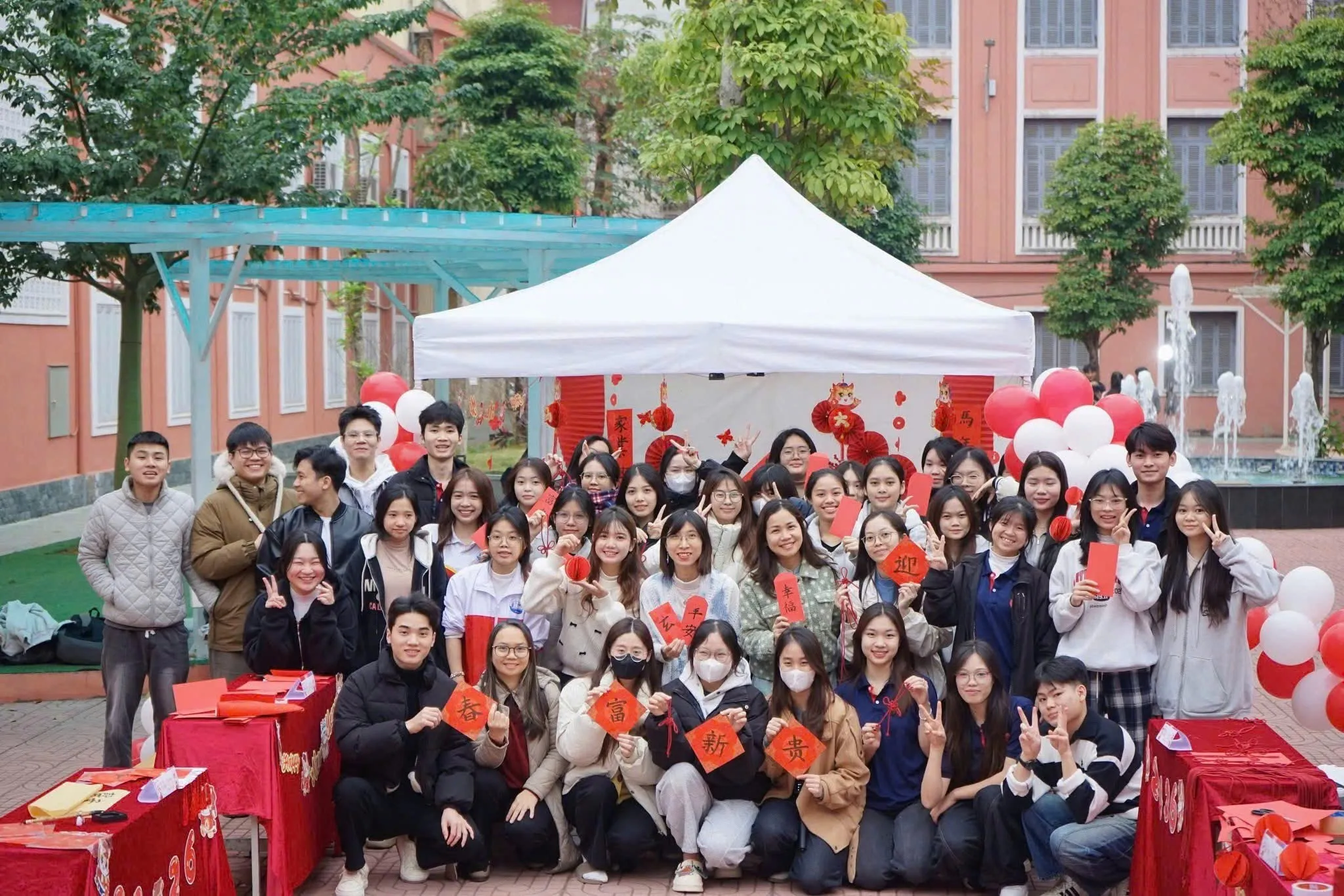
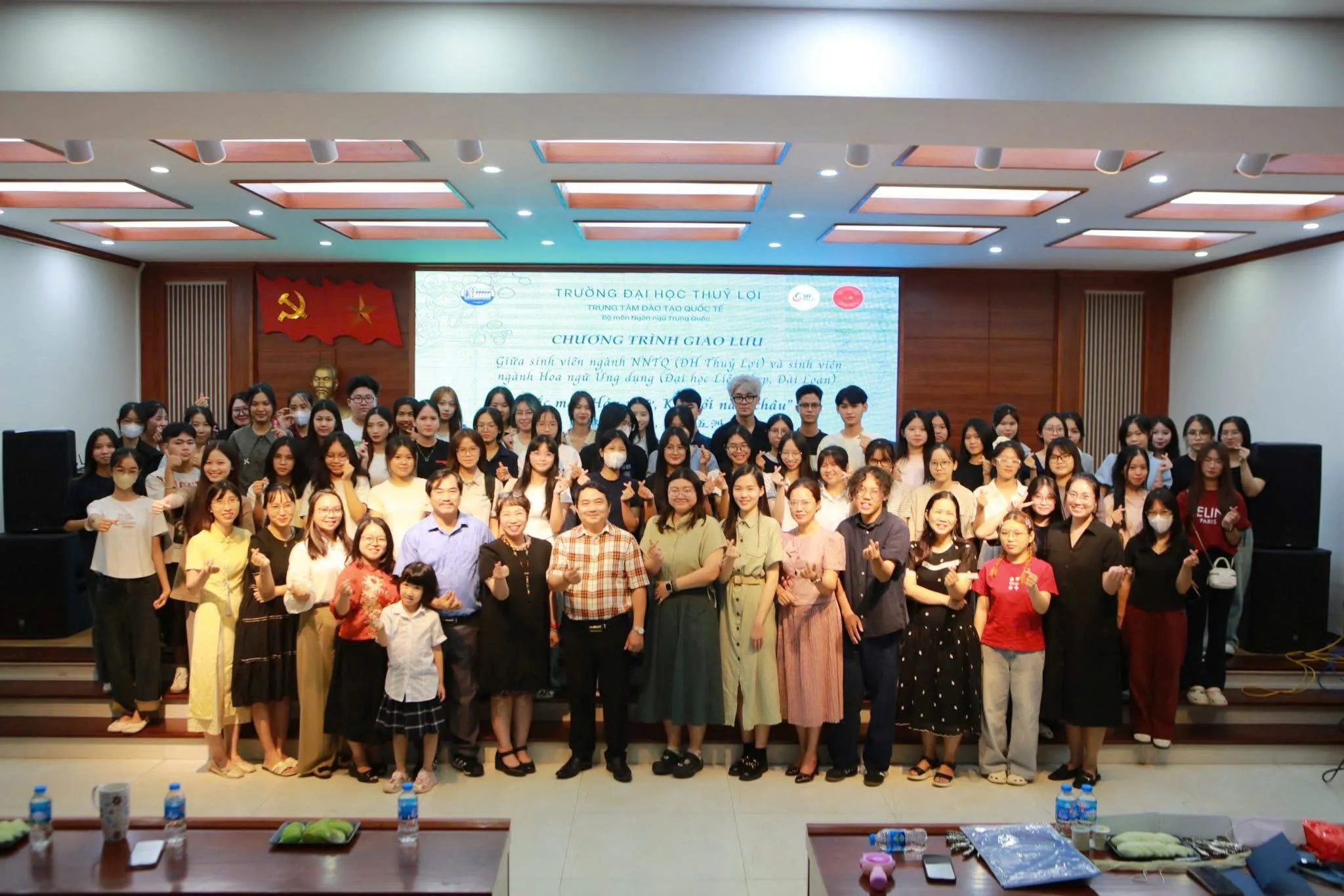
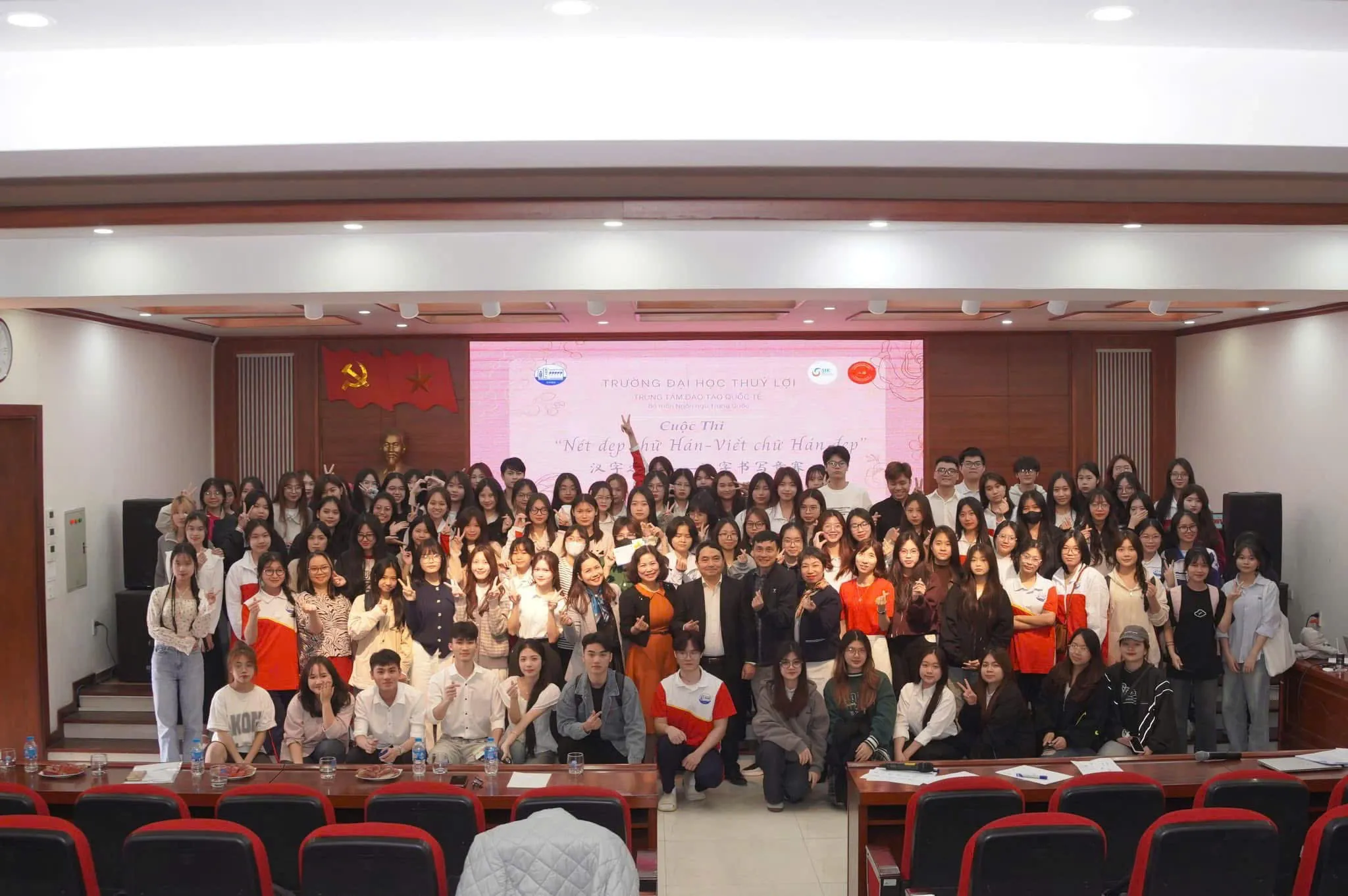
    Chinese language Chinese language Chinese language Chinese language

    Contact:

    https://sie.tlu.edu.vn/en/

  • English Language and Linguistics

    English Language and Linguistics

    Faculty of English Language and Linguistics

    Dean: Assoc. Prof. Dr. Nguyen Mai Dang

    About the faculty: We train students to use English with confidence and to work in a global environment. Our programs combine strong language skills, practical experience, and career-focused knowledge.

    Undergraduate Programs

    Major 1: Teaching methods

    • Introduction: This major prepares future English teachers. Students learn how to plan lessons, manage classes, and use modern teaching methods.
    • Highlights:
      • Practical training in real classrooms
      • Modern teaching techniques and technology
      • Skills for teaching all age groups
    • Credits: 140
    • Duration: 3.5 years of study + 0.5 year of internship and thesis
    • Objective: Graduates will have strong English skills, good teaching methods, and the ability to keep learning and improving.
    • Career prospects: Graduates can work in primary, secondary, and high schools, and in local and international education centers. They can also work in international schools, skills-training centers, and global education organizations.

    Major 2: Management Studies

    • Introduction: This major combines English with business and management knowledge. Students learn to work and communicate well in international workplaces.
    • Highlights:
      • English used in real business situations
      • Teamwork, leadership, and communication skills
      • Internships in companies and organizations
    • Credits: 140
    • Duration: 3.5 years of study + 0.5 year of internship and thesis
    • Objective: Graduates will use English effectively in management and be ready for multicultural, international workplaces.
    • Career prospects: Graduates can work in the media, radio, and television, and in local or foreign companies. They can also join education groups, domestic and international projects, travel companies, hotel groups, and resorts.

    Major 3: Translation & Interpretation

    • Introduction: This major trains students to translate written texts and interpret spoken language between English and Vietnamese, accurately and professionally.
    • Highlights:
      • Practice in translation and interpreting (consecutive and simultaneous)
      • Wide knowledge of culture, society, and specialized topics
      • Real translation projects and practice sessions
    • Credits: 140
    • Duration: 3.5 years of study + 0.5 year of internship and thesis
    • Objective: Graduates will translate and interpret with high accuracy and understand different cultures well.
    • Career prospects: Graduates can work in diplomatic agencies and embassies, in local and foreign companies, and in international corporations. They can also work in the press and media, publishing houses, and television, or teach English in schools of all levels and language centers.

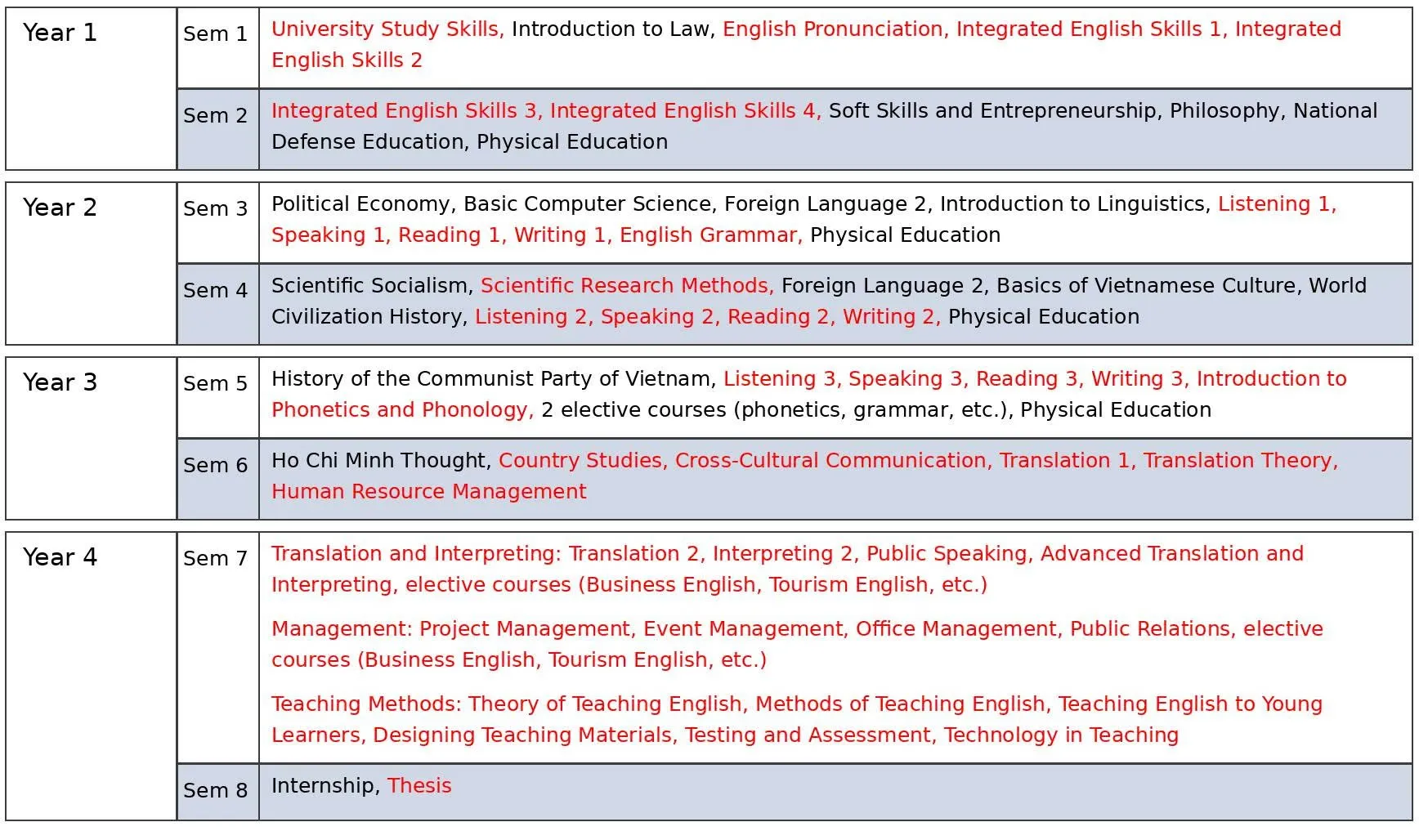
    Sample Syllabus by Semester

    English Language and Linguistics

    Photos

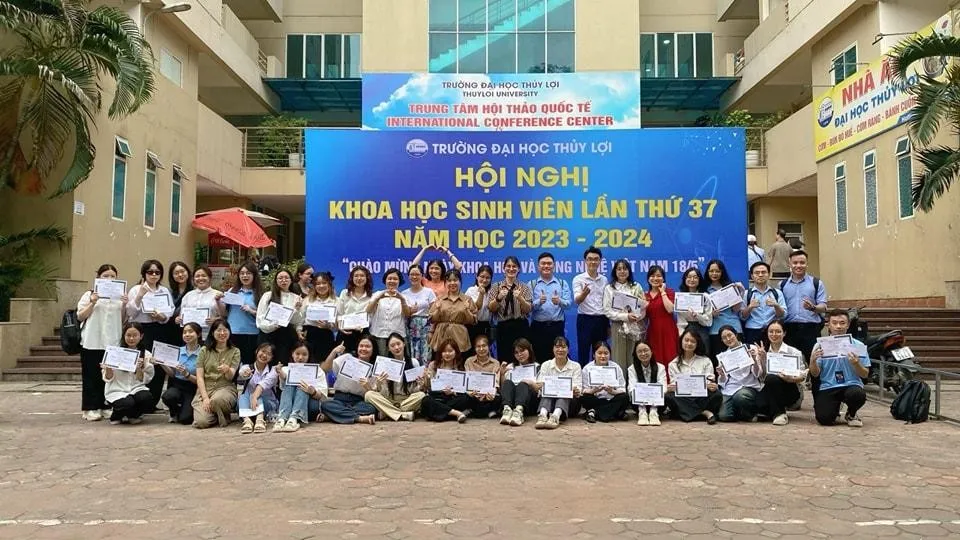
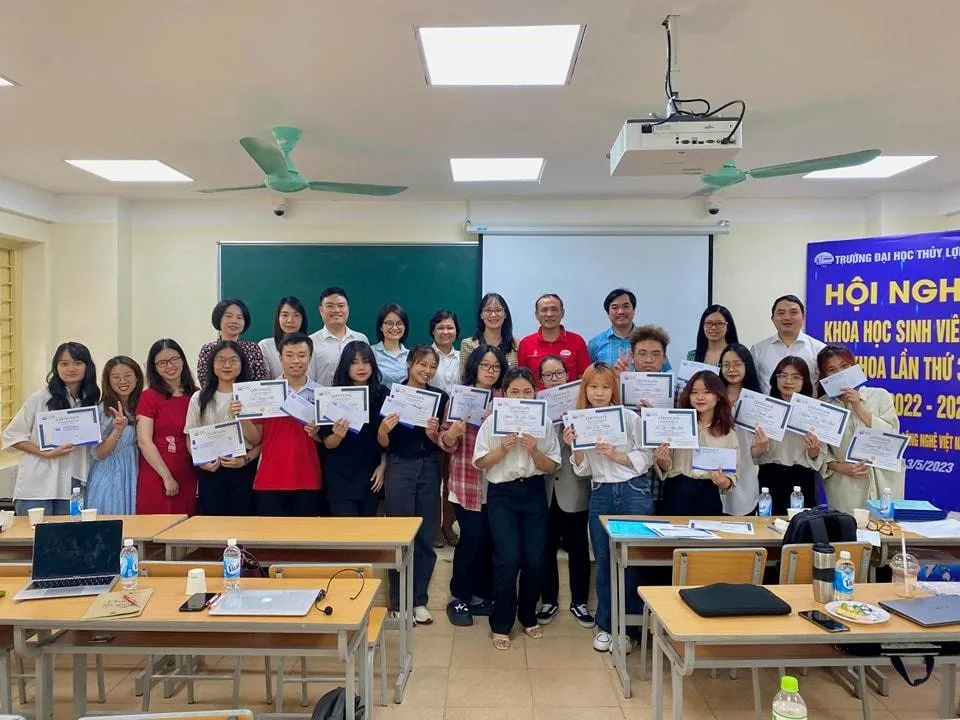
    Conferences, seminars, student research projects

    English Language and Linguistics English Language and Linguistics

    Training Programs, classrooms, practice sessions, internships

    English Language and Linguistics English Language and Linguistics

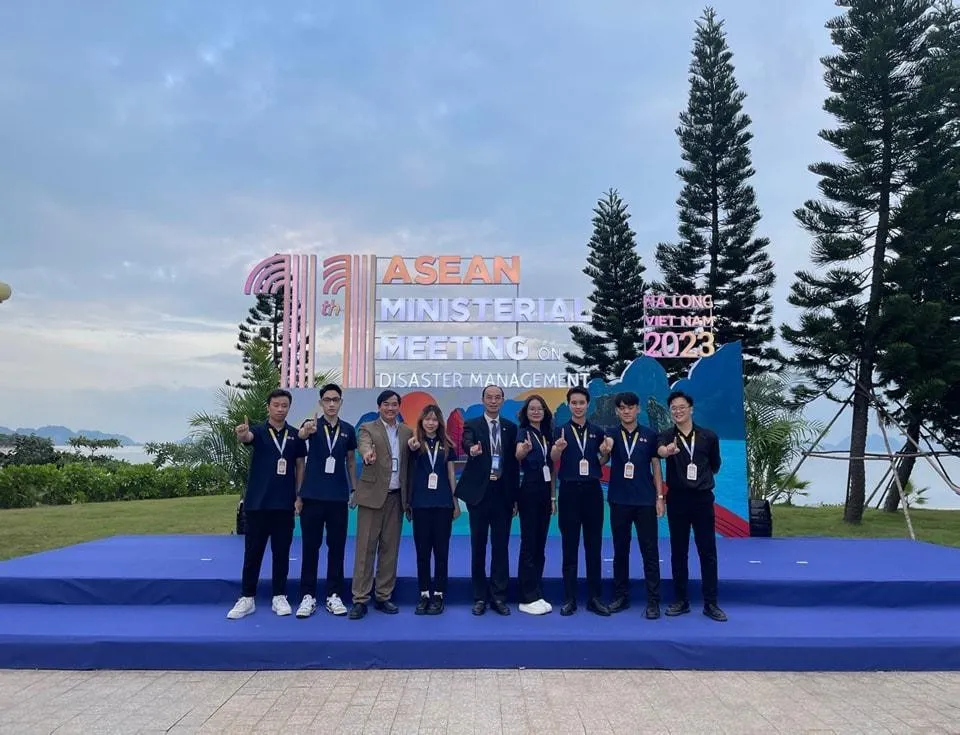
    Lecturers / students / faculty activities

    English Language and Linguistics English Language and Linguistics

    Contact

    • English Language and Linguistics, Thuy Loi University
    • Address: 175 Tay Son, Kim Lien, Hanoi
    • Website: https://tlu.edu.vn/

  • Electrical and Electronic Engineering

    Electrical and Electronic Engineering

    Undergraduate Programs


    1. Electrical Engineering
    • Introduction: The program provides education in electrical engineering, electric power systems, renewable energy, and industrial and residential electrical engineering.
    • Highlights: The curriculum combines electrical engineering foundations with three specialist orientations: Electric Power Systems, Renewable Energy Engineering, and Industrial and Residential Electrical Engineering.
    • Credits: 155
    • Duration: 4.5 years (9 semesters)
    • Objective: To equip learners with foundational and professional knowledge and practical skills for analyzing, designing, operating and managing electrical and energy systems.
    • Career Prospects: Electrical utilities; power plants and substations; electrical design and consultancy firms; renewable-energy companies; industrial and building electrical systems.
    • Professors: Assoc. Prof. Nguyen Minh Y (Head of Department), Assoc. Prof. Pham Van Hoa and teaching staff of the Department of Electrical and Electronic Engineering

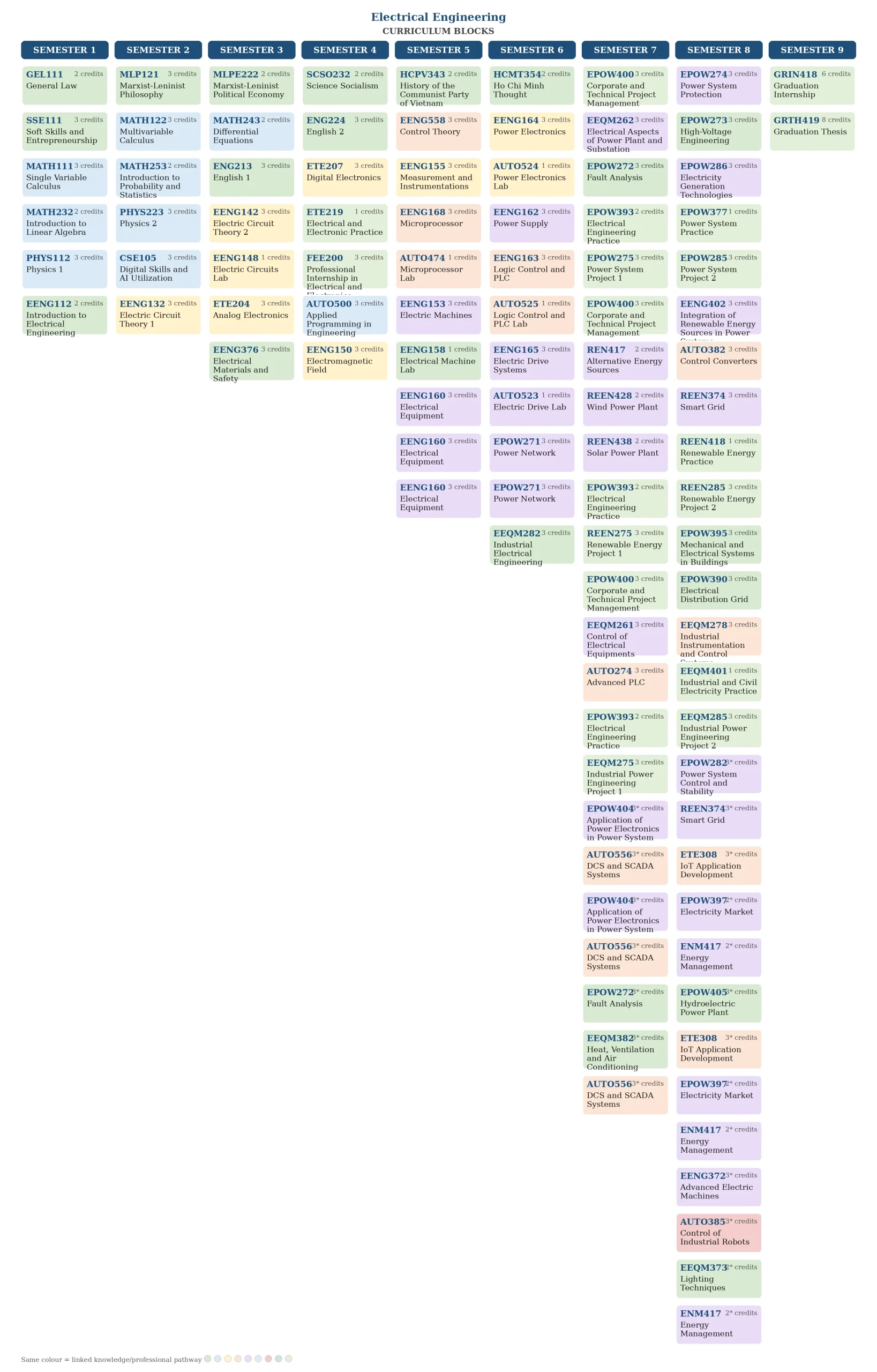
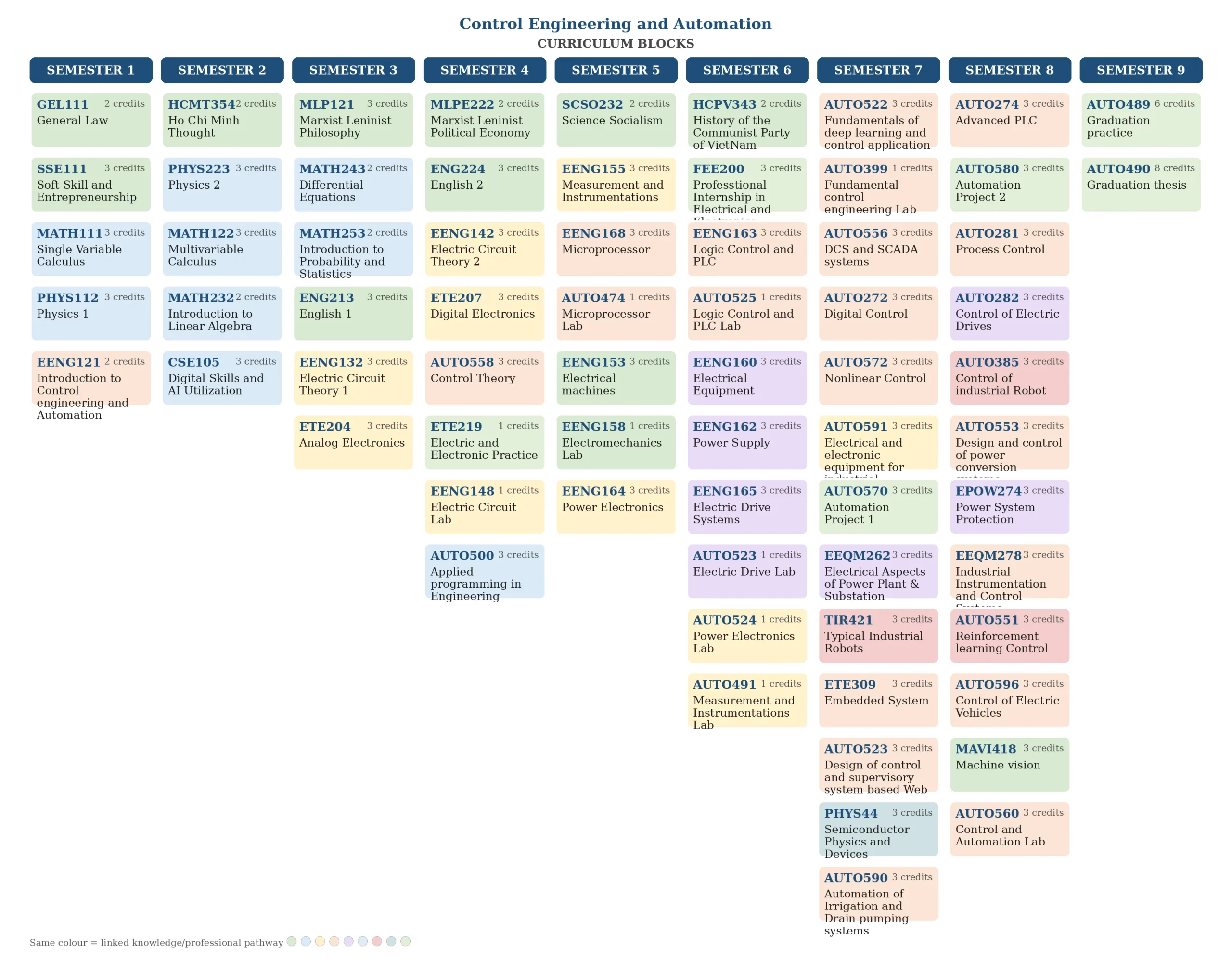
    Curriculum blocks

    Same colours identify related curriculum pathways. Course code, title, credits and semester placement follow the supplied 2025 curriculum framework.

    • 2. Control Engineering and Automation
    • Introduction: The program develops knowledge and practical skills in control, automation, industrial systems, embedded systems and the Internet of Things.
    • Highlights: The curriculum includes control theory, PLC/SCADA, process control, electric drives, power electronics and embedded/IoT applications.
    • Credits: 155
    • Duration: 4.5 years (9 semesters)
    • Objective: To prepare engineers to analyze, design, integrate, operate and maintain automatic control and industrial automation systems.
    • Career Prospects: Manufacturing plants; automation system integrators; industrial control and instrumentation companies; water supply and drainage facilities; embedded and IoT companies.
    • Professors: Prof. Than Ngoc Hoan, Assoc. Prof. Pham Duc Dai (Head of Department) and teaching staff of the Department of Control Engineering and Automation.

    Curriculum blocks

    Same colours identify related curriculum pathways. Course code, title, credits and semester placement follow the supplied 2025 curriculum framework.

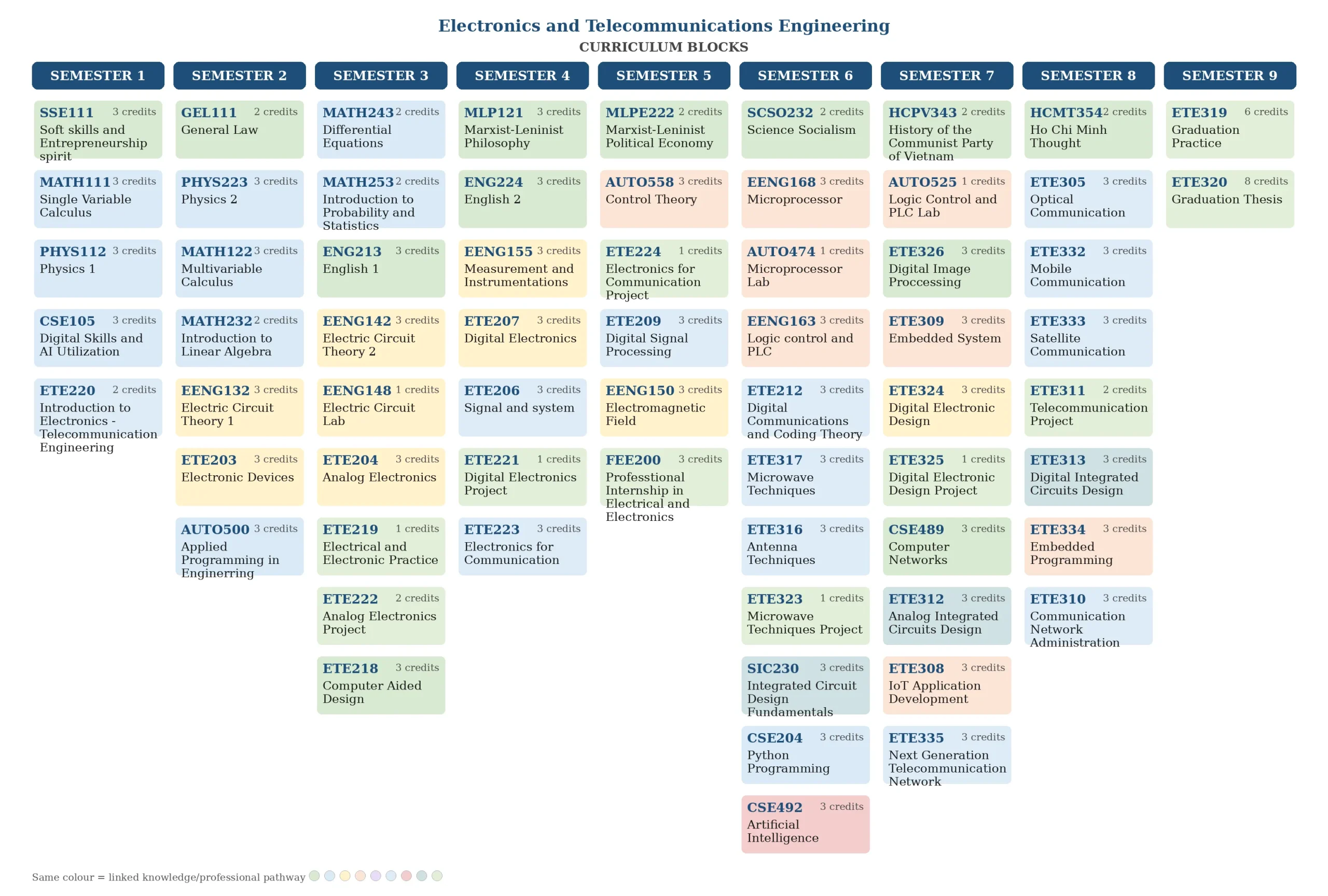
    • 3. Electronics and Telecommunications Engineering
    • Introduction: The program provides foundations and professional knowledge in electronics, telecommunications, antennas, microwave engineering, signal processing and embedded systems.
    • Highlights: Students undertake laboratory and project work in electronic circuits, communication systems, antennas, microwave engineering and embedded applications.
    • Credits: 155
    • Duration: 4.5 years (9 semesters)
    • Objective: To prepare engineers capable of analyzing, designing, deploying and operating electronic, telecommunications and embedded systems.
    • Career Prospects: Telecommunications operators; electronic equipment companies; embedded-system and IoT companies; communication, antenna and remote-monitoring technology organizations.
    • Professors: Dr. Tran Van Hoi (Head of Department), Prof. Bach Gia Duong, Assoc. Prof. Trinh Anh Vu and teaching staff of the Department of Electronics and Telecommunications.

    Curriculum blocks

    Same colours identify related curriculum pathways. Course code, title, credits and semester placement follow the supplied 2025 curriculum framework.

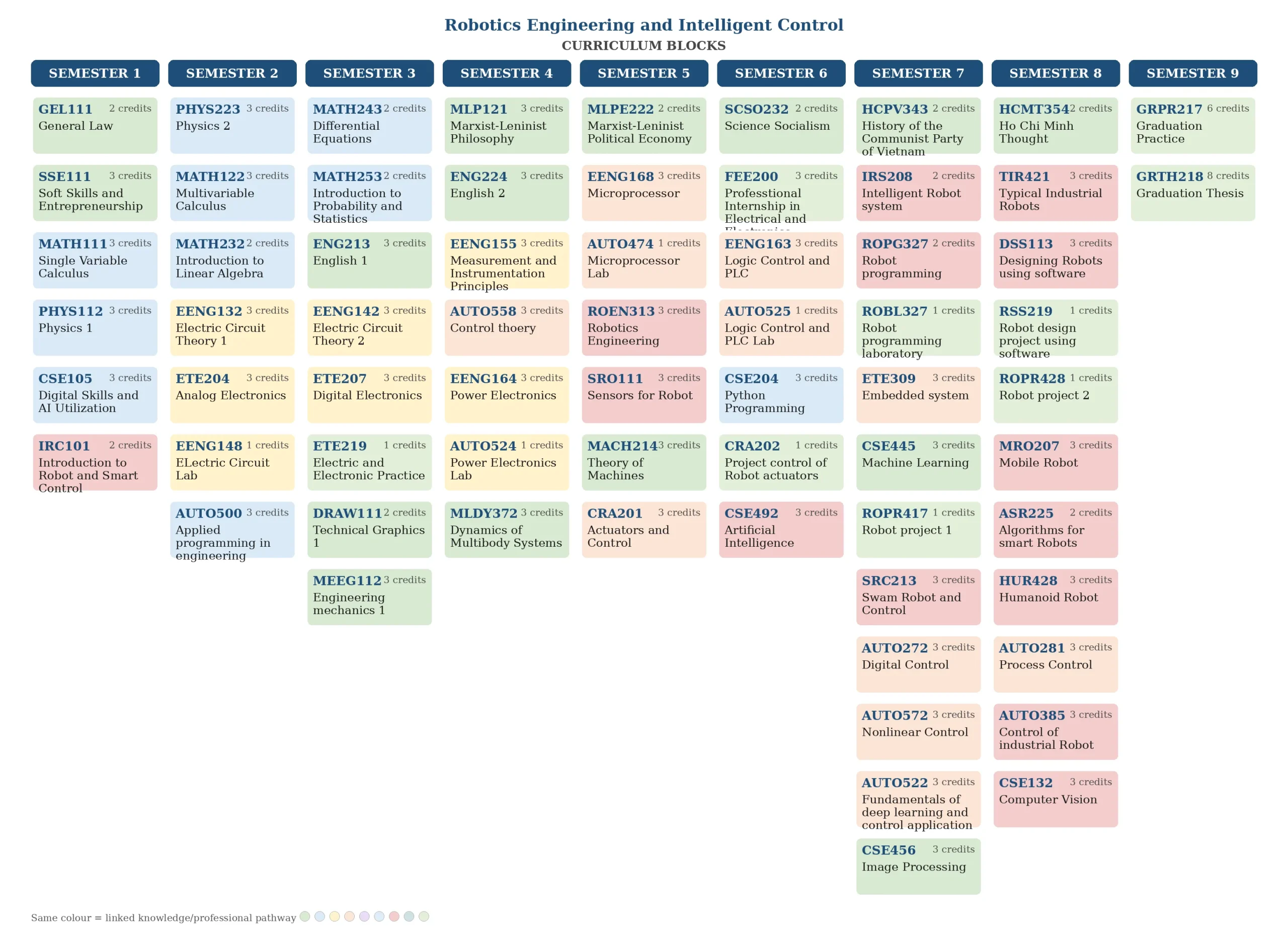
    • 4. Robotics Engineering and Intelligent Control
    • Introduction: The program integrates robotics, automatic control, artificial intelligence, computer vision and intelligent systems.
    • Highlights: The curriculum emphasizes robot design and programming, intelligent control, computer vision, AI and practical projects.
    • Credits: 155
    • Duration: 4.5 years (9 semesters)
    • Objective: To prepare engineers to design, integrate, program and operate robots and intelligent control systems.
    • Career Prospects: Robotics and automation companies; AI and computer-vision companies; smart manufacturing; autonomous systems; technology start-ups.
    • Professors: Dr. Le Trung Dung (Head of Department), Assoc. Prof. Nguyen Tien Ban and teaching staff of the Department of Robotics Engineering and Intelligent Systems.

    Curriculum blocks

    Same colours identify related curriculum pathways. Course code, title, credits and semester placement follow the supplied 2025 curriculum framework.

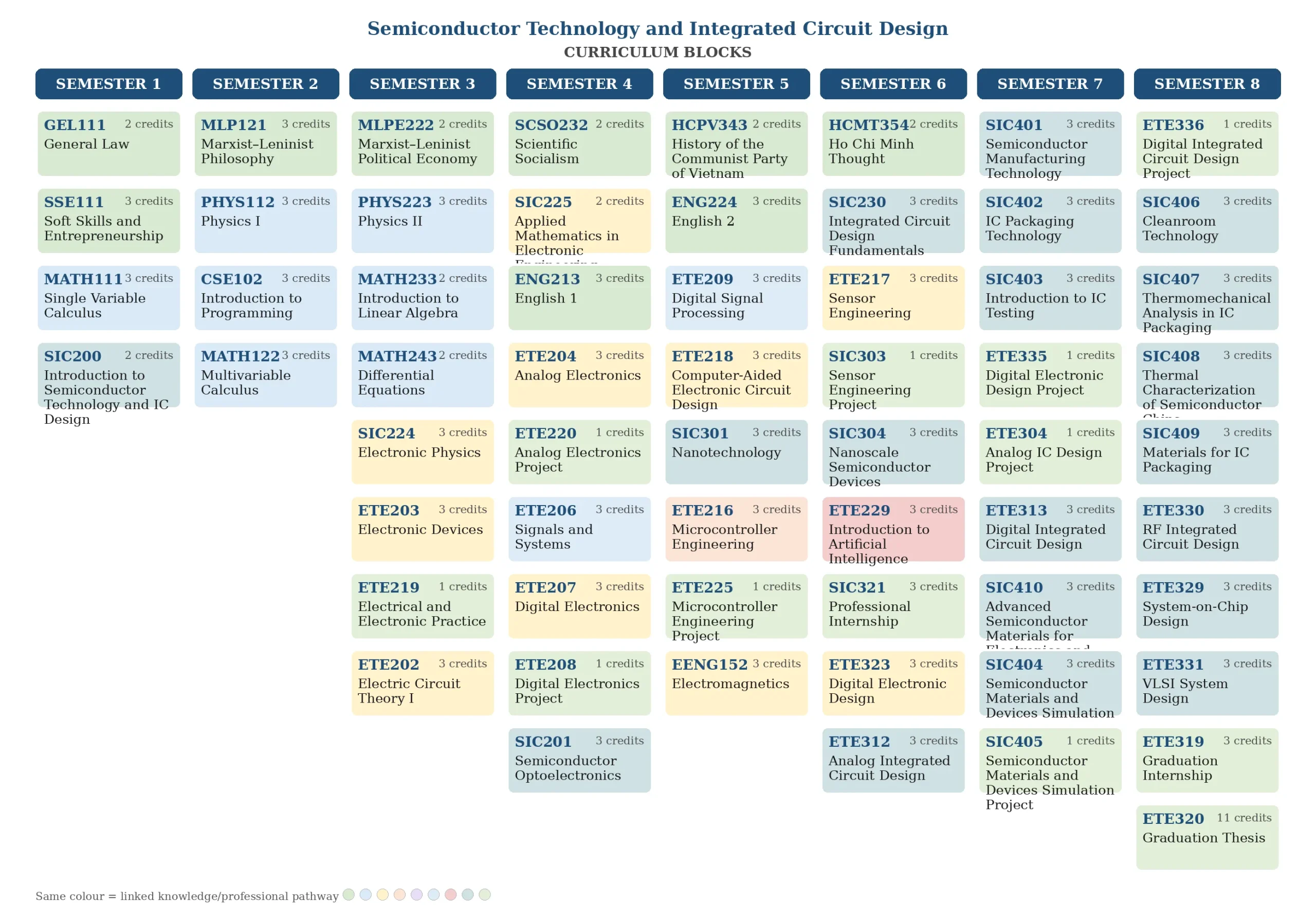
    • 5. Semiconductor Technology and Integrated Circuit Design
    • Introduction: This engineering program belongs to Electronics and Telecommunications Engineering (code 7520207) and is delivered in Vietnamese. It focuses on semiconductor materials and devices, integrated-circuit design, packaging, testing and IC applications.
    • Highlights: The official proposal states a practice-oriented curriculum and two specialist directions: IC design, and semiconductor packaging/testing. The curriculum comprises 43 credits of general education and 112 credits of professional education, including 97 compulsories and 15 elective credits.
    • Credits: 155 credits
    • Duration: 4.5 years
    • Objective: To educate engineers with specialized knowledge and practical skills in IC design, semiconductor materials and devices, packaging, testing and IC applications, particularly in electronics and telecommunications.
    • Career Prospects: IC and semiconductor design, fabrication, packaging and testing; semiconductor production-line operation and quality management; electronic and optoelectronic equipment; technical consulting and maintenance; research institutions; further master’s or doctoral study.
    • Professors: Assoc. Prof. Phan Van Do (Program Coordinator), Dr. Doan Huu Chuc (Program Coordinator) teaching staff assigned in the official program-opening proposal.

    Curriculum blocks

    Same colours identify related curriculum pathways. Data follow the June 2025 official program-opening proposal.

    Master’s Programs

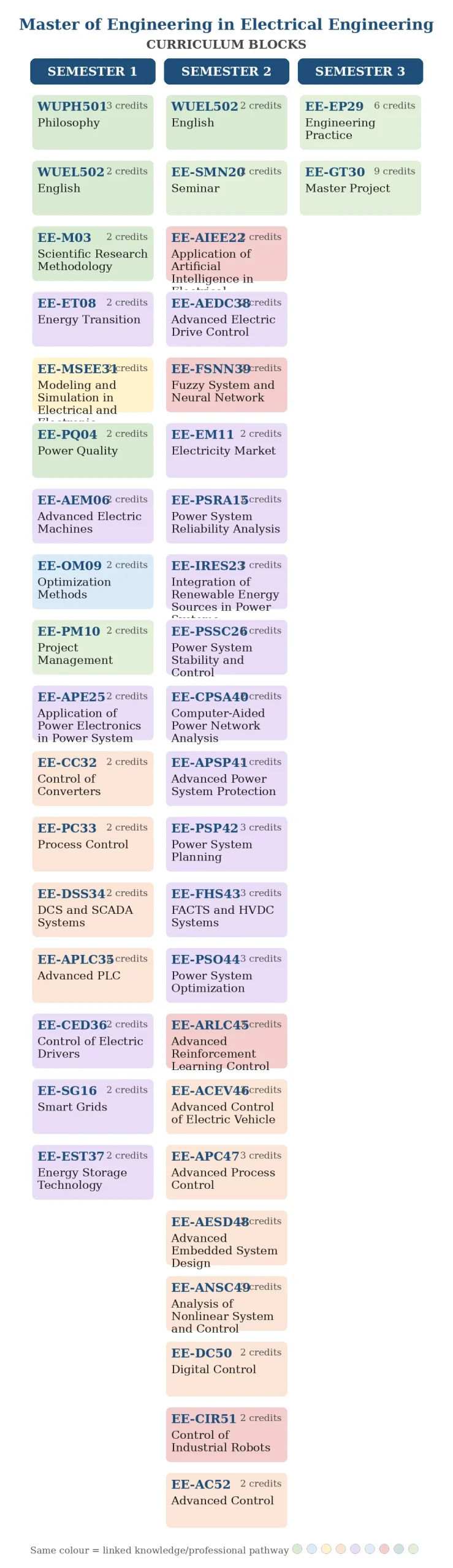
    • Master of Engineering in Electrical Engineering – Application-oriented
    • Introduction: The program is structured over three semesters and combines advanced electrical engineering, energy, control and automation with engineering practice and a master project.
    • Highlights: Two elective orientations: Power Systems and Renewable Energy; Electrical Control and Automation.
    • Credits: 60 credits
    • Duration: 3 semesters
    • Objective: To develop advanced professional and applied-research capacity for practical electrical engineering problems.
    • Career Prospects: Senior technical and management positions; consulting and project management; research, teaching and further doctoral study.
    • Professors: Teaching staff assigned by Faculty of Electrical and Electronic Engineering, Thuyloi University.

    Curriculum blocks by semester

    SEMESTER 1
    WUPH501  |  3 credits

    Philosophy

    WUEL502  |  2 credits

    English

    EE-M03  |  2 credits

    Scientific Research Methodology

    EE-ET08  |  2 credits

    Energy Transition

    EE-MSEE31  |  2 credits

    Modeling and Simulation in Electrical and Electronic Engineering

    EE-PQ04  |  2 credits

    Power Quality

    EE-AEM06  |  2 credits

    Advanced Electric Machines

    EE-OM09  |  2 credits

    Optimization Methods

    EE-PM10  |  2 credits

    Project Management

    EE-APE25  |  2 credits

    Application of Power Electronics in Power System

    EE-CC32  |  2 credits

    Control of Converters

    EE-PC33  |  2 credits

    Process Control

    EE-DSS34  |  2 credits

    DCS and SCADA Systems

    EE-APLC35  |  2 credits

    Advanced PLC

    EE-CED36  |  2 credits

    Control of Electric Drivers

    EE-SG16  |  2 credits

    Smart Grids

    EE-EST37  |  2 credits

    Energy Storage Technology

    SEMESTER 2
    WUEL502  |  2 credits

    English

    EE-SMN20  |  2 credits

    Seminar

    EE-AIEE22  |  2 credits

    Application of Artificial Intelligence in Electrical Engineering

    EE-AEDC38  |  2 credits

    Advanced Electric Drive Control

    EE-FSNN39  |  2 credits

    Fuzzy System and Neural Network

    EE-EM11  |  2 credits

    Electricity Market

    EE-PSRA15  |  2 credits

    Power System Reliability Analysis

    EE-IRES23  |  2 credits

    Integration of Renewable Energy Sources in Power Systems

    EE-PSSC26  |  2 credits

    Power System Stability and Control

    EE-CPSA40  |  2 credits

    Computer-Aided Power Network Analysis

    EE-APSP41  |  3 credits

    Advanced Power System Protection

    EE-PSP42  |  3 credits

    Power System Planning

    EE-FHS43  |  3 credits

    FACTS and HVDC Systems

    EE-PSO44  |  3 credits

    Power System Optimization

    EE-ARLC45  |  3 credits

    Advanced Reinforcement Learning Control

    EE-ACEV46  |  3 credits

    Advanced Control of Electric Vehicle

    EE-APC47  |  3 credits

    Advanced Process Control

    EE-AESD48  |  3 credits

    Advanced Embedded System Design

    EE-ANSC49  |  3 credits

    Analysis of Nonlinear System and Control

    EE-DC50  |  2 credits

    Digital Control

    EE-CIR51  |  2 credits

    Control of Industrial Robots

    EE-AC52  |  2 credits

    Advanced Control

    SEMESTER 3
    EE-EP29  |  6 credits

    Engineering Practice

    EE-GT30  |  9 credits

    Master Project

    Same colours identify related curriculum pathways. Data follow the supplied 2026 application-oriented Master’s curriculum framework.

    Photos

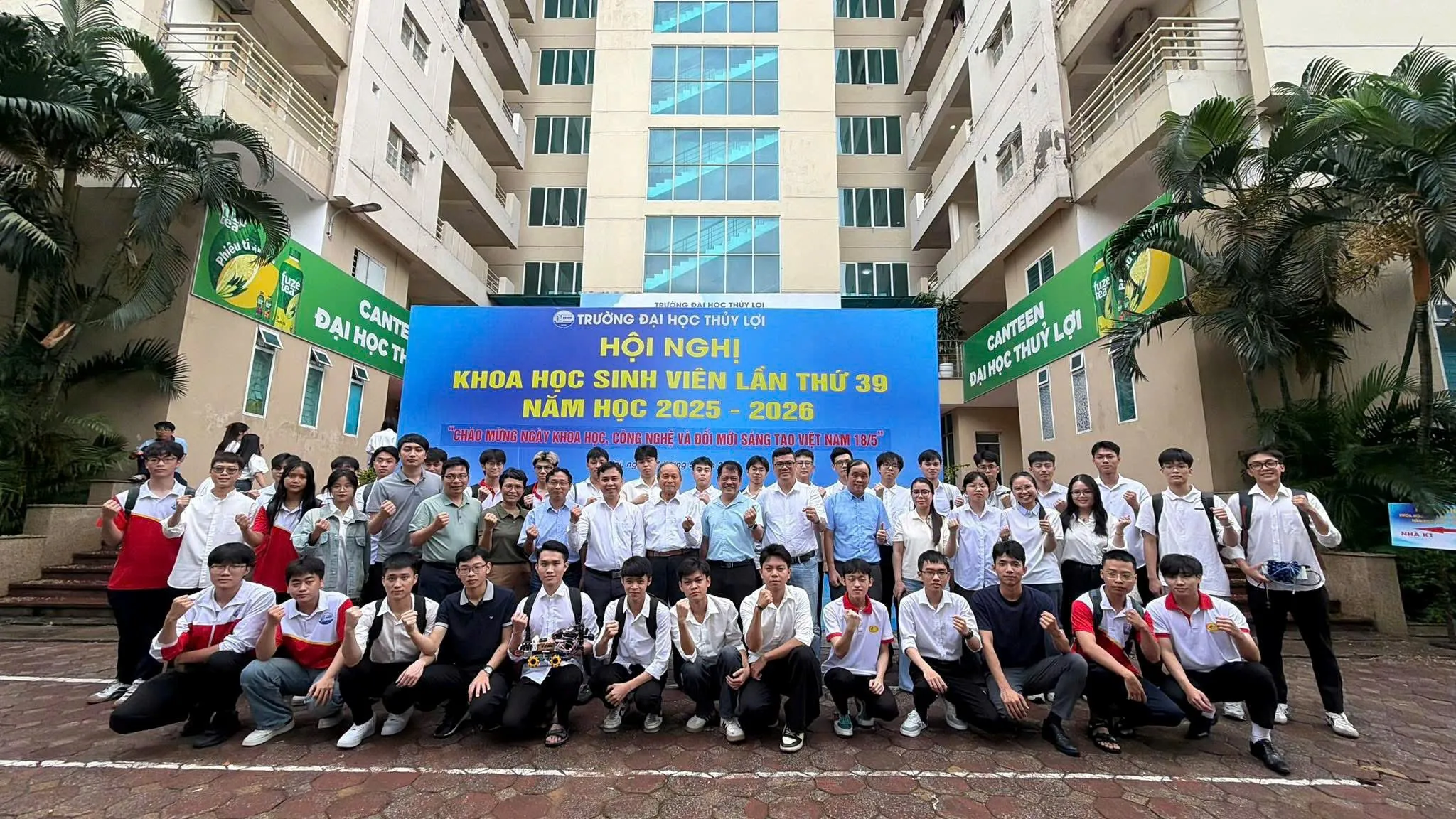
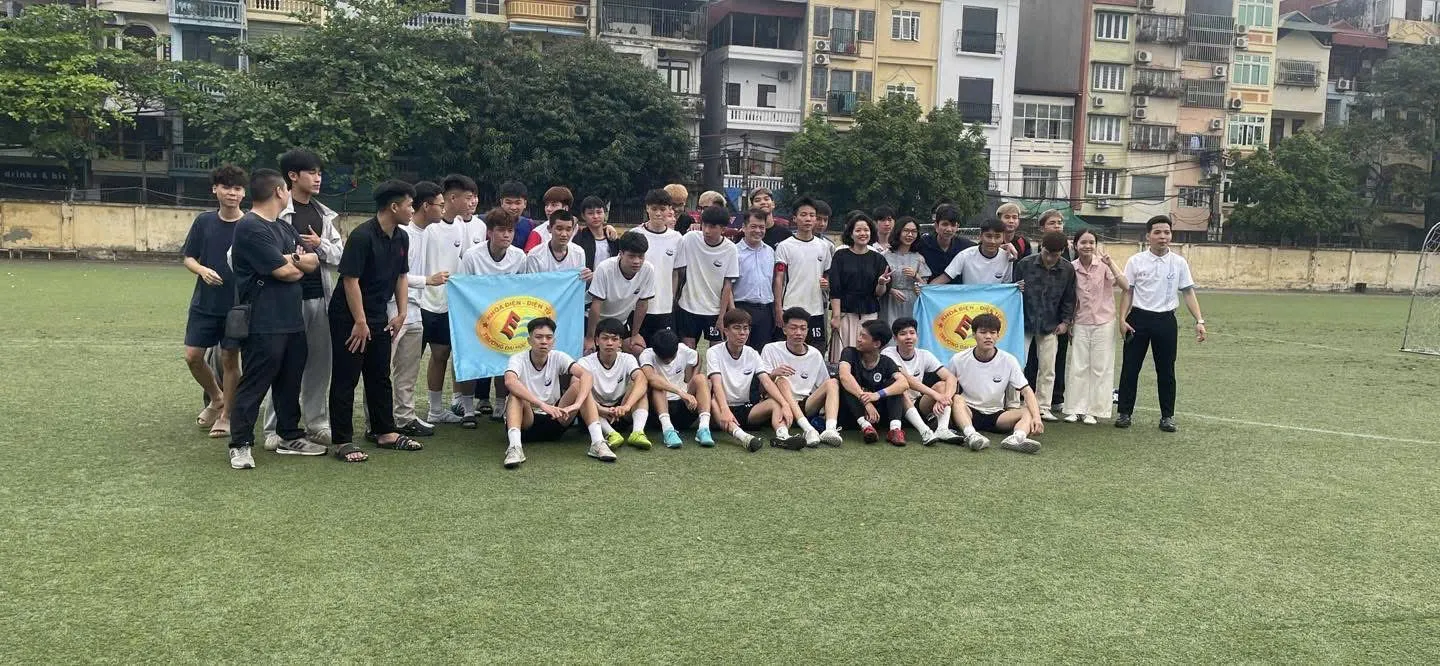
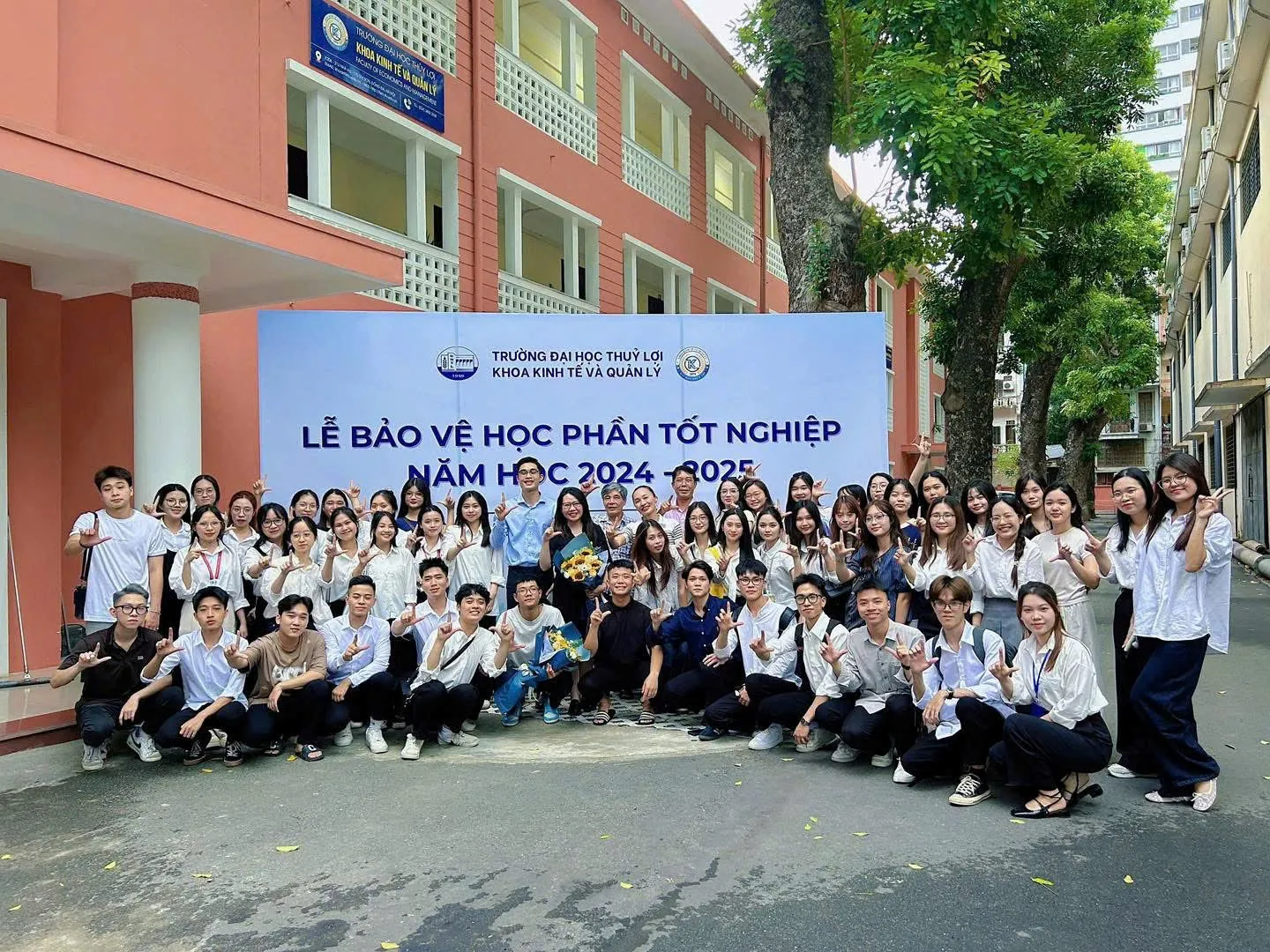
    Professional and scientific research: Use approved photographs of laboratories, seminars and research projects.

    Training programs: Use approved photographs of teaching, practical classes and laboratory activities.

    Professors, students and Faculty activities: Use approved portraits and activity photographs with publication permission.

    Contact

    • Faculty: Faculty of Electrical and Electronic Engineering, Thuyloi University
    • Contact Address: Administrative Office Room 401- A1; Thuyloi University
    • Faculty website: https://ee.tlu.edu.vn
    • University website: https://www.tlu.edu.vn


  • Master’s Program in Economic Management

    Introduction

    The Master’s Program in Economic Management at the Faculty of Economics and Management, Thuyloi University, is an application-oriented graduate program for professionals in public administration, enterprises and development organizations who seek advanced competence in economic governance, policy and management. The program strengthens learners’ capacity to analyze economic problems, design and evaluate policies, plan and manage investment and development, and lead organizations through digital transformation. Through a 60-credit curriculum combining advanced coursework, two special topic internships and a master’s graduation project, learners develop the ability to address complex practice-based problems in economic management.

    Highlights

    • Application-oriented curriculum completed in 1.5 years (three semesters), totaling 60 credits.
    • A common foundation in economics for managers, management science, quantitative methods, public policy and law, strategic management and human resource management.
    • A broad pool of 24 elective courses covering state management of the economy, policy analysis, development and international economics, investment economics, cost-benefit analysis, finance and accounting, risk management, supply chains, digital transformation and construction management.
    • Strong practical component, including two special topic internships (7 credits) and an 8-credit master’s graduation project addressing a practice-based problem.
    • Teaching by experienced academic staff with research expertise in public policy, resource and development economics, investment and quantitative analysis.

    Objectives

    The program aims to enable graduates to:

    • apply advanced knowledge of economics, management science and public policy to economic management at the organizational, sectoral and local levels;
    • use research methods and quantitative tools to analyze economic information, forecast trends, and appraise policies, programs and investment projects;
    • formulate, implement, monitor and evaluate strategies, plans and policies for economic and social development;
    • manage resources, risks, finance and people effectively and lead change, including digital transformation, in public and private organizations; and
    • work independently, exercise professional judgment, communicate evidence-based recommendations and pursue further study at doctoral level when appropriate.

    Career prospects

    Graduates are prepared for managerial and advisory roles in state management agencies at central and local levels, public service units, state-owned and private enterprises, banks and financial institutions, project management units, consulting firms, international and non-governmental organizations, and research and educational institutions. Typical areas of work include economic and policy analysis, development planning, investment management and appraisal, public finance and budgeting, enterprise management, and monitoring and evaluation. The program also provides a foundation for progression to the Doctoral Program in Economic Management.

    Academic staff

    Selected doctoral-level academic staff teaching in the program include:

    Name Teaching and research areas
    Assoc. Prof. Dr. Le Van Chinh Policy impact analysis; state management of investment and of the economy; resource economics; construction economics
    Assoc. Prof. Dr. Nguyen Thien Dung Resource and environmental economics and policy; economic and financial appraisal of investment projects; circular economy
    Dr. Phung Mai Lan Policy impact evaluation; international trade; macroeconomic analysis and forecasting
    Dr. Do Van Chinh Economic efficiency analysis; cost management; risk management; investment project management
    Dr. Le Minh Thoa Sectoral state management; investment project management; cost management
    Dr. Bui Anh Tu Resource economics and management; construction investment economics; water resources economics
    Assoc. Prof. Dr. Truong Duc Toan Public economics and management; investment risk management; policy analysis
    Dr. Nguyen Thi Thanh Huyen Policy impact evaluation; international trade; macroeconomic analysis and forecasting
    Dr. Nguyen Anh Tuyet Macroeconomic policy; economic forecasting; firm productivity and FDI spillovers
    Dr. Le Phuong Thao Policy impact evaluation; economic growth and structural change; technological change
    Dr. Phan Thuy Thao Investment mobilization and management (FDI, ODA, public investment); state management of investment

    Curriculum structure

    The 2026 curriculum (subject to official approval by Thuyloi University) comprises 60 credits distributed across the following blocks:

    Curriculum block Credits Share of program
    General knowledge 9 15%
    Foundation knowledge 12 20%
    Specialized electives 24 40%
    Special topic internships and master’s graduation project 15 25%
    Total 60 100%

    Indicative study plan by semester

    Semester Credit load Main components
    Semester I 20 credits Scientific Research Methodology; English; five foundation courses; 4 credits of specialized electives.
    Semester II 23 credits Advanced Strategic Management; 18 credits of specialized electives; Special Topic Internship 1 (3 credits).
    Semester III 17 credits Philosophy (3 credits); 2 credits of specialized electives; Special Topic Internship 2 (4 credits); Master’s Graduation Project (8 credits).

    General and foundation courses

    Code Course title Credits Semester
    SRM502 Scientific Research Methodology 2 I
    WUEL502 English 4 I
    WUPH501 Philosophy 3 III
    EEM501 Economics for Managers 2 I
    ECM508 Advanced Management Science 2 I
    EQM502 Quantitative Methods for Management 2 I
    BAHM507 Advanced Human Resource Management 2 I
    BAPL512 Public Policy and Law 2 I
    BASM509 Advanced Strategic Management 2 II
      Total 21  

    Specialized elective pool

    Students complete 24 credits from the following 24 approved elective courses (2 credits each; 48 credits offered), subject to the official study plan and course availability.

    No. Code Course title (2 credits) Semester
    1 ECM520 Advanced Management Information Systems I
    2 ASME526 Advanced State Management of the Economy I
    3 EPA503 Economic Policy Analysis and Assessment II
    4 BAAG525 Advanced Game Theory Applications in Economics and Business I
    5 EIE505 Advanced International Economics II
    6 BARM517 Advanced Risk Management in Economics and Business II
    7 ECM513 Science and Technology Management II
    8 ADE508 Advanced Development Economics II
    9 BADT511 Leading Digital Transformation II
    10 BAMA520 Advanced Managerial Accounting II
    11 AFBA508 Advanced Corporate Financial Analysis II
    12 ESP509 Economic Development Strategy and Planning II
    13 BASM528 Advanced Securities Markets II
    14 CMCC515 Construction Cost Management II
    15 EIE510 Advanced Investment Economics II
    16 EAF511 Advanced Economic Analysis and Forecasting III
    17 BASC515 Advanced Supply Chain Management II
    18 ACPM508 Advanced Construction Project Management II
    19 MAEI509 Economic Information Management and Analysis III
    20 CEBM510 Contemporary Issues in Economics, Business and Management III
    21 ATE501 Advanced Tourism Economics III
    22 CBA512 Cost-Benefit Analysis I
    23 AIEC513 Applied Informatics in Economics I
    24 ECON514 Feasibility Study Preparation and Appraisal of Investment Projects I

    Applied learning and graduation requirement

    Code Component Credits Semester
    ESI511 Special Topic Internship 1 3 II
    ESI512 Special Topic Internship 2 4 III
    — Master’s Graduation Project 8 III
      Total 15  


    Note: English course titles have been standardized for accuracy and international readability. The official Vietnamese curriculum and the approved course list remain the governing documents.

    Suggested website visuals

    To accompany the program page, three high-resolution photographs are recommended:

    • Graduate learners in a seminar, policy case discussion or group project on economic management.
    • Field visits or applied learning with public agencies, enterprises or development projects.
    • Research seminar, graduation project defence or faculty–student scholarly activity.

    Video

    Faculty of Economics and Management introduction video (2026): https://www.youtube.com/watch?v=KZMnY4NWJSU

    Contact

    Faculty Faculty of Economics and Management, Thuyloi University
    Location Room 211, Building A5, Thuyloi University, 175 Tay Son Street, Kim Lien Ward, Hanoi, Vietnam
    Academic contact Assoc. Prof. Dr. Le Van Chinh
    Email [email protected]
    Faculty email [email protected]
    Website https://fem.tlu.edu.vn/


  • Logistics and Supply Chain Management

    Logistics and Supply Chain Management

    Head of the Department of E-commerce: Prof. Dr. Dang Dinh Dao

    Overview: The Logistics and Supply Chain Management programme at Thuyloi University integrates knowledge of economics, management, and technology to develop highly qualified professionals in logistics and supply chain management. Throughout the programme, students acquire specialized knowledge and practical skills in logistics management, international freight transportation and forwarding, warehouse management, import–export operations, and supply chain management. The curriculum emphasizes the integration of theoretical knowledge and practical experience through experiential learning, industry internships, and engagement with industry experts. The programme prepares graduates for diverse career opportunities in logistics, import–export, manufacturing, and trading enterprises, as well as multinational corporations.

    Undergraduate Programs:

    • Introduction: The Logistics and Supply Chain Management programme integrates economics, management, and technology with industry practices, equipping students with professional competencies to meet the evolving demands of global supply chains, digital transformation, and sustainable development.
    • Highlights:
      • Highly qualified faculty members educated at prestigious universities in Vietnam and abroad.
      • Integration of theoretical knowledge and practical experience through case studies, real-world projects, experiential learning activities, and industry internships.
      • Regular seminars, expert-led discussions, and industry engagement activities, providing students with practical insights and opportunities to expand their career prospects.
      • Modern facilities, well-equipped classrooms, and learning resources in central Hanoi, supporting students’ academic and research activities.
      • Practice-oriented courses, including Logistics Management, Supply Chain Management, International Freight Transportation and Forwarding Operations, Warehousing and Packaging in Logistics, Import–Export Operations, and Green Logistics and Supply Chains..
    • Credits: 130
    • Duration: 4 years

    Objective: The Logistics and Supply Chain Management programme aims to develop graduates with a solid foundation in economics, management, and technology, alongside the competencies to organize, manage, and optimize logistics and supply chain operations. It fosters professional skills, innovative thinking, and adaptability in international business environments, while emphasizing professional ethics and social responsibility.

    Career Prospects: Graduates of the Logistics and Supply Chain Management programme can pursue career opportunities in the following positions:

    • Logistics and Supply Chain Management Specialists in manufacturing, trading, and service enterprises.
    • Import–Export, International Freight Forwarding, and Customs Clearance Specialists.
    • Transport Coordinators, Warehouse Managers, and Distribution Specialists.
    • Procurement, Order Management, and Supplier Management Specialists.
    • Logistics and Supply Chain Data Analysts and Optimization Specialists.
    • Logistics Consultants and Solution Development Specialists.
    • Management Professionals in logistics companies, import–export enterprises, and multinational corporations.
    • Researchers and Lecturers at universities, research institutes, and government agencies.
    • Professors: Prof. Dr. Dang Dinh Dao (Head of Department) and Dr. Do Thanh Thu (Deputy Head)

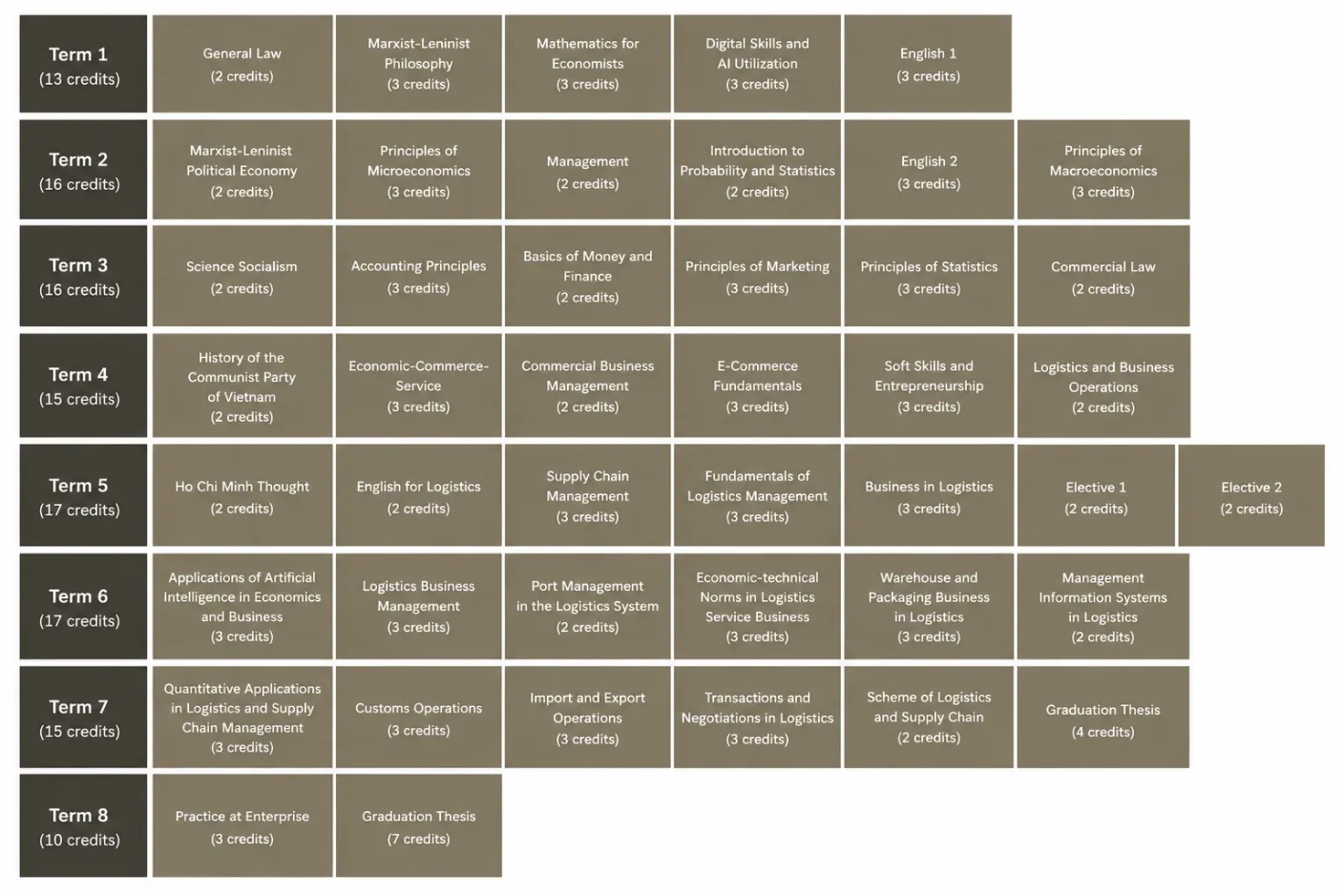
    Syllabus:

    Logistics and Supply Chain Management

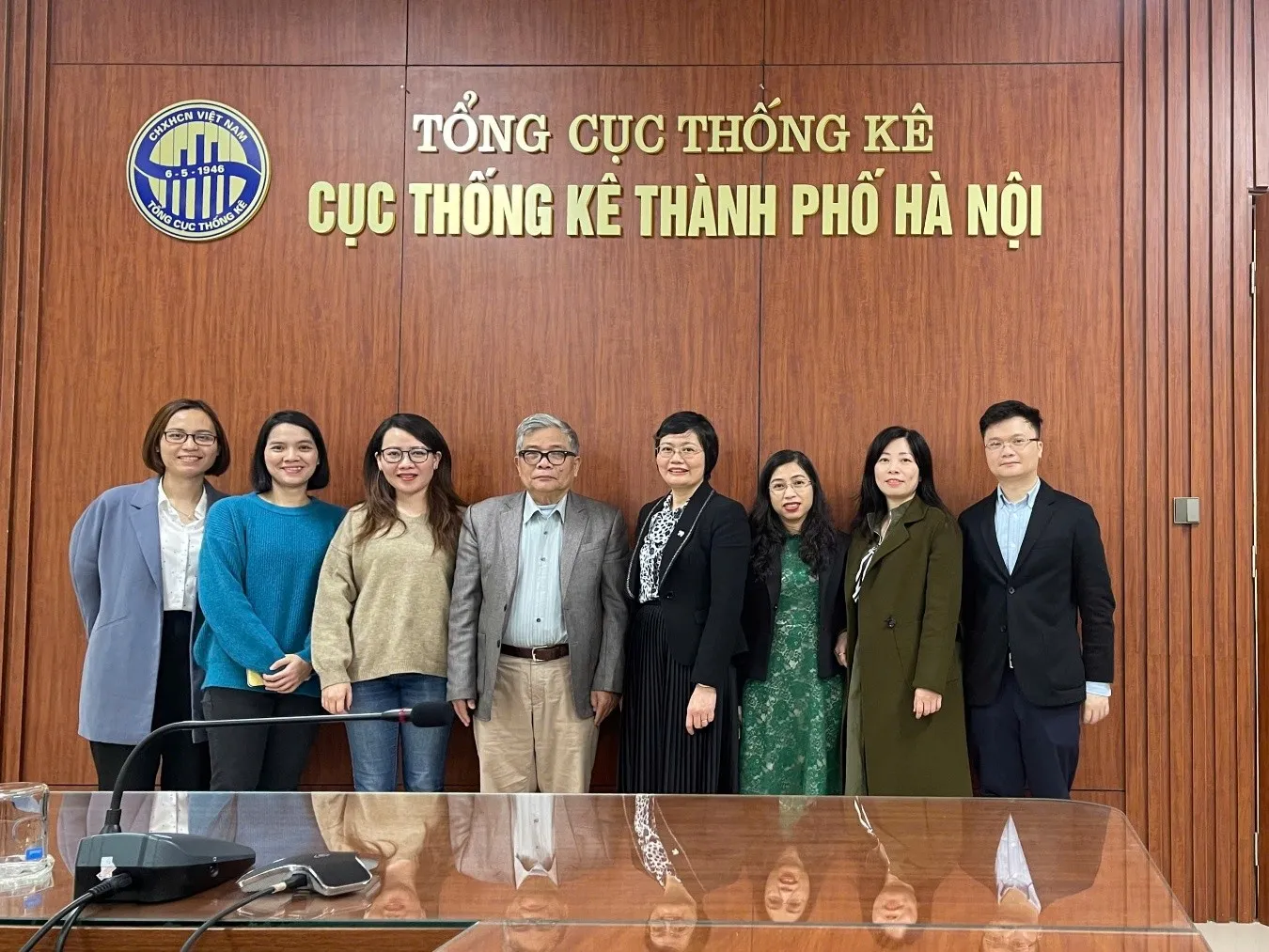
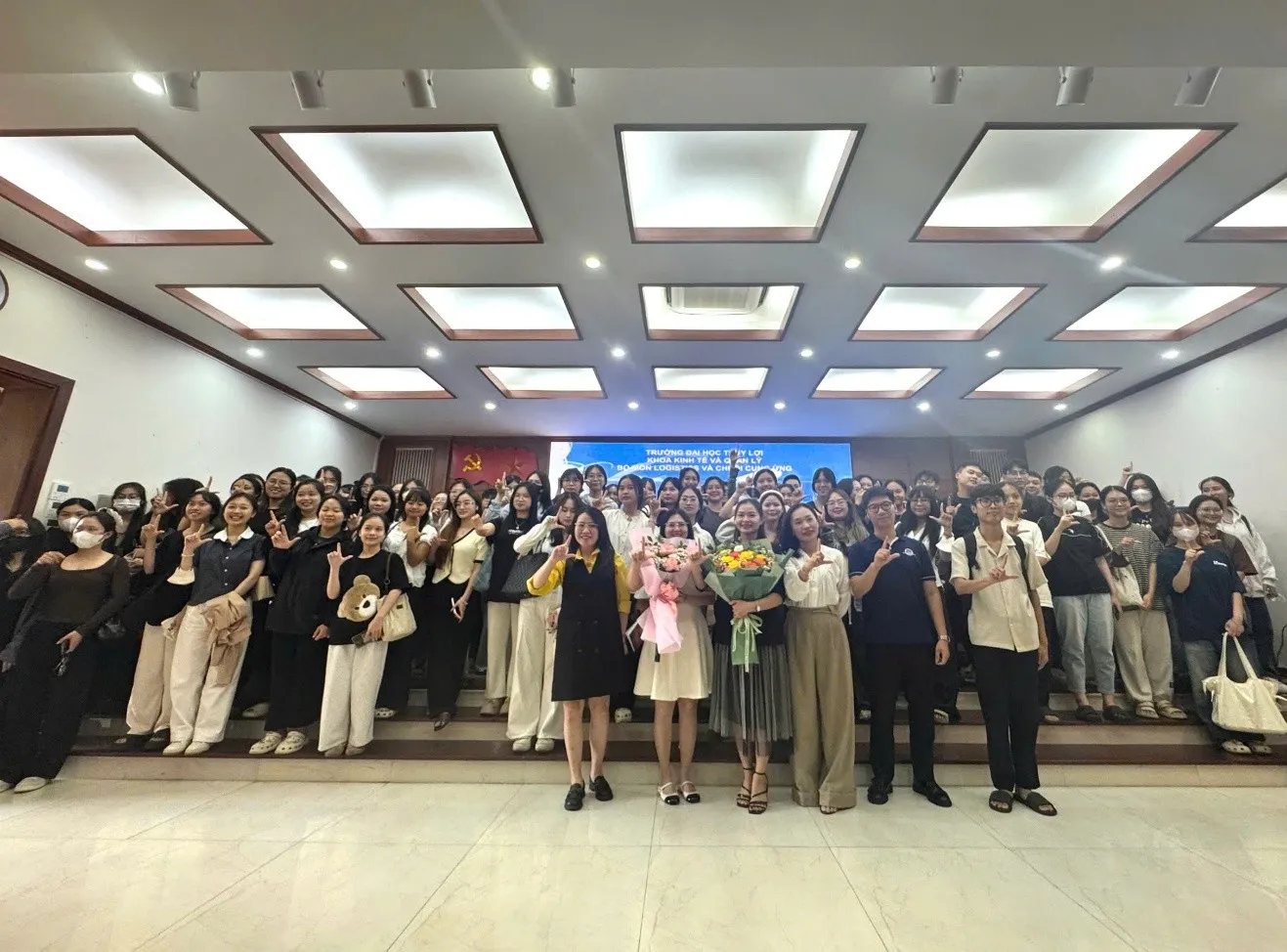
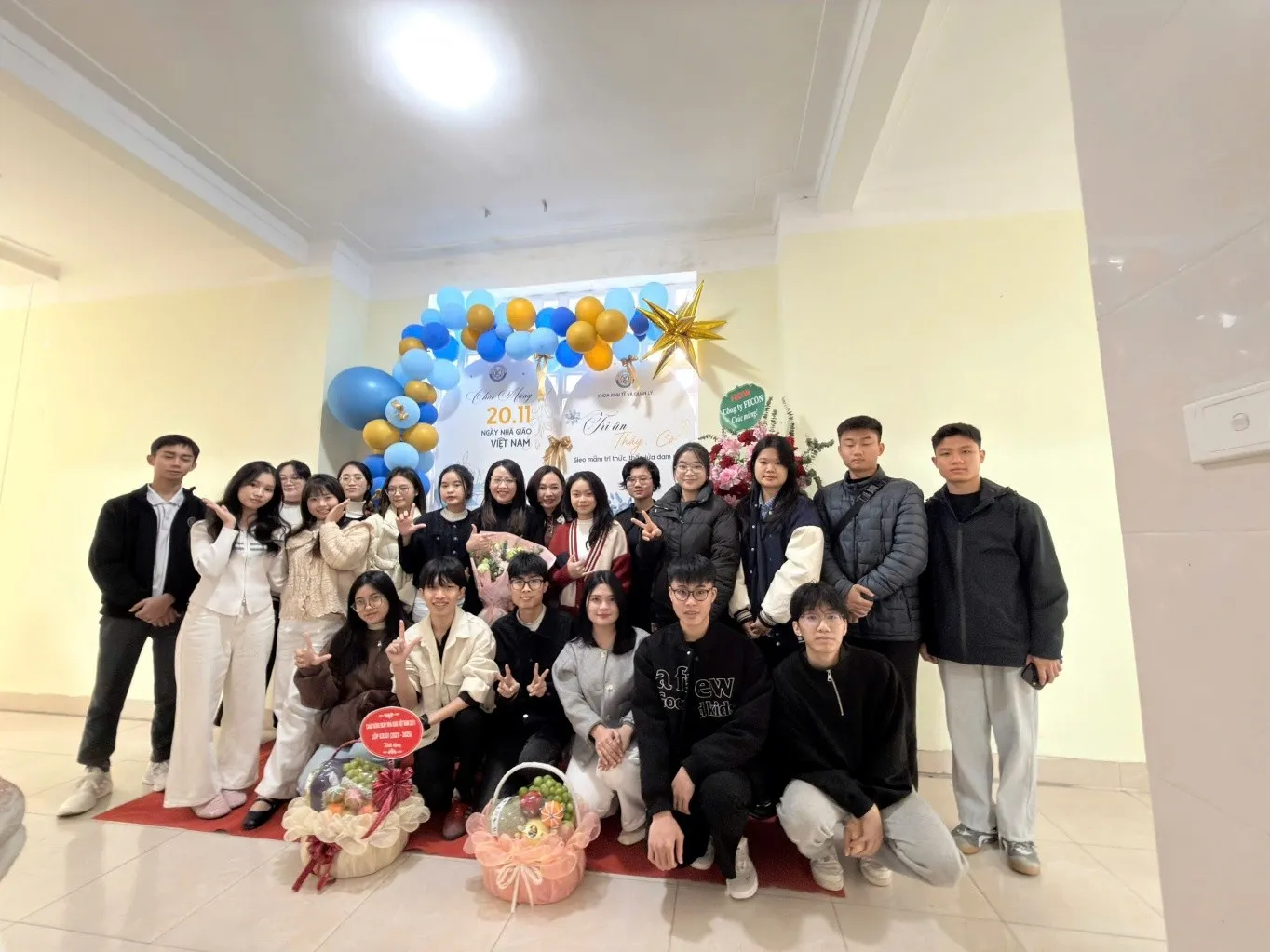
    Activities:

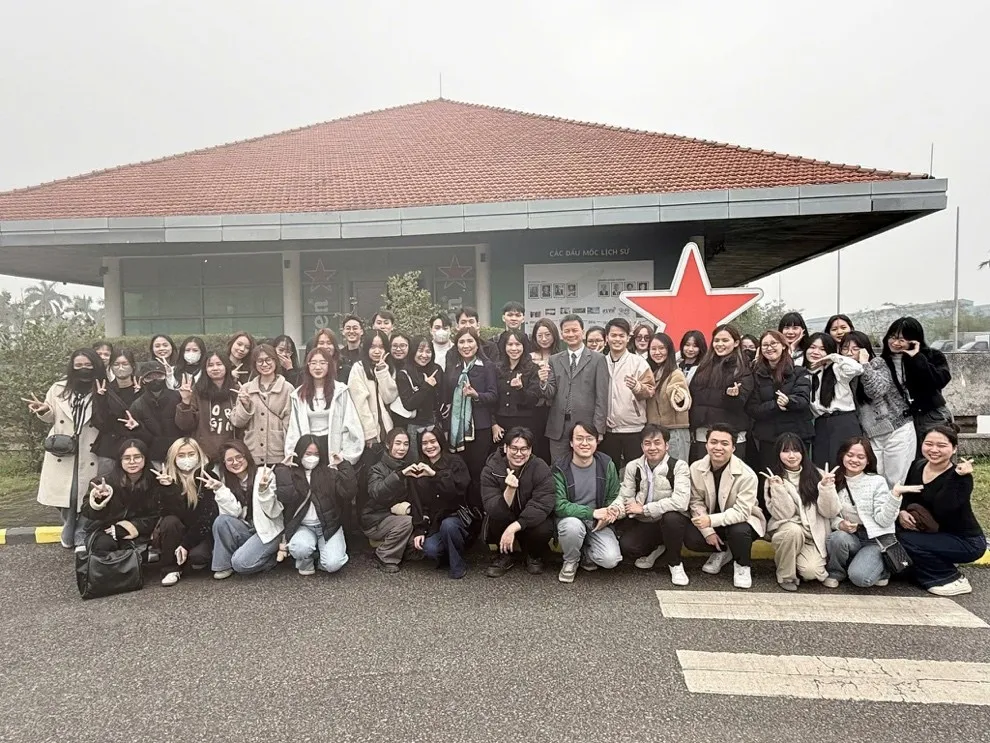
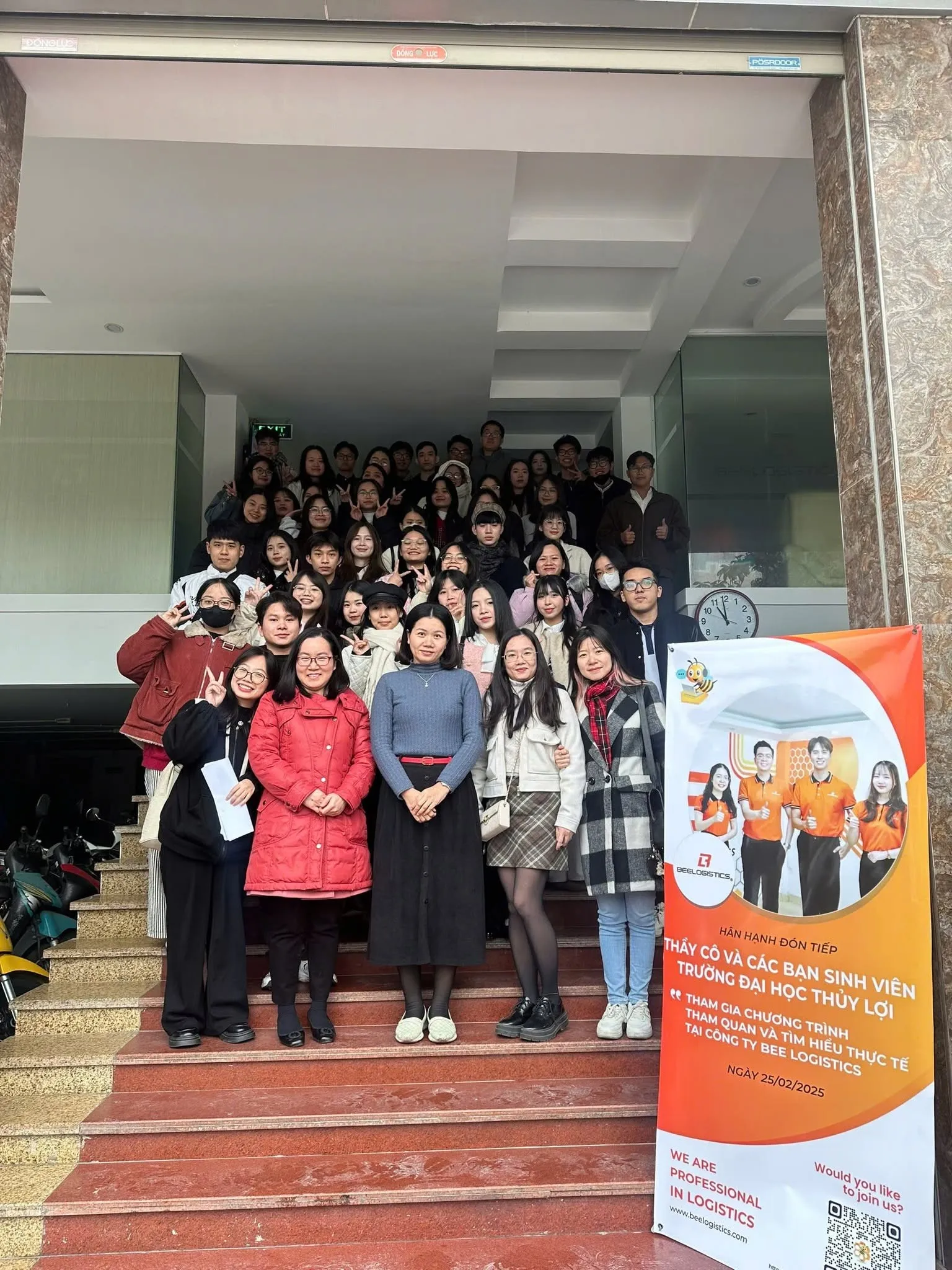
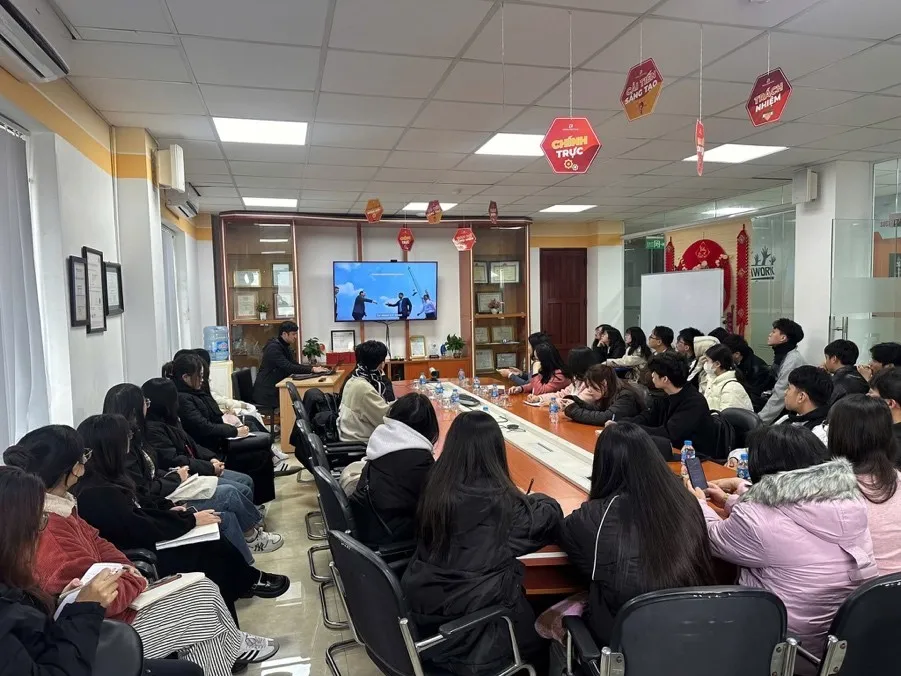
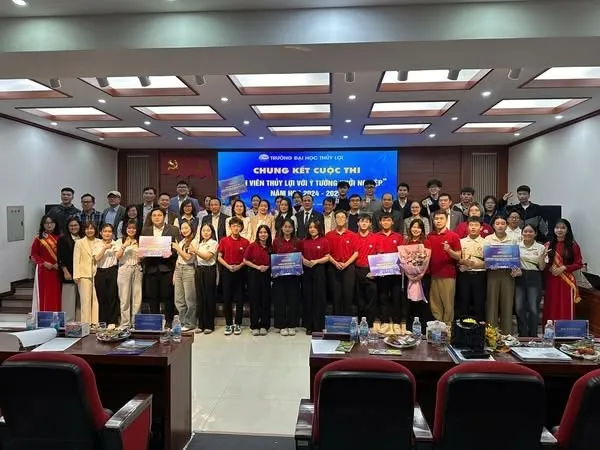
    Logistics and Supply Chain Management Logistics and Supply Chain Management Logistics and Supply Chain Management Logistics and Supply Chain Management Logistics and Supply Chain Management Logistics and Supply Chain Management Logistics and Supply Chain Management Logistics and Supply Chain Management Logistics and Supply Chain Management

    Contact:

    Website: fem.tlu.edu.vn

    Fanpage: https://fem.tlu.edu.vn/bm-logistics-va-chuoi-cung-ung

    Department office: Room 203, Building A5, Thuyloi University, 175 Tay Son, Kim Lien Ward, Hanoi

    Phone / Email: (024) 3852 2028 (Faculty hotline); [email protected].

    Direct contact: Dr. Do Thanh Thu, 0904 475 413, [email protected]

  • Economics

    Economics

    TRAINING PROGRAMS: ECONOMICS – UNDERGRADUATE PROGRAMS

    Introduction

    Economics.  The Bachelor’s Degree Program in Economics (Major Code: 7310101) at Thuyloi University is designed to train high-quality human resources equipped with strong political integrity, professional ethics, and a solid foundation in economics, law, and technology. The program focuses on fostering economic thinking, qualitative and quantitative analytical skills, and the application of artificial intelligence (AI). Students are prepared to meet socio-economic development demands in the context of international integration and the Fourth Industrial Revolution, with four specialized fields, including Natural Resources Economics, Development Economics, International Economics, and Investment Economics.

    Highlights

    ▸  Modern Curriculum & Cutting-Edge Technologies.  Integrates modern technological tools, data analytics models, and Artificial Intelligence (AI) applications directly into economic and business modules.

    ▸  Diverse Specialization Fields.  Offers four specialized fields to cater to different career paths: Natural Resources Economics, Development Economics, International Economics, and Investment Economics.

    ▸  Practical & Learner-Centric Teaching Methods.  Employs active learning strategies such as project-based learning, problem-based learning, case studies, flipped classrooms, and direct engagement with industry experts and corporate guest lecturers.

    ▸  Comprehensive Skill Development.  Strongly emphasizes critical thinking, systemic mindset, teamwork, communication, and startup/innovation competencies.

    Credits & Duration

    CREDITS

    Total Credits: 130 credits (excluding physical education and national defense education certificates).

    •  General Education: 30 credits

    •  Professional Education: 100 credits (Compulsory: 83 credits, Elective: 17 credits)

    DURATION

    Standard Duration: 4 years (divided into 8 main semesters, plus parallel and summer semesters supporting early graduation or credit acceleration).


    Objective

    General Objective.  To develop qualified professionals with sound ethics, autonomy, and social responsibility; equipped with foundational and specialized economic knowledge to solve practical socio-economic problems in the era of the Fourth Industrial Revolution.

    Specific Objectives:

    1. Equip fundamental knowledge in political theory, law, and economic science to foster critical thinking and analytical capabilities.
    2. Develop profound expertise in economics and specialized domains to handle complex management and business challenges.
    3. Build essential professional skills (communication, teamwork, IT proficiency, foreign languages, qualitative/quantitative data analysis).
    4. Instill professional ethics, civic awareness, self-study capacity, and innovation spirit.
    5. Enable graduates to take on professional, managerial, research, or consulting positions or successfully pursue entrepreneurial ventures.

    Career Prospects

    Graduates of the Economics program can flexibly adapt to dynamic job markets and assume professional, managerial, consulting, or research roles across various sectors:

    ▸  Natural Resources Economics.  Specialists in resource and environmental economics, sustainable development, climate change adaptation, ecological economics, natural resource valuation, and coastal/water resource management.

    ▸  Development Economics.  Planners, analysts, and project managers in public economics, regional development policies, socio-economic development programs, and public finance.

    ▸  International Economics.  Professionals in international trade, import-export operations, global logistics, international credit and payments, multinational enterprises, and cross-border business strategies.

    ▸  Investment Economics.  Investment analysts, project planners and appraisers, capital market specialists, risk management personnel, and investment promotion experts for domestic and international corporations.

    Academic staff

    The program is instructed by a highly qualified, dedicated faculty of experienced professors, lecturers, and leading industry experts who apply modern student-centered teaching methodologies, guide practical projects, and foster innovative startup mindsets among students.


    NAME TEACHING AND RESEARCH AREAS
    Dr. Phung Mai Lan     Economics; International Economics; Environmental Economics, Green growth and sustainability, Development Economics; Economic Policy, Trade, FDI, and firm productivity and efficiency, Managerial Economics
    Assoc. Prof. Dr. Truong Duc Toan   Economics and public policy in a market economy, Environmental economics and policy, Investment and development economics, Public service management and delivery, Efficient management and utilization of natural resources and the environment
    Assoc. Prof. Dr. Tran Van Hoe International Economics, Risk Management, Policy Analysis and Evaluation
    Dr. Le Phuong Thao Development Economics, economics and public policy, green growth and sustainability, Managerial Economics, resource allocation
    Dr. Nguyen Anh Tuyet Economics, Managerial Economics, Development Economics, firm productivity and efficiency, policy analysis, state budget
    Dr. Nguyen Thi Thanh Huyen  Economics, Green growth and sustainability, Development Economics, Trade and exports Managerial Economics
    Dr. Phan Thuy Thao  Investment Economics, international investment, FDI, Project management, procurement and bidding, investment project appraisal, Development Economics; Economic Policy, Economic management, state management of investment, public financial management, Digital transformation, sustainable development, green economy, Capital markets
    MSc. Nguyen Thuy Trang International Economics, FDI, economic growth, green economy, Environmental Economics
    MSc. Tran Khac Ninh Investment Economics, securities, FDI
    MSc. Lam Thi Thuy Linh Investment Economics, securities, FDI, investment capital, firm efficiency, digital transformation
    MSc. Truong Thi Tieu Le International Economics, global supply chains, green economy
    MSc. Phan Thuy Tam Business Administration, Development Economics
    MSc. Tran Thi Ngoc Tu Investment Economics, securities, FDI, employment, economic growth
    MSc. Mai Huong Giang Investment Economics, securities, FDI


    CURRICULUM – SEMESTER-BY-SEMESTER SYLLABUS

    (*): Required courses   (★ marks elective courses)

    Common Core Curriculum (all specializations) – Semesters 1–7

    HK1

    (16 TC)

    General Law

    GEL111 | 2 TC

    Marxist-Leninist Philosophy

    MLP121 | 3 TC

    Mathematics for Economists

    MAEC112 | 3 TC

    Principles of Microeconomics

    ECON102 | 3 TC

    Management

    BACU101 | 2 TC

    Economic Thinking and Career Orientation in Economics

    TCOE101 | 3 TC

       
    HK2

    (17 TC)

    Soft Skills and Entrepreneurship

    SSE111 | 3 TC

    Introduction to Probability and Statistics

    MATH253 | 2 TC

    Digital Skills and AI Utilization

    CSE105 | 3 TC

    Principles of Macroeconomics

    ECON103 | 3 TC

    Accounting Principles

    ACC102 | 3 TC

    International Economics

    INEC213 | 3 TC

       
    HK3

    (17 TC)

    Marxist-Leninist Political Economy

    MLPE222 | 2 TC

    English 1

    ENG213 | 3 TC

    Basics of Money and Finance

    ACC101 | 2 TC

    Principles of Statistics

    BACU203 | 3 TC

    Commercial Law

    CLAW204 | 2 TC

    Econometrics

    ECON207 | 2 TC

    Development Economics

    DEEC314 | 3 TC

     
    HK4

    (17 TC)

    Science Socialism

    SCSO232 | 2 TC

    English 2

    ENG224 | 3 TC

    Principles of Marketing

    BACU102 | 3 TC

    Applied Informatics in Economics

    AIEC427 | 3 TC

    Application of Artificial Intelligence in Economics and Business

    AIEB325 | 3 TC

    Investment Economics 1

    INVE315 | 3 TC

       
    HK5

    (20 TC)

    Cost-Benefit Analysis

    CBA213 | 3 TC

    English for Economics

    EECO316 | 3 TC

    State Management in Economy

    SMIE212 | 2 TC

    Economic Managment

    EM212 | 2 TC

    Human Resources Economics

    HRE214 | 2 TC

    Environmental Econonomics

    EEC220 | 2 TC

    Construction Economics 1

    CECON316 | 2 TC

    Business – Economic Strategy and Policy

    BESP322 | 2 TC

    Design Thinking, Creativity and Innovation

    DTCI375 | 2 TC

         
    HK6

    (14 TC)

    History of the Communist Party of Vietnam

    HCPV343 | 2 TC

    Fourth Industrial Revolution

    FIR210 | 3 TC

    Data Analysis in Economics

    DAE265 | 3 TC

    Fundamentals of Tourism Economy

    FOTE423 | 2 TC

    Introduction to Natural Resources Economics

    INRE317 | 2 TC

    Technology Transfer and Management

    TIM318 | 2 TC

       
    HK7

    (4 TC)

    Ho Chi Minh Thought

    HCMT354 | 2 TC

    Economic Analysis and Forecasting

    EAF221 | 2 TC


    Specialization: Natural Resources Economics – Semesters 5–8

    HK5

    (6 TC)

    Sustainable Development Economic

    SDE325 | 3 TC

    Economics of Climate Change

    ECC326 | 3 TC

       
    HK6

    (12 TC)

    Ecological Economics

    EE417 | 3 TC

    Natural Resources Economics

    NRE316 | 3 TC

    Coastal and Marine Economics  ★

    CME332 | 3 TC

    Socio – economic Development Planning  ★

    SEDP326 | 3 TC

    HK7

    (18 TC)

    Scheme on Natural Resources Economics

    SNRE316 | 3 TC

    Valuation of Environment and Natural Resources

    VENR417 | 3 TC

    Forestry Economy  ★

    FOEC333 | 3 TC

    Water Resources Economics  ★

    WRE316 | 3 TC

    Investment Project Management  ★

    IPM417 | 3 TC

    Development Project Program  ★

    DPP449 | 3 TC

       
    HK8

    (10 TC)

    Graduate Intership in Natural Resources Economics

    INTE461 | 3 TC

    Graduate Thesis

    GRTH401 | 7 TC


    Specialization: International Economics – Semesters 5–8

    HK5

    (9 TC)

    Export – Import Practice

    EIPR336 | 3 TC

    Financial Investment Analysis  ★

    FIA369 | 3 TC

    International Investment  ★

    INT468 | 3 TC

     
    HK6

    (12 TC)

    Integration and International Institutions

    INTI334 | 3 TC

    Logistics

    LOG417 | 3 TC

    Data Management in International Economics  ★

    DMIE367 | 3 TC

    Multilateral Trade  ★

    MTA417 | 3 TC

    HK7

    (18 TC)

    The World Market and International Trade Bussiness

    MITB335 | 3 TC

    Scheme on International Economics

    SCIN316 | 3 TC

    International Credit and Payment

    ICP426 | 3 TC

    International Negotiations  ★

    INN341 | 3 TC

    Multinational Enterprises and Global Business Strategies  ★

    MEGB417 | 3 TC

    Corporate Finance  ★

    ACC427 | 3 TC

       
    HK8

    (10 TC)

    Graduate Intership in International Economics

    GIIE462 | 3 TC

    Graduate Thesis

    GRTH401 | 7 TC


    Specialization: Development Economics – Semesters 5–8

    HK5

    (9 TC)

    Public Economics

    PUEC343 | 3 TC

    Finacial Investment Analysis  ★

    FIA369 | 3 TC

    International Investment  ★

    INT468 | 3 TC

     
    HK6

    (10 TC)

    Economics and Public Finance

    PE417 | 3 TC

    Socio – Economic Development Planning

    SEDP326 | 3 TC

    Feasibility Study and Appraisal of Investment Projects  ★

    ECON428 | 2 TC

    Models of Growth and Development  ★

    MGD351 | 2 TC

    HK7

    (19 TC)

    Applied Development Economics

    ADE344 | 2 TC

    Development Project Program

    DPP449 | 3 TC

    Scheme on Developmental Economics

    SDE326 | 3 TC

    Economics and Policies of Regional Developemnt

    EPDP345 | 2 TC

    Quantitative Application in Economic Analysis  ★

    QAEA316 | 3 TC

    Investment Project  Management  ★

    IPM417 | 3 TC

    Corporate Finance  ★

    ACC427 | 3 TC

     
    HK8

    (10 TC)

    Graduate  Intership in Development Economics

    GIDE463 | 3 TC

    Graduate Thesis

    GRTH401 | 7 TC


    Specialization: Investment Economics – Semesters 5–8

    HK5

    (9 TC)

    Finacial Investment Analysis

    FIA369 | 3 TC

    Analysis and Decision-Making in Investment  ★

    ADMI360 | 3 TC

    International Investment  ★

    INT468 | 3 TC

     
    HK6

    (7 TC)

    Feasibility Study and Appraisal of Investment Projects

    ECON428 | 2 TC

    Investment Economics 2

    INVE353 | 2 TC

    Capital Market

    CAMA315 | 3 TC

     
    HK7

    (22 TC)

    International Tender

    INTE417 | 3 TC

    Investment Project  Management

    IPM417 | 3 TC

    Scheme on Investment Economics

    SIEC316 | 3 TC

    Risk Management in Investment  ★

    RMIN417 | 3 TC

    Development Project Program  ★

    DPP449 | 3 TC

    Corporate Finance  ★

    ACC427 | 3 TC

    Investment Promotion  ★

    INPR355 | 2 TC

    Economics and Policies of Regional Developemnt  ★

    EPDP345 | 2 TC

    HK8

    (10 TC)

    Graduate Intership in Investment Economics

    GIIE364 | 3 TC

    Graduate Thesis

    GRTH401 | 7 TC


    PHOTOGRAPHS

    Economics Economics Economics Economics Economics Economics Economics Economics Economics Economics Economics Economics Economics Economics

    VIDEO

    ▸  https://www.facebook.com/watch/?v=1786043661577448

    CONTACT

    ✉  Faculty of Economics and Management Office: Room 206–207, Building A5, Thuyloi University, 175 Tay Son, Kim Lien Ward, Hanoi. Tel: (024) 3852 2028. Email: [email protected]

    ✉  Department of Economics Office: Room 210, Building A5.

    ✉  Dr. Phung Mai Lan – Vice Dean of the Faculty; in charge of the Department of Economics. Email: [email protected]
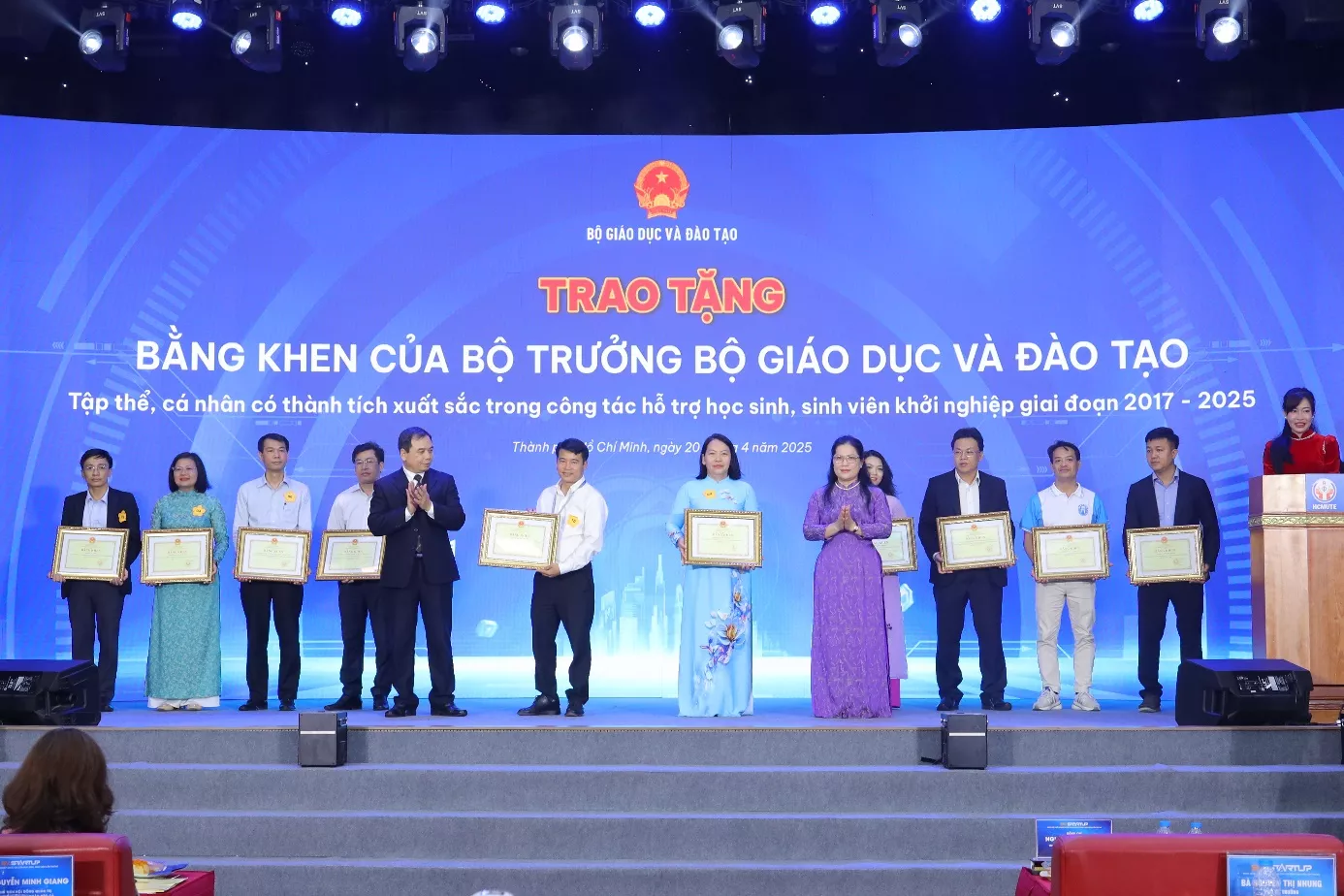
    ✉  Assoc. Prof. Dr. Truong Duc Toan – Vice Head, Department of Economics. Email: [email protected]